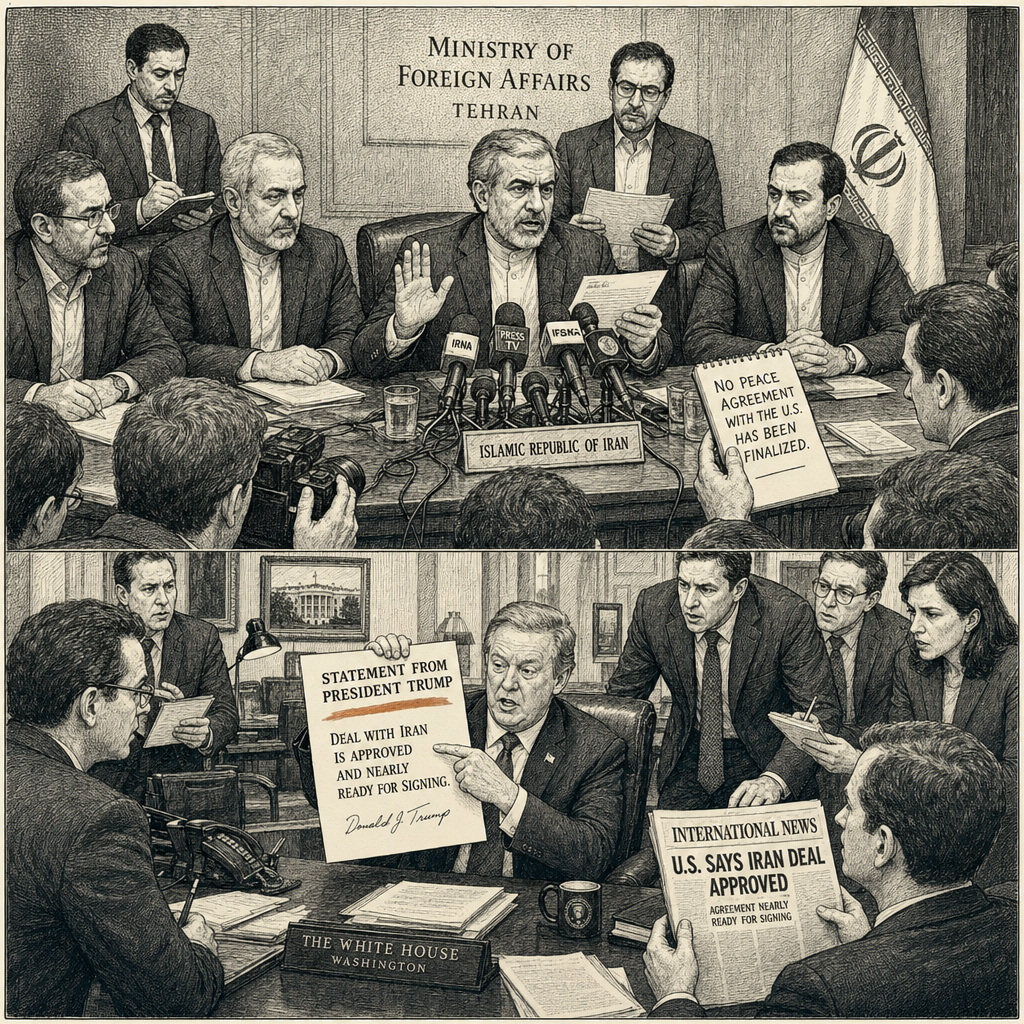
Iran said Thursday it has not finalized an agreement with the United States to end the war, directly contradicting President Donald Trump’s announcement earlier in the day that a deal was approved and nearly ready for signing.
Speaking Thursday night, Iranian Foreign Ministry spokesman Esmaeil Baqaei said Tehran is reviewing a proposal brokered by Qatar and Pakistan but rejected reports that agreement had been reached. “So far, Iran has not reached a final conclusion on the agreement,” Baqaei said in a statement. “Whenever we reach a conclusion that the text of the [memorandum of] understanding is in the interest of the Iranian nation, we will announce it.”
Baqaei described the status of negotiations as clear from the start, saying “a major part of the text had been finalized, but the Americans kept changing their positions.” He said Iran would never retreat from or compromise “on what it defines as its red lines.”
Baqaei’s comments came hours after Trump called off planned large-scale strikes against Iran, including on Kharg Island, from which 90% of Iran’s crude oil exports are shipped. Trump said Thursday afternoon that Iranian leadership and other regional powers had approved “final points” of a deal to end the war. “Based on the fact that discussions with the Islamic Republic of Iran have been brought to the highest level of Iranian leadership and approved, I have, as President of the United States of America, cancelled the scheduled strikes and bombings against Iran this evening,” Trump said.
Trump later said the deal was “subject to finalization of documents, which should get done, over the next few days” and that there would “probably” be a signing ceremony, with Europe the most likely location.
The agreement being negotiated is a memorandum of understanding that would extend the current cease-fire for 60 days, allowing broader negotiations on core issues including Iran’s enriched uranium stockpile and its nuclear program. A two-week cease-fire originally came into force on April 28.
Trump has stated that a deal to end the fighting was imminent on multiple occasions since the April cease-fire took hold, and previous rounds of talks have produced periods of optimism followed by Iranian denials.
Oil markets reacted strongly to the conflicting signals. Brent crude for August delivery fell $3.83 a barrel to $86.54 in mid-morning London trading Friday. West Texas Intermediate crude for July delivery traded at $83.88 a barrel, also down $3.83.
The status of the Strait of Hormuz also remained in dispute. U.S. Central Command announced that the key shipping route was not controlled by Iran and was “open for transit” to all vessels not in breach of the U.S. blockade of Iran. Baqaei directly contradicted that, saying, “The Strait of Hormuz remains closed due to illegal U.S. actions.”
The conflicting public statements from the two governments underscored the distance that remains between them on even fundamental facts of the current situation, and raised questions about whether a formal deal is as close as Trump has asserted.