Body
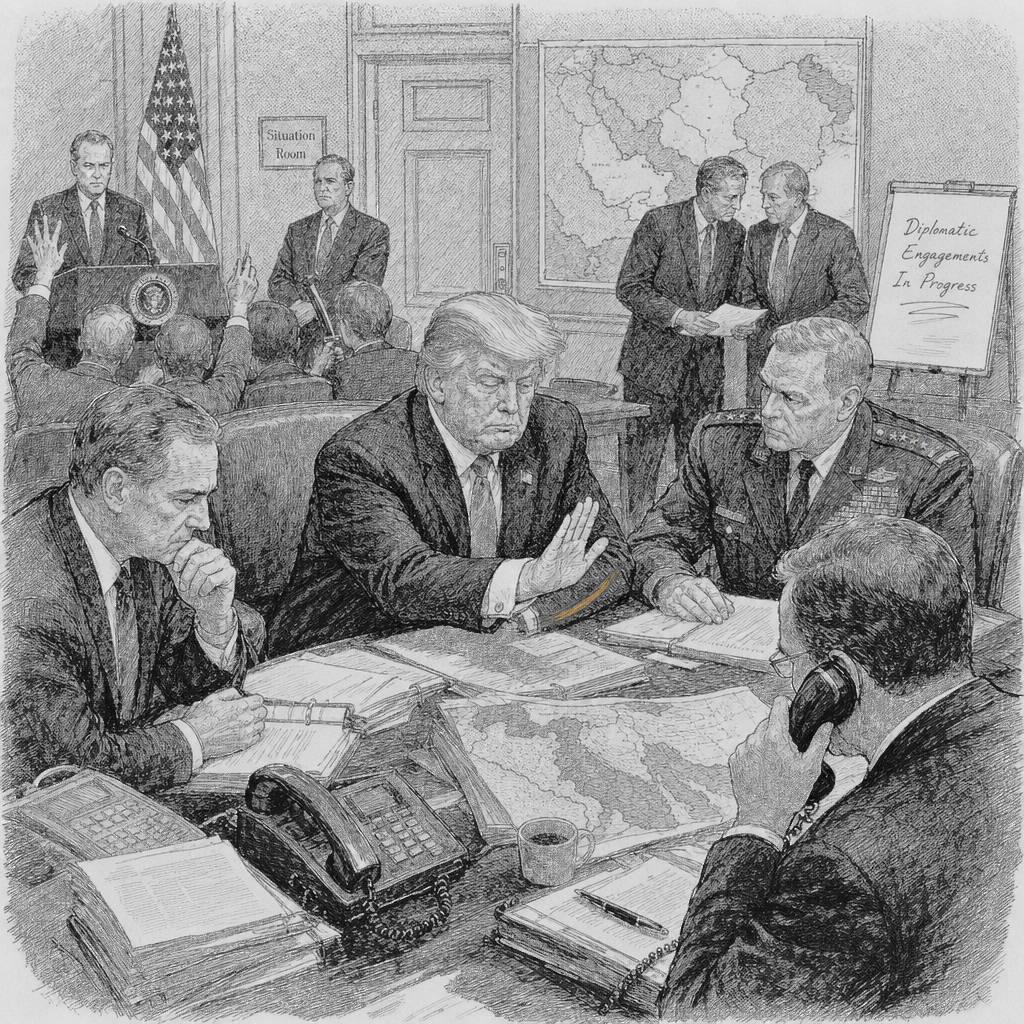
President Donald Trump said Monday that he is holding off a military strike on Iran planned for Tuesday, pointing to “serious negotiations” aimed at ending the war. Speaking at the White House after making the announcement in a social media post, Trump said he believed there was “a very good chance that they can work something out.” He said that if talks produced a deal, he would prefer to avoid what he described as bombing military targets.
Trump said he had planned “a very major attack” but put it off “for a little while, hopefully, maybe forever,” framing the decision as an effort to give diplomacy time to work. He said America’s Gulf allies asked the U.S. to wait for two or three days because they felt they were close to a deal with Iran.
Trump said he was calling off the planned attack at the request of allies in the Middle East, including the leaders of Qatar, Saudi Arabia and the United Arab Emirates. In his social media post, he also said he had instructed the U.S. military “to be prepared to go forward with a full, large scale assault of Iran, on a moment’s notice, in the event that an acceptable Deal is not reached.”
In the broader run-up, Trump has threatened for weeks that the ceasefire reached in mid-April could end if Iran did not make a deal, with shifting parameters for when the U.S. would strike. He has previously set deadlines for Tehran and then backed off, and the White House said the pause for negotiations was “a very positive development,” though Trump acknowledged that similar moments in the past had not produced a result.
While the U.S. paused its plans, drone and other attacks continued to shape the regional picture. Iran and allied Shiite militias in Iraq have launched drone attacks targeting Gulf Arab states in the war, and the United Arab Emirates has accused Iran of launching drone and missile attacks despite the ceasefire. The AP reported that on Sunday a drone strike sparked a fire on the edge of the UAE’s sole nuclear power plant, which authorities described as an “unprovoked terrorist attack” without assigning blame.
Trump also said in recent days he spoke with Israeli Prime Minister Benjamin Netanyahu and Chinese President Xi Jinping about the Iran war. In parallel, the shift in expectations after Trump’s post affected markets tied to energy routes, with petroleum futures trading before the announcement at $108.83 a barrel and ending Monday at $107.25, after a quick drop of more than $2.
Beyond the diplomacy, negotiators also face pressure tied to the flow of goods through the region. Iran has effectively closed the Strait of Hormuz, a vital waterway for shipping oil, gas, fertilizer and other petroleum products, and the U.S. is blockading Iranian ports, U.S. Central Command said it had redirected 85 commercial vessels from mid-April through Monday.
Turkey’s foreign minister, Hakan Fidan, said Monday in Berlin that the immediate concern of negotiations between the U.S. and Iran was keeping the Strait of Hormuz open, while Iran’s nuclear program remained central. Fidan said much of Iran’s enriched uranium that could potentially be used for a nuclear weapon was buried under collapsed tunnels following attacks in June that the U.S. launched with Israel, adding that the U.S. said it was monitoring any movements around the stockpile.