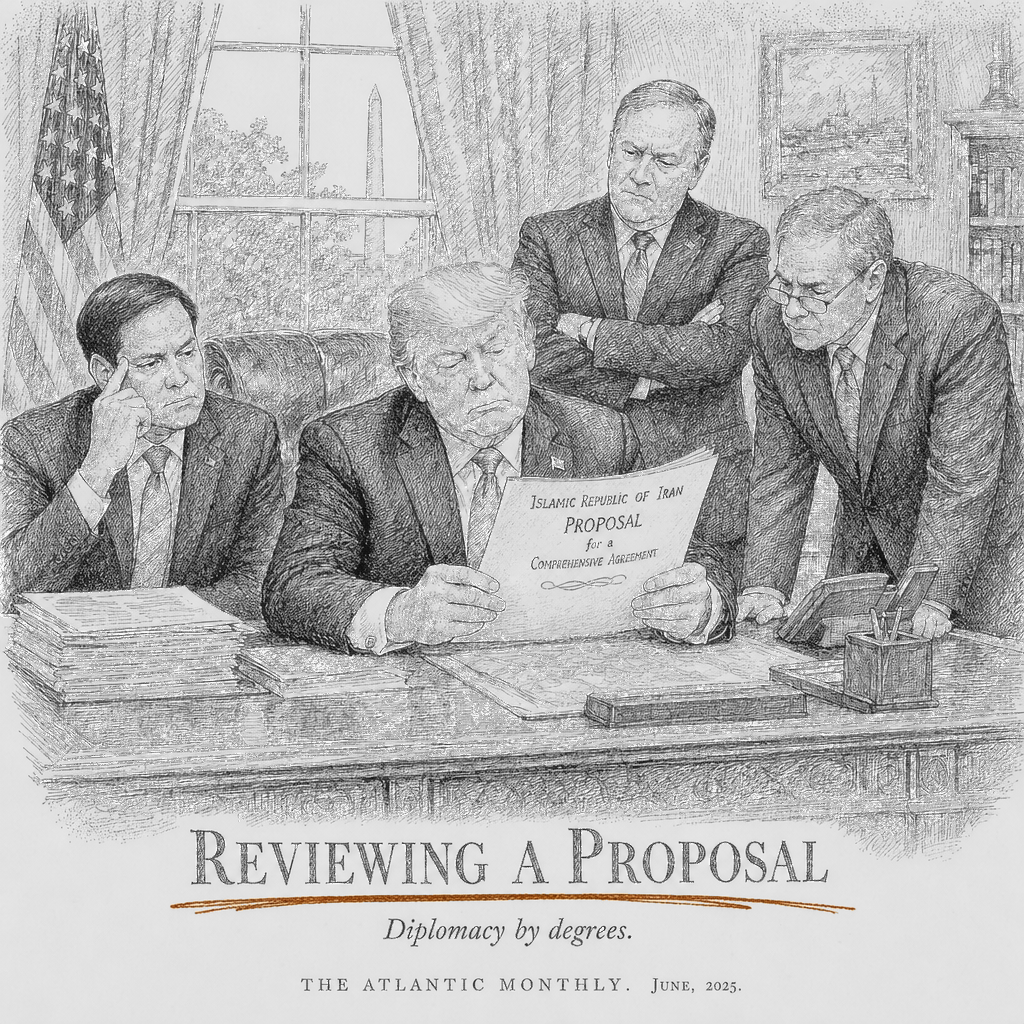
President Donald Trump said Saturday that he was reviewing a new Iranian proposal meant to end the war, but he doubted it would result in an agreement. Speaking to reporters in West Palm Beach, Florida, before boarding Air Force One, Trump said, “I’ll let you know about it later,” adding that “they’re going to give me the exact wording now.” He also posted on social media after the remarks, writing that he “can’t imagine that it would be acceptable in that they have not yet paid a big enough price for what they have done to Humanity, and the World, over the last 47 years.”
The latest proposal surfaced amid continued diplomatic activity involving both sides. Trump rejected a previous Iranian proposal earlier this week, though talks continued and a three-week ceasefire “appears to be holding,” the Associated Press reported.
In Iran, two semiofficial outlets believed to be close to the Revolutionary Guard, Tasnim and Fars, said Iran has sent a 14-point proposal through Pakistan in response to a nine-point U.S. proposal. Iran’s state-run media had not reported the new proposal at the time of the report, and Pakistan has hosted prior negotiations between Iran and the United States.
Alongside the diplomacy, the U.S. has intensified pressure related to maritime access to the Strait of Hormuz. The U.S. warned shipping companies they could face sanctions for paying Iran to pass safely through the strait. The warning covered not only cash but also “digital assets, offsets, informal swaps, or other in-kind payments,” including charitable donations and payments at Iranian embassies.
The Associated Press said Iran effectively closed the strait after the U.S. and Israel launched a war on Feb. 28, and that Tehran later offered some ships safe passage via routes closer to Iran’s shore, charging fees at times. The U.S. has also responded with a naval blockade of Iranian ports since April 13, and the U.S. Central Command said on Saturday that 48 commercial ships have been told to turn back.
The AP report also detailed international pressure over the health of Narges Mohammadi, an imprisoned Iranian rights lawyer and Nobel Peace Prize laureate. Her foundation and family said Saturday her condition was at “very high risk,” and they said Iran’s Intelligence Ministry opposed a transfer to Tehran for treatment by her own doctors.
Mohammadi was transferred urgently to a hospital in Zanjan, in Iran’s northwest, on Friday after a cardiac crisis and fainting, according to the report. Her family said her health had been worsening in part from a beating she received during her Dec. 12 arrest, and that medical teams in Zanjan requested her records before any treatment, while recommending she be transferred to Tehran. Mohammadi’s Paris-based husband, Taghi Rahmani, said in a voice message shared with the AP by the foundation that the Intelligence Ministry opposed the transfer for angiography, or imaging of the blood vessels.
The Norwegian Nobel Committee issued a statement urging Iranian authorities to transfer Mohammadi immediately to her medical team, saying her life is in their hands. “She has the mental resilience for imprisonment, but her body does not have the readiness. The Ministry of Intelligence wouldn’t even mind if (she) died,” Rahmani told Sky News, according to the AP report, adding that their children hadn’t seen Mohammadi for more than a decade.
The AP report said Mohammadi had been serving a sentence of 13 years and nine months on charges of collusion against state security and propaganda against Iran’s government, and that she had been released on furlough since late 2024 over medical concerns. Her legal team is pursuing the case with Iran’s General Prosecutor’s office, the foundation said.
Iran also announced judicial actions in espionage cases. Iran said Saturday it hanged Yaghoub Karimpour and Nasser Bekrzadeh, with the judiciary’s news outlet Mizanonline saying Karimpour was accused of sending “sensitive information” to a Mossad intelligence officer, and saying Bekrzadeh allegedly sent details about government and religious leaders as well as information about Natanz, where nuclear enrichment is carried out.
The report said Iran has hanged more than a dozen people in recent weeks over alleged espionage and terrorist activities, and that rights groups say Iran often holds closed-door trials in which defendants cannot challenge the accusations they face.