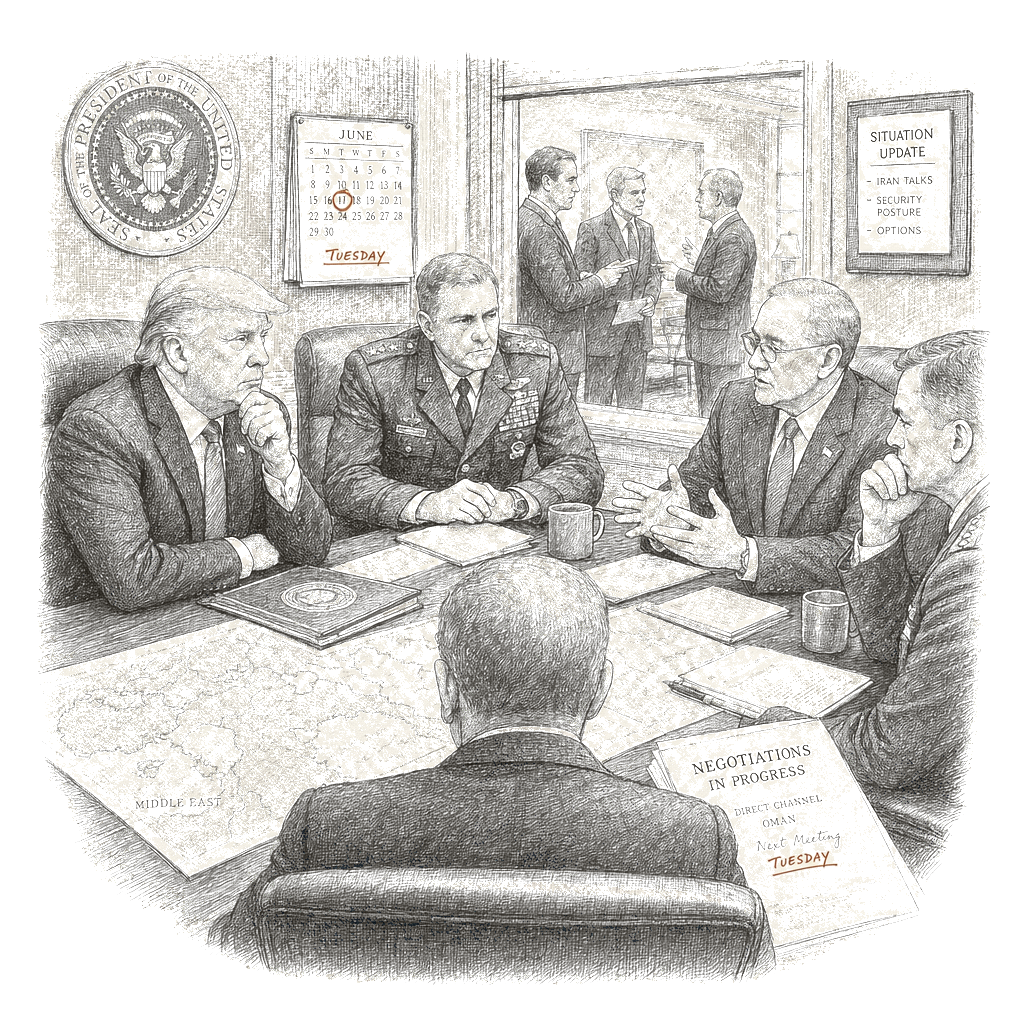
Trump pauses Iran strike as negotiations proceed
President Donald Trump said Monday that he is delaying a planned military strike on Iran that was set for Tuesday, citing ongoing efforts to negotiate an end to the war. Speaking at the White House after first announcing the decision in a social media post, Trump said there was a “very good chance” the sides could work out an agreement without resorting to force.
Trump said the planned action had been a “very major attack,” but he was holding it back “for a little while, hopefully, maybe forever.” He said America’s Gulf allies asked him to wait for two to three days because they believe they are close to a deal with Iran.
In his remarks, Trump framed the pause as “a very positive development” and acknowledged that in the past, negotiations sometimes appeared close before failing to produce results. He also described the timing as tied to his view of what can be achieved through talks during the current negotiations.
Trump’s announcement did not mean the U.S. relinquished its military posture. Trump said he instructed the U.S. military “to be prepared to go forward with a full, large scale assault of Iran, on a moment’s notice, in the event that an acceptable Deal is not reached.”
Over the preceding weeks, Trump had repeatedly warned that terms governing potential strikes against Iran could change if Tehran did not make a deal, while also shifting his deadlines and sometimes backing off to allow negotiations to continue. The new pause, he said, differed from past instances in which a deal seemed close but did not materialize.
U.S. allies and regional security concerns remained part of the context for the decision. Trump said he was calling off the attack at the request of Gulf leaders, including those of Qatar, Saudi Arabia and the United Arab Emirates. Iran and allied Shiite militias in Iraq have launched drone attacks targeting Gulf Arab states during the war, and the UAE has accused Iran of launching drone and missile attacks despite the ceasefire, including a Sunday drone strike that sparked a fire near the UAE’s sole nuclear power plant.
Trump also said he had spoken recently with Israeli Prime Minister Benjamin Netanyahu and Chinese President Xi Jinping about the Iran war. Separately, his post affected market expectations: petroleum futures had been trading at $108.83 a barrel minutes before the announcement, and after the announcement the price fell by more than $2 before ending the day at $107.25.
Negotiations, meanwhile, have centered on the conflict’s immediate military risks and on nuclear conditions. Iran has effectively closed the Strait of Hormuz, a critical waterway for energy shipments, while the U.S. has said it is blockading Iranian ports and has redirected 85 commercial vessels from mid-April through Monday, according to U.S. Central Command.
Turkey’s Foreign Minister Hakan Fidan said Monday that the immediate focus of negotiations between the U.S. and Iran was keeping the Strait of Hormuz open, while also maintaining that Iran’s nuclear program remained a central issue. Speaking at a joint news conference in Berlin with his German counterpart, Fidan said much of Iran’s enriched uranium that could be used for a nuclear weapon was buried under collapsed tunnels following attacks in June that the U.S. launched with Israel.
Fidan said, “At present, there isn’t a situation that poses a real threat,” but added that for that to continue, the parties needed to reach and conclude a nuclear negotiation. He said Iran was not opposed in principle to complying with nuclear conditions, but raised questions about what would be given in return, in what order, and under what conditions.