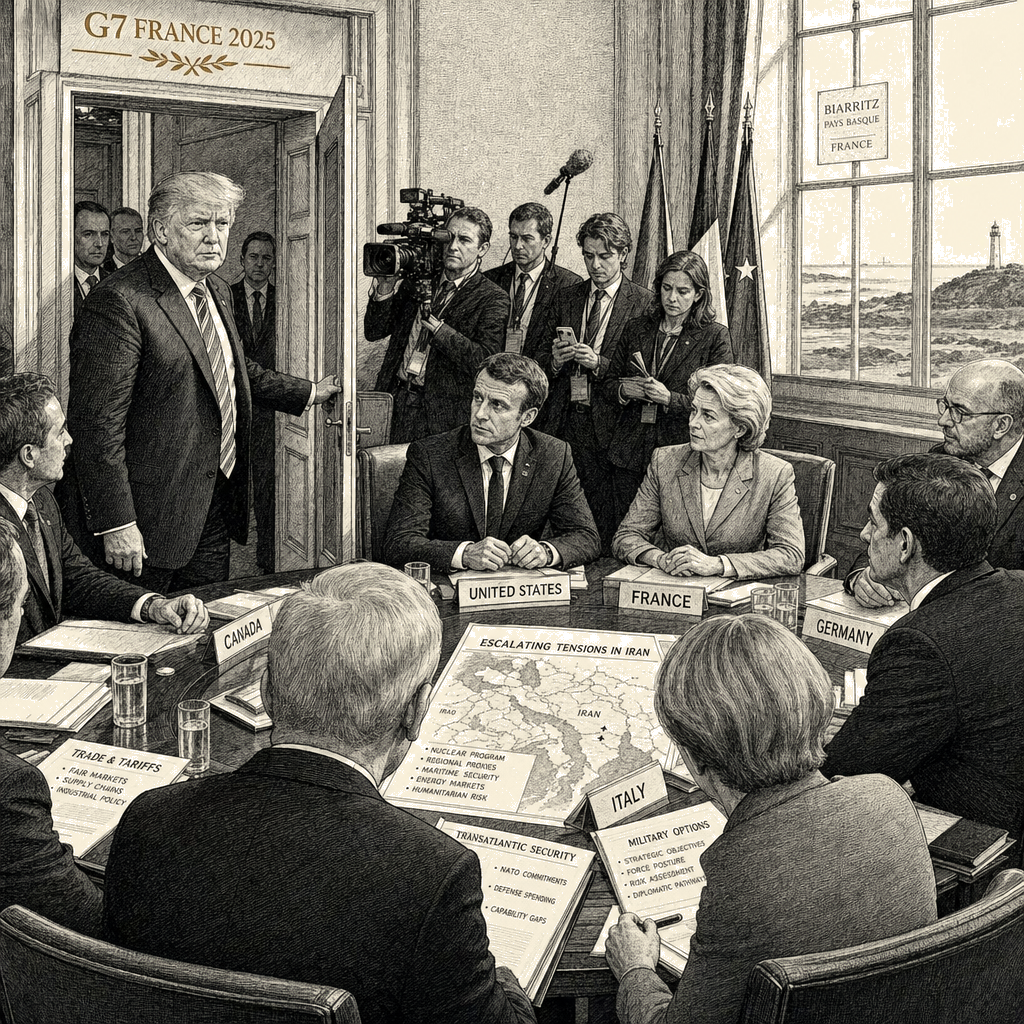
President Donald Trump is set to depart for France this week for a G7 summit that senior administration officials said will focus heavily on the U.S.-led war in Iran, a conflict that has widened fissures between Washington and its European partners over trade, defense spending, and military strategy.
Trump will meet individually and in group sessions with French President Emmanuel Macron, Ukrainian President Volodymyr Zelenskyy, and key Middle Eastern leaders, according to U.S. officials who spoke on condition of anonymity because they were not authorized to discuss the schedule publicly. One official said Trump will “meet with G7 leaders to address key issues of shared importance, including economic growth and development, supply chain resilience, illegal immigration and artificial intelligence.” But what was originally planned as a meeting centered on separate economic and security issues has been overtaken by surging energy costs and disagreements over a geopolitical crisis that is exposing fractures among the world’s leading democracies, according to analysts.
“There is no doubt Iran is going to dominate the agenda at Evian,” said Brett Bruen, who served on the National Security Council under President Barack Obama and who plans to meet with G7 officials at the summit. “It is going to be both a military and security challenge. It’s a major economic challenge, but it’s also a political challenge.”
The bubbling tensions between the U.S. and its G7 allies over the war in Iran exploded into public view weeks ago when Trump announced the withdrawal of at least 5,000 U.S. troops from Germany, citing European reluctance to support the U.S.-led war in Iran. The decision was partially reversed, with the troops redirected to Poland, but the episode illustrated what diplomats described as the real security consequences of embarrassing or crossing the president.
Constanze Stelzenmüller, a transatlantic security expert at the Brookings Institution, said European leaders will carry that lesson into any meetings with Trump at the summit. “Any meeting that includes the president raises the prospect of significant uncertainty,” she said. “The president’s volatility is legendary. He could get upset very quickly. He can be charming at other times. And he can whiplash between one or the other in the blink of an eye.”
Some analysts said the friction has had an unintended effect of strengthening European cohesion. Nathalie Tocci, a former top EU foreign policy adviser who is now a professor at Johns Hopkins SAIS Europe, said repeated U.S. pressure over trade, defense spending, and security policy has pushed European governments closer together and led to greater strategic autonomy. “The Europeans are in a much better place now than they were a year ago,” Tocci said. “There is less bending of the knee going on and there’s more willingness to politely sort of be firm on certain issues.”
Europe remains in a bind because of the war and its economic fallout, the source said. The United Kingdom is working with France to build a coalition of nations to help with demining the Strait of Hormuz once a peace deal is reached. Trump has said he expects European and other Western countries that depend on the strait to play a role, officials said, adding that the topic will also be discussed at the summit.
Trump administration officials said the president also aims to discuss strengthening economic ties, investment partnerships, critical mineral supply chains, and global pressing issues such as innovation, artificial intelligence, and addressing the Ebola outbreak. The broader divide comes at a moment of heightened global risk, according to observers.
Bruen said the situation has shown the limits of an “America First” approach to a global crisis — one that leaves the U.S. more isolated and less coordinated with allies. “If the United States can’t contain the fallout from a military operation of our choice against a single country, that at best is a middling power,” he said. “How on earth are we going to be able to push back against a larger power, a nuclear power.”