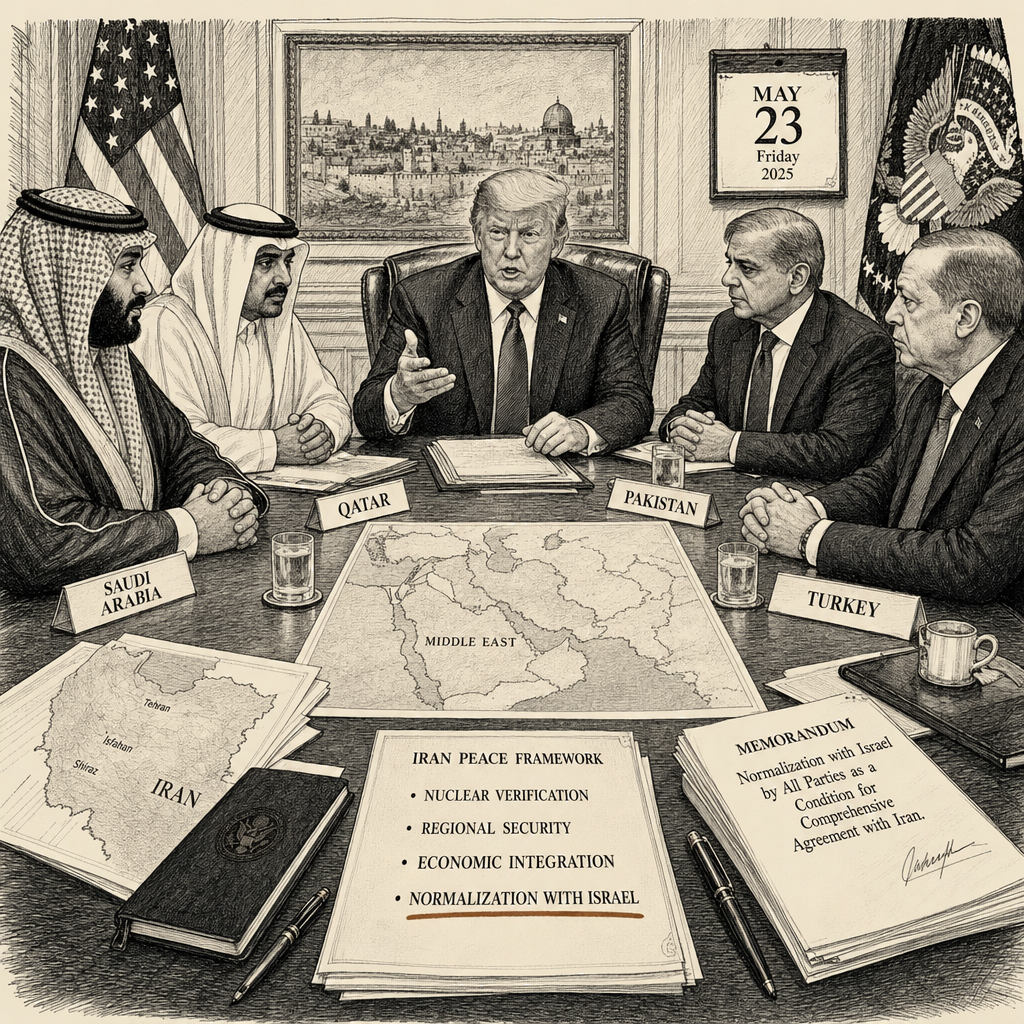
President Trump told the leaders of Saudi Arabia, Qatar, Pakistan and Turkey on May 23 that as part of a deal to end the war with Iran, it “should be mandatory” for them to establish diplomatic relations with Israel under the Abraham Accords, the 2020 agreement negotiated during his first term that saw the U.A.E. and Bahrain formalize ties with Israel.
Trump later wrote on social media that the process “should start with the immediate signing by Saudi Arabia and Qatar, and everybody else should follow suit.” He said those that did not join would be “guilty of having bad intentions.”
The demand has landed in a dramatically altered diplomatic environment. The war with Iran has inflicted major costs on Gulf states. The U.A.E. was targeted with more than 2,800 drones and missiles during the conflict, more than any other country, including Israel. All six member states of the Gulf Cooperation Council incurred damage from retaliatory strikes against U.S. bases and civilian infrastructure such as airports and residential areas.
Analysts said Gulf leaders have become increasingly distrustful of both the U.S. and Israel as a result of the war, and that Trump’s proposal adds pressure on countries that already feel they bore the conflict’s costs without adequate American attention to their security.
“The feeling in the Gulf is not how much they owe the United States but rather how much they feel disappointed,” said Jon Alterman, the Zbigniew Brzezinski chair in global security and geostrategy at the Center for Strategic and International Studies. “While they’re careful not to say it explicitly, they feel the United States was very motivated to protect Israel and not very motivated to protect them.”
Firas Maksad, managing director for the Middle East and North Africa practice at risk consulting firm Eurasia Group, said Trump is pressuring the countries that suffered damaging Iranian attacks to now pay a political price by antagonizing an Iranian regime that has been emboldened by the war and threatens long-term control of the Strait of Hormuz.
“It just doesn’t compute for the GCC,” said Maksad, who visited Saudi Arabia, Qatar and the U.A.E. in May. “Nobody’s going to move in that direction in the current climate.”
Saudi Arabia, the region’s most prominent potential signatory, has long said openly that it would only agree to the Abraham Accords if there were a clear pathway toward a Palestinian state. Riyadh came close to normalizing relations with Israel in 2023 before the Hamas-led attacks on Oct. 7 of that year set off the war in Gaza. Qatar, which mediated between Israel and Hamas to end the Gaza war, has no plans to join the Abraham Accords. Any engagement with Israel at this point would focus on the resolution of the Palestinian issue, a Qatari official has said.
Trump doubled down at a cabinet meeting on May 28, saying envoys Steve Witkoff and Jared Kushner were speaking to regional leaders about normalization. “That would really be a tremendous sign, and I think those countries owe it to us,” Trump said. “It’ll be great for Saudi Arabia. It’ll be great for Qatar, for Kuwait and the whole group.”
He also said he might not sign an Iran deal if the other states do not join the Abraham Accords.
While Trump declared a ceasefire on April 7, Iran has yet to agree to U.S. demands, including that Tehran must never obtain a nuclear weapon and must hand over its existing stockpile of enriched uranium. In an interview that aired May 31, Trump told his daughter-in-law Lara Trump on Fox News that the Iranians were “good negotiators” and that he was not in a rush because “if you’re going to be in a hurry, you’re not going to make a good deal.”
Arab populations across the region are even less disposed than they were a few years ago to accept deeper ties with Israel after its campaign in Gaza, analysts said. Many consider Israel a destabilizing force in the region. Political relations with Israel have worsened across the region since the Gaza campaign and two wars against Iran, threatening the stability of the economically sensitive Gulf.
The U.S. had a stronger position for regional integration after the 1991 Gulf war, when it led a coalition to liberate Kuwait from invading Iraqi troops and used the resulting goodwill to convene a peace conference in Madrid. That process eventually paved the way for Israeli accords with Jordan and the Palestine Liberation Organization. The current effort comes against a very different backdrop.
Michael Ratney, who previously served as U.S. ambassador to Riyadh and consul general in Jerusalem, said the Gulf states and Pakistan were unlikely to normalize with Israel under pressure and have become accustomed to statements from Trump that they find difficult to act on.
“They are just at a point where they grit their teeth and do their best to continue the relationship without blowing it up,” Ratney said. “They’re all going to wait for the dust to settle before they do anything else that could be controversial or destabilizing.”
Riyadh and other Arab governments have cooperated with Israel and the U.S. on security matters since 2024, sharing intelligence and radar-tracking information to shoot down Iranian drones and missiles, opening their airspace to warplanes, and in some cases supplying forces to help. But that security coordination has not translated into political normalization, and the war has made the political calculus more difficult, not less.