Summary
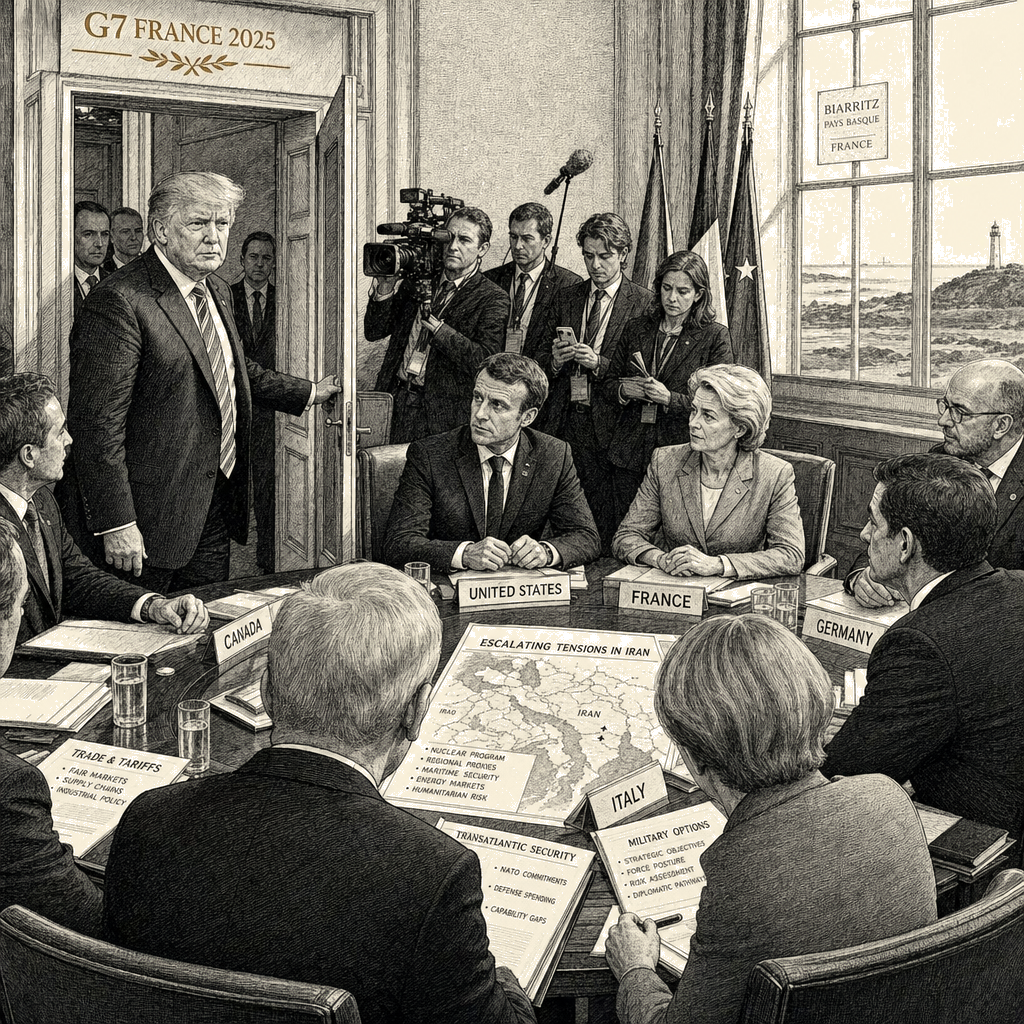
- The U.S.-led war in Iran has overtaken the G7 summit’s original agenda, converting a forum designed for cooperative economic and security policy into a crisis-management venue focused on a conflict European allies did not collectively authorize.
- The Strait of Hormuz demining initiative illustrates a recursive dependency: post-conflict stabilization requires alliance cohesion that the manner of the conflict’s initiation has degraded.
- European leaders face a nested decision landscape under deep uncertainty, where accommodating U.S. preferences risks eroding long-term strategic autonomy while asserting independence risks concrete military consequences, as the Germany troop withdrawal demonstrated.
- The interlocking of Ukraine and Iran policy at the summit — with Zelenskyy present alongside Middle Eastern leaders — creates a dependency fragility in which friction on one crisis directly constrains capacity on the other.
- Former NSC official Brett Bruen’s assessment that the conflict tests whether the United States can “contain the fallout from a military operation of our choice against a single country” frames the summit as a credibility test for alliance leadership at higher escalation tiers.
The G7 summit at Evian, originally organized around economic growth, supply chain resilience, immigration, and artificial intelligence, has been overtaken by the U.S.-led war in Iran as the dominant preoccupation of assembled leaders. Senior U.S. administration officials, speaking on condition of anonymity because they were not authorized to discuss the schedule publicly, confirmed the Iran focus. What was designed as a forum for cooperation across multiple policy domains has become, in former Obama-era National Security Council official Brett Bruen’s characterization, a simultaneous “military and security challenge,” “major economic challenge,” and “political challenge.” The crisis the G7 partners did not collectively authorize has consumed the bandwidth for non-crisis coordination — including the supply-chain-resilience infrastructure that would absorb the economic shock of prolonged disruption. The summit’s original agenda items — AI governance, Ebola response, critical mineral supply chains — appear in the NPR report as a single sentence attributed to an unnamed official, functioning as context-setting rather than substantive content.
How the summit is being framed
The operative frame is that allied management of unilateral-war fallout has supplanted alliance management of shared crises. The G7 is no longer primarily a steering committee for the liberal order but a venue for managing the spillover caused by its most powerful member’s independent military action. The summit is being narrated not as a gathering of equals addressing a shared crisis but as an exercise in containment — containment of the conflict’s economic and security costs and, implicitly, of further unilateral action by the primary conflict initiator. The summit’s transformation from an economic and security policy discussion to an Iran-dominated crisis session illustrates the diagnostic function: the problem is not the war alone but the erosion of allied consultation that preceded it.
The labeling of the conflict as “U.S.-led” throughout the NPR report performs two functions simultaneously: it attributes agency and therefore responsibility to Washington, and it positions European allies as parties brought into a situation rather than one they chose. This framing structures every subsequent negotiation: the question becomes whether allies will support a U.S. decision, not whether they co-own the strategic direction.
The framing dimensions operate through distinct registers. Problem definition centers on the war’s economic and security repercussions, layered atop pre-existing U.S.-European tensions over defense spending and trade. Causal interpretation positions the United States as having initiated the conflict, with allies now managing consequences they did not choose. Moral evaluation is conveyed through Bruen’s characterization of the crisis as a test of American capacity to “contain the fallout from a military operation of our choice against a single country.” The treatment recommendation emerges through Tocci’s observation that European governments are in “a much better place now” with “less bending of the knee.”
The selection-and-salience calculus is visible in what the NPR report foregrounds and what it subordinates. The Iran war, troop withdrawals, alliance friction, and European strategic autonomy receive extended treatment; AI governance, Ebola response, and critical mineral supply chains receive a single sentence. This pattern reflects a real dynamic in which crisis compresses bandwidth. But it also means the G7’s capacity to advance longer-term cooperative frameworks is narratively erased at the moment it may be most needed.
The sourcing structure introduces a further framing layer. Of the named voices, two are former Obama-era officials or advisers (Bruen and Nathalie Tocci, a former top EU foreign policy adviser now at Johns Hopkins SAIS Europe) and one is a Brookings Institution analyst (Constanze Stelzenmüller) whose quoted observation centers on Trump’s volatility. The current administration’s perspective is conveyed through unnamed officials in paraphrase rather than direct quotation, while the critical analytical voices receive the authority of direct quotation. This common pattern in diplomatic coverage may produce a particular framing effect for the reader in which the summit appears more adversarial and more fraught than it may appear from inside the room.
The NPR report is overwhelmingly episodic in Iyengar’s sense: it centers on personalities, meetings, and reactions rather than on the structural policy questions that produced the crisis. Trump’s “volatility” is described as “legendary” by Stelzenmüller. The troop withdrawal is presented as a punitive action illustrating “the real security consequences of embarrassing or crossing the president.” The episodic dominance makes for compelling reading but may obscure the strategic terrain that will actually determine summit outcomes: the strategic logic behind troop redistribution to Poland, European defense spending trajectories, and the concrete terms under which a Hormuz peace deal might be structured.
Linguistic mechanisms within the report are visible in how nominalization of conflict consequences into “energy costs,” “fissures,” “uncertainty,” and “fallout” transforms political agency into passive conditions, naturalizing a world in which allies respond to consequences while the originating decision goes unrevised. The NPR report leads with the administration’s positioning (“economic growth and development, supply chain resilience”) but immediately pivots to analyst commentary that reframes the agenda as crisis management.
The incentive structure beneath the alliance
Trump’s redeployment of troops from Germany — initially framed as a punitive withdrawal but “partially reversed,” with troops redirected to Poland, according to the NPR report — illustrates an alliance incentive structure where partners appear to be rewarded for alignment with U.S. preferences. This pattern, in which the deployment of U.S. forces appears to track a single decision-maker’s approval of partner behavior, has been characterized by analysts as a shift from alliance management to a conditional incentive structure where alignment is rewarded and non-compliance punished. The Germany episode demonstrates the cost of asserting independence: a concrete military consequence only partially reversed. The fragility is not just a loss of trust but a shift in the incentive gradient — one that makes future allied support less a function of collective deliberation and more a matter of anticipatory accommodation or resistance.
The NPR report describes the troop redirection to Poland as a “partial reversal,” but subsequent reporting from other outlets points to a cancellation of planned deployments rather than a redirection. The claim is retained here with attribution to the NPR report as a contested element.
Decision landscape under deep uncertainty
European leaders face a nested set of choices under multiple intersecting uncertainties, none of which have well-defined probability distributions.
The first uncertainty concerns the trajectory of the Iran conflict itself. European leaders are being asked to commit to post-conflict coordination — demining, reconstruction participation — while the conflict’s duration, escalation potential, and eventual settlement terms remain unknown. This places them in a posture of commitment without adequate information: the costs of engagement are known and immediate, while the conditions under which engagement would pay off are contingent and distant.
The second uncertainty is the Iran-Ukraine interlock. Zelenskyy’s presence alongside Middle Eastern leaders means that Ukraine policy and Iran policy are interlocked. European defense resources, diplomatic attention, and alliance goodwill are finite. A posture that maximizes coordination with Washington on Iran may constrain Europe’s leverage on Ukraine; a posture that asserts European autonomy on Iran may reduce the alliance cohesion that underpins Ukraine support. The NPR report does not explore this tension, but it is the strategic bind beneath the summit’s surface.
The third uncertainty is accommodation versus assertion. Tocci’s observation about “less bending of the knee” describes a trend, not a stable equilibrium. The Germany troop withdrawal illustrates the cost of the assertive posture. Four decision alternatives carry different robustness profiles.
A unified European position is robust across scenarios — whether the war de-escalates or persists, European unity is an asset — but potentially perceived as confrontational, which the Germany precedent suggests carries real costs. Individual bilateral meetings preserve flexibility and avoid the optics of a coordinated challenge but sacrifice collective leverage. Deferring substantive commitments reduces risk of premature commitment under uncertainty but signals passivity at a forum designed for collective action, potentially emboldening the isolationist framing that Bruen describes. Hedging through parallel tracks — supporting demining and post-conflict planning through the UK-France initiative while declining to engage on the broader strategic framing of the war itself — separates the operational question from the political question and preserves optionality. This posture appears to offer the greatest robustness across multiple states but may be perceived by all parties as evasive.
No alternative dominates. The accommodationist posture is robust but erodes long-term autonomy. The assertive posture is optimal in a scenario where the U.S. administration needs European support enough to absorb the friction, but costly in the scenario where the administration punishes dissent.
The epistemic terrain
The behavior of oil markets under a protracted Hormuz closure falls within the domain of risk: outcomes can be modeled using probabilities from comparable historical disruptions. The willingness of European publics to sustain defense spending increases under economic pressure is a matter of uncertainty: multiple plausible states exist, and their probabilities are not bounded with precision, though they are partially assessable through public opinion surveys and budgetary track records. The potential for a U.S. administration’s commitment to troop deployments to shift in response to a specific domestic political trigger sits in the realm of deep uncertainty: neither the outcomes nor the probabilities can be agreed upon, because the trigger is uniquely contingent on a decision-maker whose reactions are not systematically modelable. Stelzenmüller’s use of “uncertainty” (“significant uncertainty”), tied explicitly to the president’s “volatility,” maps onto this third category.
The counterframe and its limits
A counterframe is visible in the NPR report: allied coalescence around shared threat has driven burden-redistribution toward greater European capability, as in Tocci’s observation that repeated U.S. pressure has pushed European governments toward greater cohesion and autonomy. If this counterframe held, it would recast the G7 as a forum for a more balanced transatlantic partnership. However, the weight of the report’s narrative — the troop withdrawal disputes, the “real security consequences of embarrassing or crossing the president” — militates against this reading.
Alliance strain predates the Iran war: European defense-spending shortfalls, energy-dependence decisions, and divergent threat perceptions regarding Iran are part of the causal substrate that the NPR report only partially addresses. Tocci’s “less bending of the knee” can be read as European resolve, but it also points to reduced coordination capacity that has mutual roots, in which both Washington and European capitals have contributed to a fraying of the consultative fabric.
Fragility structure
The summit’s fragility landscape can be organized into five classes.
Load fragilities. The Strait of Hormuz is both a military objective and an economic chokepoint. The UK-France demining coalition presupposes a peace deal; if that deal does not materialize, the load on European energy systems continues to grow without a relief valve. The summit’s original agenda item on supply chain resilience, now subordinated, is in fact the infrastructure that would absorb the economic shock of prolonged Hormuz disruption. The crisis is consuming the bandwidth needed to build the very resilience the crisis demands.
Dependency fragilities. European support for Ukraine depends on alliance cohesion that the Iran war is eroding. If the summit produces a visible rupture on Iran, the spillover to Ukraine coordination is not a separate risk but a direct consequence. Zelenskyy’s presence at the summit makes this dependency concrete: he is a dependent party whose outcomes are shaped by a bilateral friction he cannot influence.
Interface fragilities. These appear at multiple junctures — between U.S. expectations and European willingness; between the summit’s economic and security agendas; between the Hormuz demining initiative and the absent peace deal; between individual European governments’ bilateral calculations and the collective cohesion narrative. The Germany troop withdrawal was itself an interface failure — a unilateral U.S. decision that disrupted a multilateral arrangement. The redirect to Poland introduces a new interface between the Iran and Ukraine theaters.
State fragilities. The European alliance system has absorbed multiple shocks — trade disputes, defense spending pressure, the Iran conflict, the Ukraine war. Each shock is individually manageable. The question is whether the accumulated state has moved the system closer to a threshold beyond which further accommodation becomes politically untenable for European governments. Tocci’s “less bending of the knee” may describe the early signal of such a threshold.
Emergent fragilities. The most plausible candidate failure scenario is one in which the summit’s Iran discussions produce a visible public disagreement; that disagreement weakens the Ukraine coordination framework; the weakened framework signals to Moscow that Western resolve is fragmenting; and that signal produces escalation in the Ukraine theater that consumes the political resources needed for Hormuz post-conflict planning. No single element of this chain is a failure; their interaction is.
The recursive stress at the Hormuz conditional
The coordinating conjunction “once” in the NPR report’s statement that the UK and France are building a demining coalition “once a peace deal is reached” reveals the structural brittleness of the arrangement. Economic and military stabilization is conditional on a peace that is itself conditional on allied cooperation — cooperation strained precisely because of the manner in which the conflict was initiated. If the cooperative architecture required for post-conflict stabilization is the same architecture fractured by the conflict’s origins, the operational sequence reveals a recursive stress: stabilization requires alliance cohesion; alliance cohesion has been degraded by the unilateral decision to go to war.
The great-power extrapolation
Bruen’s assessment — “If the United States can’t contain the fallout from a military operation of our choice against a single country, that at best is a middling power. How on earth are we going to be able to push back against a larger power, a nuclear power.” — serves a dual analytical function. It frames the current conflict as a preview of a more significant failure: the credibility of U.S. alliance leadership at a higher tier of escalation. The fragility assessment does not just consider failure within the Iran context but folds forward into alliance failure under a great-power conflict scenario.
Integrating layers
The framing, the decision landscape, and the fragility structure are mutually reinforcing. The episodic framing — personalities, friction, volatility — crowds out the thematic framing of structural interdependencies, strategic alternatives, and fragility management. The decision landscape is dominated by a binary accommodate-or-assert framing that obscures the hedging and sequencing alternatives. And the fragility structure is most dangerous at the interfaces and in the emergent interactions that the episodic framing does not capture.
Bruen’s assessment frames the summit as a test of American strategic capacity. But the summit is simultaneously a test of European strategic capacity — the capacity to manage multiple interlocked crises simultaneously, to resist both accommodation and confrontation as defaults, and to build the resilience infrastructure that the crises demand even as the crises consume the bandwidth to build it.
The dominant condition is deep uncertainty over alliance cohesion, with specific events — troop withdrawals, redeployments, the demand for a Hormuz demining coalition — as the measurable loads on a structure whose capacity is now in doubt. The greatest fragility may be the interaction between the summit’s framing and its actual strategic demands: a forum designed for collective action is being narrated as a test of individual temperament, and the gap between the two may widen under the very pressures the forum is meant to address. The troop redeployment pattern is the indicator that incentive structures have been modified so that interrupted cooperative signaling may define future rounds of conflict diplomacy.
Analytical techniques used in this piece
This analysis applies the methods below. Each links to a short, plain-English explainer you can read and reuse.
- Decision Under Uncertainty
- Weighs options by probability and time when the environment is genuinely uncertain.
- Frame Audit
- Surfaces the frame an argument adopts and what that framing quietly includes or excludes.
- Pre-Mortem (Fragility)
- Imagines a system has already broken and traces the structural fragilities that let it.