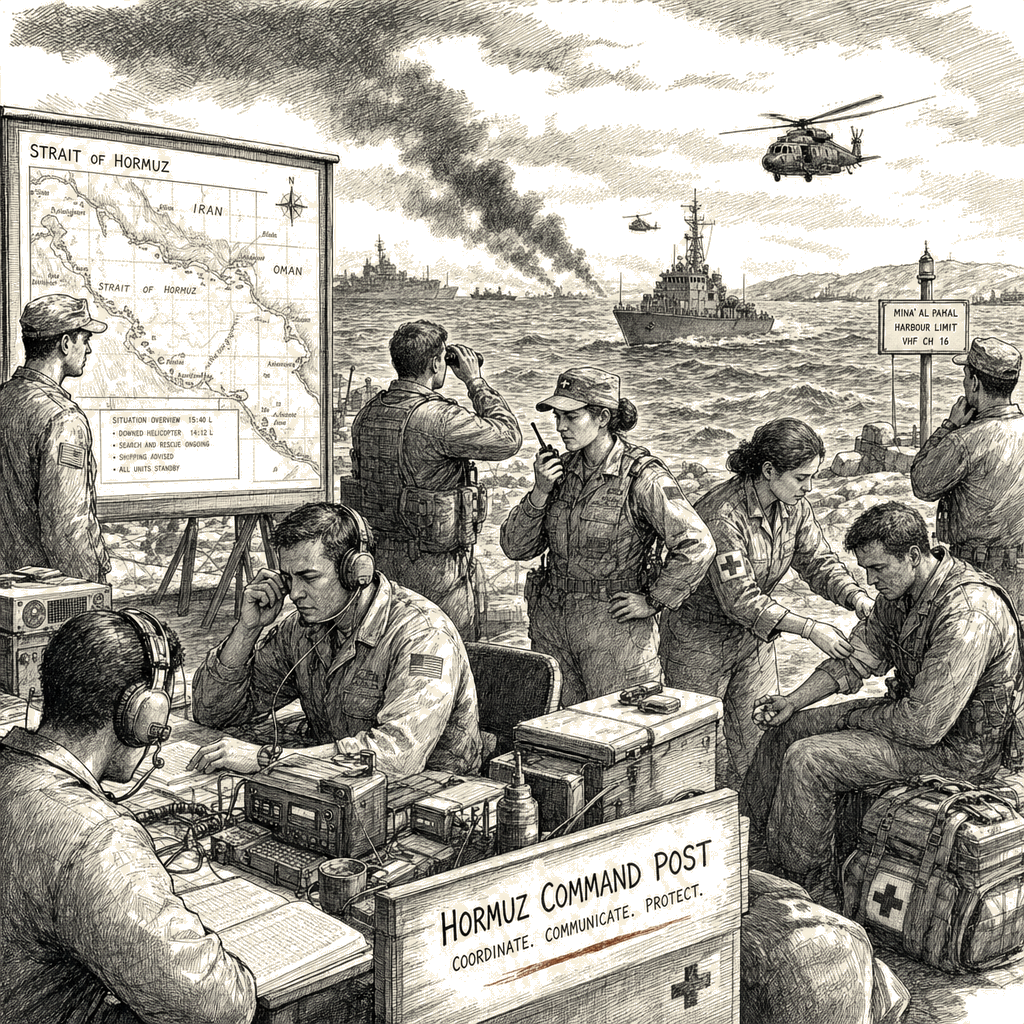
The United States carried out a wave of precision strikes against Iranian military targets in southern Iran on Wednesday, a response President Donald Trump described as necessary to uphold U.S. credibility after an American helicopter was downed near the Strait of Hormuz. Iran said it retaliated with its own attacks against U.S. bases in three neighboring countries.
The U.S. strikes began at 5 p.m. local time and lasted roughly four hours, according to U.S. Central Command. In a statement, CENTCOM said Air Force and Navy fighter jets struck “Iranian air defense, ground control stations, and surveillance radar sites near the Strait of Hormuz with precision munitions.” The command called the operation “a proportional response to unjustified Iranian aggression” and said U.S. forces remained “vigilant and ready to defend against any further Iranian threats.”
The escalation followed the downing of a U.S. Army Apache helicopter near the Strait of Hormuz on Monday. President Trump blamed Iran for the incident, though Iranian officials said they did not target the helicopter and suggested it went down in an accident. The troops aboard the helicopter were unharmed, NPR reported.
Shortly after the U.S. strikes, Iran’s Khatam al-Anbiya Central Headquarters announced a “powerful assault” on U.S. military assets in the region. In a statement published by the state-run Islamic Republic News Agency, the IRGC claimed it fired ballistic missiles at Jordan’s Muwaffaq Salti airbase, where U.S. F-35 fighter jets operate, and attacked facilities in Kuwait and Bahrain. The IRGC said it also targeted the U.S. Fifth Fleet in Bahrain with drones.
Jordan’s armed forces said they intercepted five Iranian missiles that were aimed at the country’s al-Azraq district, about 60 miles east of Amman. The Kuwaiti military posted on X that its air defenses were “currently intercepting hostile aerial targets.” Bahrain’s interior ministry issued multiple air-raid alerts advising residents to shelter, urging them not to panic. No deaths or injuries were reported from any of the impacts.
A photo released alongside the Iranian statement showed six ground-launched ballistic missiles launching from an undisclosed desert location, but the image was undated and uncredited, and it was unclear whether it depicted Wednesday’s strikes, according to UPI. The attacks themselves had yet to be independently verified.
The exchange drew calls for de-escalation from world powers. Chinese foreign ministry spokesman Lin Jian told reporters that China is “deeply concerned” and that “relevant parties need to remain calm, exercise restraint, stop exacerbating confrontation and escalating tensions, take concrete actions to ease the situation, stick to political and diplomatic means for resolving disputes, and work for an early realization of a comprehensive and lasting cease-fire.”
Russian Foreign Ministry spokesperson Maria Zakharova said in a post on X that Moscow was “very worried” about “the new spiral of U.S.-Iran armed confrontation.” She called on both sides to halt military attacks immediately and said Russia stood ready to help find “mutually acceptable negotiated solutions.”
The strikes are the latest in a series of escalating confrontations between the U.S. and Iran in and around the Strait of Hormuz since the collapse of a cease-fire in late April. The waterway, through which about a fifth of the world’s oil passes, has been a flashpoint for skirmishes, drone attacks, and broader exchanges of fire between the two countries.