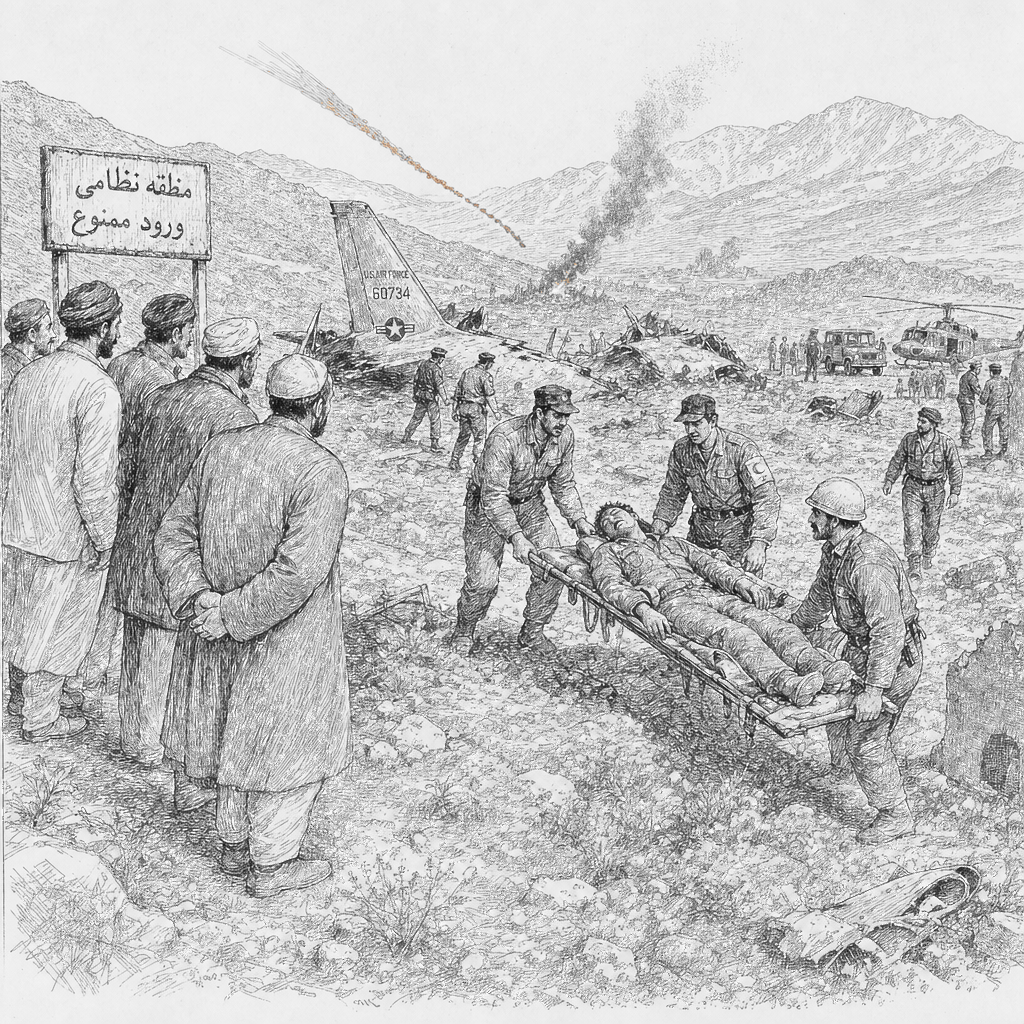
In a dramatic escalation after weeks of fighting, Iran shot down two U.S. military aircraft in separate attacks Friday, according to U.S. and Iranian-linked reports cited by the Associated Press. The incidents came with uncertainty about the fate and location of U.S. crews, as one service member was reported rescued while at least one other remained missing.
The Associated Press reported that one U.S. fighter jet was downed in Iran, with officials saying a crew member from that plane was rescued and that a second was missing. The Pentagon and White House did not release public information about the downed planes, though the Pentagon notified the House Armed Services Committee that the status of a second service member was not known, and sent an email to the committee that said it had received notification of “an aircraft being shot down” in the Middle East without more details.
President Donald Trump, in a brief telephone interview with NBC News, declined to discuss the search-and-rescue efforts but said what happened would not affect negotiations with Iran. Trump told NBC News, “No, not at all. No, it’s war.” The comments marked a sharp linkage between a developing rescue operation and the administration’s stated approach to talks.
Separately, Iranian state media reported that a U.S. A-10 attack aircraft crashed in the Persian Gulf after being struck by Iranian defense forces. A U.S. official who spoke anonymously to discuss a sensitive military situation told the Associated Press that it was not clear whether the aircraft crashed or was shot down, or whether Iran was involved, and that the status of the crew and exactly where the aircraft went down were not immediately known.
The AP said the aircraft downings were the first time U.S. aircraft were shot down inside the conflict zone, which has lasted nearly five weeks. The incidents also came two days after Trump, in a national address, said the United States had “beaten and completely decimated Iran” and was “going to finish the job, and we’re going to finish it very fast.”
Before the reported rescue, social media footage showed U.S. drones, aircraft and helicopters flying over a mountainous region, after a TV channel affiliated with Iranian state television said earlier that at least one pilot bailed out. In the reported account, the anchor urged residents to hand over an “enemy pilot” to police and promised a reward, a shift from prior patterns in which Iran had made claims about downed piloted aircraft that later proved untrue.
The aircraft downing news also reflected broader pressure across the region. Friday’s escalation included attacks on Gulf energy infrastructure, with Kuwait’s Mina al-Ahmadi oil refinery targeted, and Kuwait Petroleum Corp. saying firefighters were working to control several blazes. Kuwait also said an Iranian attack caused “material damage” to a desalination plant that supplies drinking water for Gulf states, and the AP said authorities in other countries issued reports of missile interceptions and disruptions, including in Bahrain, Saudi Arabia and the United Arab Emirates.
In Lebanon, where Israel has launched a ground invasion against the pro-Iranian Hezbollah militant group, the AP reported that an Israeli drone strike on worshippers leaving Friday prayers near Beirut killed two people, according to Lebanon’s state-run National News Agency. The Associated Press also reported that activists said strikes hit around Tehran and the central city of Isfahan, though it was not immediately clear what was hit.
As the conflict continued, an AP review cited the Armed Conflict Location and Event Data project saying civilian casualties were clustered around strikes on security and state-linked sites “rather than indiscriminate bombardment” of urban areas. The AP also reported reported tallies across countries involved in the war and said more than 13 U.S. service members had been killed, along with more than 1,300 people killed and more than 1 million displaced in Lebanon.
World leaders, meanwhile, faced continued difficulty in ending Iran’s tight grip on the Strait of Hormuz, a waterway through which a fifth of the world’s oil and natural gas transits in peacetime. The AP said the U.N. Security Council was expected to take up the matter Saturday, and noted that Trump has vacillated on how the U.S. role should look for opening the strait, including a Friday social media post saying, “With a little more time, we can easily OPEN THE HORMUZ STRAIT, TAKE THE OIL, & MAKE A FORTUNE.” The AP reported that Brent crude spot prices were around $109, up more than 50% since the start of the war when Iran began restricting traffic through the strait.