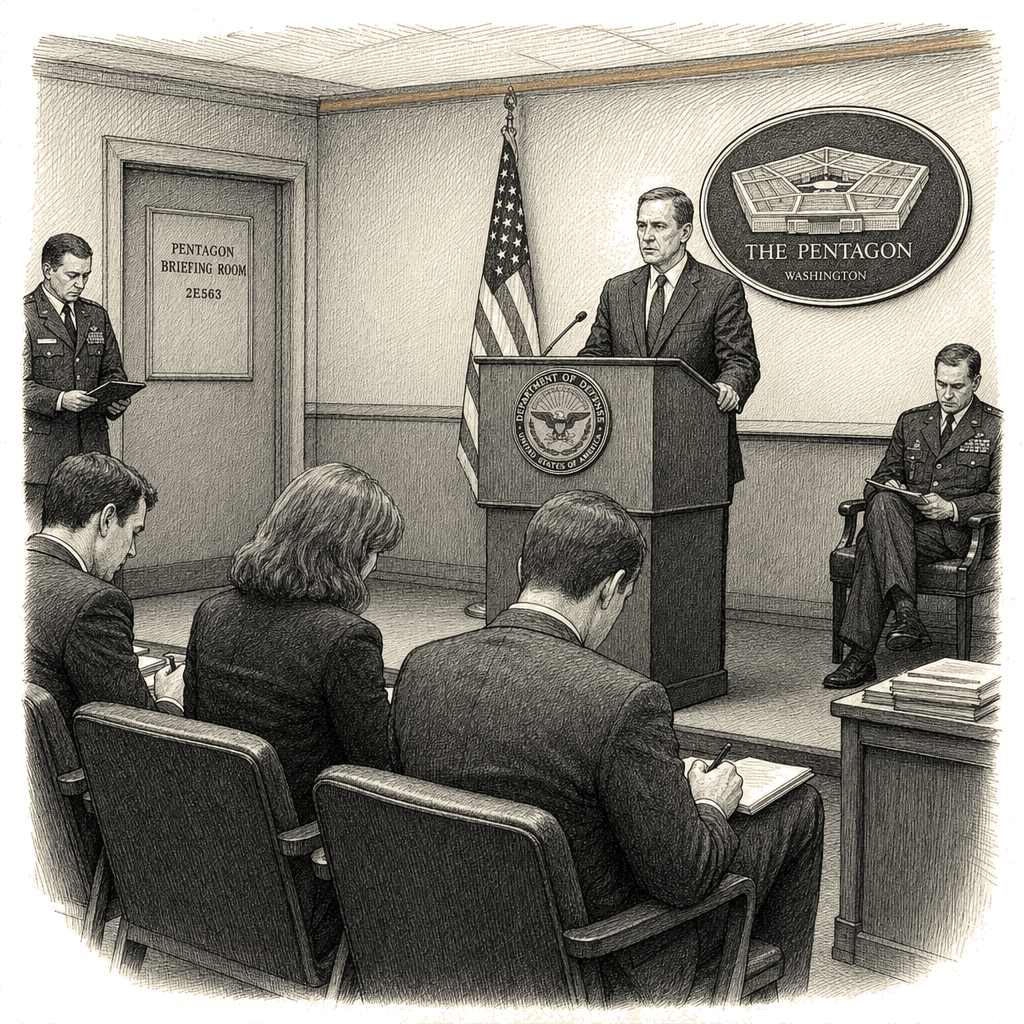
The Pentagon held just eight press briefings — all led by Defense Secretary Pete Hegseth — during the nearly six-week joint U.S.-Israeli bombing campaign against Iran, compared with 40 briefings in the first five weeks of the 2003 invasion of Iraq, a Medill News Service analysis found.
Hegseth gave a single media interview during that period, while then-Secretary Donald Rumsfeld or one of his top deputies gave nearly 50 interviews to make the administration’s case for the war at the same stage, according to the analysis.
The analysis, covering five previous U.S. military flashpoints, showed that Pentagon leaders conducted far fewer press briefings and interviews than during any recent major combat operation. Instead, the department conducted much of its wartime messaging through a social media blitz with few operational specifics.
“All of [the Pentagon’s] policies right now are intended to create the least capacity for oversight, the least transparency and the least understanding of the American public,” said Thomas Crosbie, an associate professor at the Royal Danish Defense College who studies U.S. military-media relations. “It’s just an attempt to strangle the message.”
Crosbie called the messaging shift a “seismic” change aimed at insulating the department from public view. “The whole goal of this administration is to create maneuver space,” he said. “So, any type of norm that exists that limits the behavior of principals is viewed as a negative thing.”
Greg Jaffe, a New York Times reporter who has covered the military for nearly 30 years, said the information from U.S. Central Command, which leads Middle East operations, has been “pretty bare bones.”
“In past wars, when we’re having a bombing campaign like this, we’d have daily press conferences with a uniformed military person, who would be talking about what they were striking, but also the strategy behind it and suggestions of whether they were making progress or not,” Jaffe said. “And we don’t get that.”
The reduction in traditional briefings comes alongside other access restrictions. Reports emerged June 1 that the Pentagon had barred journalists from its press office and redesignated it a classified space. The office had long been a freely accessible room where reporters could pose questions to public affairs officers.
Acting Pentagon Press Secretary Joel Valdez said in a social media statement that the change was due to speechwriters who routinely handle classified material sharing the facility. “This is the most transparent War Department in history,” Valdez wrote. “No amount of spin from the fake news media will change that.”
The Pentagon did not respond to a detailed request for comment about Hegseth’s availability and the department’s communications strategy. On Wednesday, Hegseth was reported to be at the U.S. naval base in Guantanamo, Cuba, as tensions with that island nation remain high.
The shift toward social media saw the department’s X account post videos of U.S. strikes with triumphalist commentary. One post simply had “NO MERCY” overlaid on a missile image. Pentagon spokesman Sean Parnell, who has not held a live news conference since before the war, posted “THE IRANIAN NAVY IS DECIMATED” above a cartoon illustration of an exploding ship on his personal account.
Chris Meagher, who served as chief Pentagon spokesman under President Joe Biden, said the current messaging is “overtly political” and “more intended to position the president in a position of power and strength rather than provide information in a transparent manner to the American people.”
During the final three weeks of the U.S. withdrawal from Afghanistan in August 2021, when 13 service members were killed, the Pentagon’s then-spokesman John Kirby briefed reporters more than 20 times, often twice a day, Meagher noted.
The Pentagon’s limited transparency comes as U.S. forces sustained more than 400 casualties, including 13 dead, over the first 38 days of Operation Epic Fury. Pentagon officials estimated the cost of the campaign at $29 billion, not including repairs to bases damaged by Iranian retaliation.
In response to the bombing, Iran closed the Strait of Hormuz, sending U.S. gasoline prices above $4.50 per gallon in May. An April Ipsos poll found that only 24% of Americans said the military action was worth the costs and benefits.
A federal judge in March ruled some of the Pentagon’s media-access restrictions unconstitutional, though the government appealed and litigation continues.
The Pentagon has said the war was a success and that it would take Iran’s military a generation to rebuild, but media reports have suggested the regime retains significant capacity despite more than 13,000 U.S. strikes.
On Tuesday, President Donald Trump said on social media that Iran was responsible for downing a U.S. Army helicopter over the Strait of Hormuz the previous day, writing that the U.S. “must, of necessity, respond to this attack.” The United States and Iran then exchanged a series of strikes, with Central Command reporting operations in southern Iran and Iran firing missiles and drones that militaries of Jordan, Kuwait and Bahrain said they intercepted.
Trump said Wednesday that Iran had “taken too long to negotiate a deal,” and added: “we hit them hard yesterday and we’ll be hitting them hard again today.”