Body
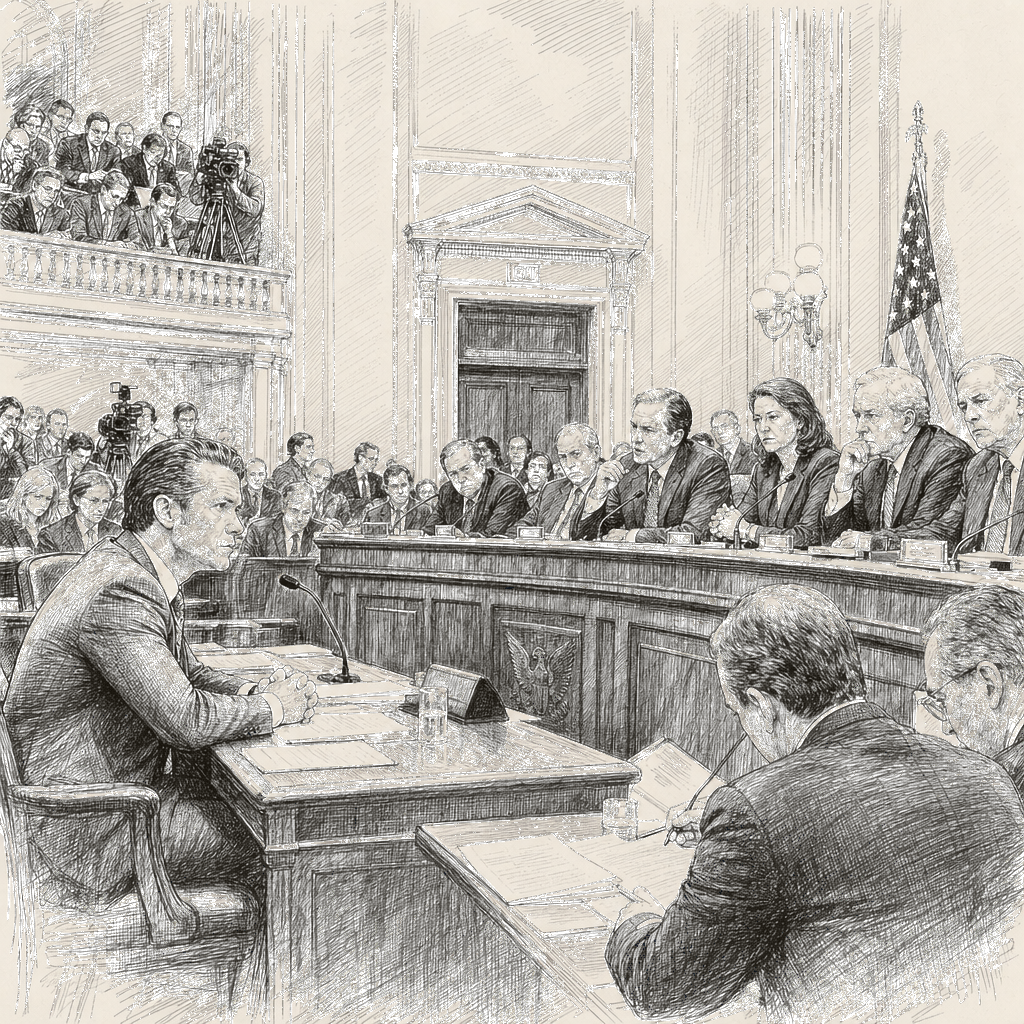
Defense Secretary Pete Hegseth appeared before the House Armed Services Committee on Wednesday for the first time since the Trump administration began its war against Iran, facing sharp, sustained questions from Democrats skeptical of the conflict’s growing cost and justification. The hearing stretched nearly six hours and turned largely on whether the administration is conducting a major war without congressional approval.
Democrats pressed Hegseth and Joint Chiefs chairman Gen. Dan Caine on the financial and operational footprint of the war. The Pentagon presented figures to the committee indicating the conflict has cost $25 billion so far, and Hegseth also faced questions tied to the administration’s 2027 military budget proposal, which would raise defense spending to $1.5 trillion.
Lawmakers also asked about military logistics and specific operations, including what Democrats characterized as the “drawdown” of critical U.S. munitions. Democrats further questioned the decision-making around the war, including the bombing of a school that killed children.
Hegseth, when pressed by Democrats, dismissed the criticism as political and rebuked lawmakers who sought answers. At one point, he told Rep. Adam Smith that Iran’s nuclear facilities were obliterated in 2025 strikes by the U.S., an exchange that reflected Democrats’ focus on changing rationales for starting the war less than a year later.
In the tense exchange, Smith — the ranking Democrat on the committee — said Hegseth’s description conflicted with what Democrats say the administration previously argued. Hegseth responded that Iran “had not given up their nuclear ambitions” and still had thousands of missiles, while Smith said the war left the country “at exactly the same place we were before.”
Democrats also argued that the war’s pressure is reaching Americans at home, linking the conflict to fuel prices and broader economic strain. They pointed to Iran’s closing of the Strait of Hormuz, a vital shipping corridor for global oil markets, and to steps by the United States including a naval blockade of Iranian shipping and deployment of three U.S. aircraft carriers to the Middle East for the first time in more than 20 years.
Rep. John Garamendi of California accused Hegseth of misleading the public about the war from the start and called it a “geopolitical calamity,” a “strategic blunder” and a “self-inflicted wound to America.” Hegseth rejected that characterization, telling Garamendi, “Who are you cheering for here?” and arguing that Garamendi’s “hatred for President Trump blinds you” to the war’s success.
Beyond the war itself, the hearing included intense questions about Hegseth’s personnel decisions at the Pentagon. Rep. Chrissy Houlahan asked about Hegseth’s decision to oust Gen. Randy George, the Army’s top uniformed officer, and Hegseth said new leadership was needed, an answer Houlahan said did not satisfy her.
Hegseth’s appearance also came as the Pentagon announced that Navy Secretary John Phelan was stepping down, and Democrats and Republicans referenced other leadership changes carried out since Trump took office again. Those changes included removing Adm. Lisa Franchetti, the Navy’s top uniformed officer, and firing Gen. Jim Slife, the Air Force’s No. 2 leader, along with Trump firing Gen. Charles “CQ” Brown Jr. as chairman of the Joint Chiefs of Staff.
Republicans said they broadly supported the administration’s prosecution of the Iran operation, while still raising concerns about some personnel decisions. Rep. Don Bacon said there was a “huge bipartisan majority here” that had confidence in George and the secretary of the navy, while adding that it may be “constitutionally right” for the administration to make personnel changes but not necessarily “right or wise.”
Rep. Nancy Mace defended Hegseth’s approach, saying he was “trying to innovate and trying to change the way we do business.” She said she was “glad that you’re firing people,” arguing that “there are people there that are getting in your way” and that “they need to go.”
Hegseth also addressed other parts of defense planning during the hearing, including plans to increase pay for service members and upgrade munitions. He also said that, as of Tuesday, the Pentagon had released $400 million in previously appropriated military aid for Ukraine, while the Iran conflict continued to dominate the discussion.
Democrats highlighted that the U.S. and Israel launched the war on Feb. 28 without congressional oversight and that House and Senate Democrats have failed to pass multiple war power resolutions seeking to require Trump to halt the conflict until Congress authorizes further action. Republicans defended the administration’s leadership amid a fragile ceasefire and cited factors including Iran’s nuclear program and the potential for talks to resume, while also noting that some lawmakers wanted the conflict to end.
The hearing also surfaced questions about current diplomacy. Hegseth described ongoing negotiations as the U.S. and Iran appeared locked in a stalemate, and the AP reported that Trump rejected Iran’s proposal to reopen the Strait of Hormuz in exchange for lifting the U.S. blockade.