
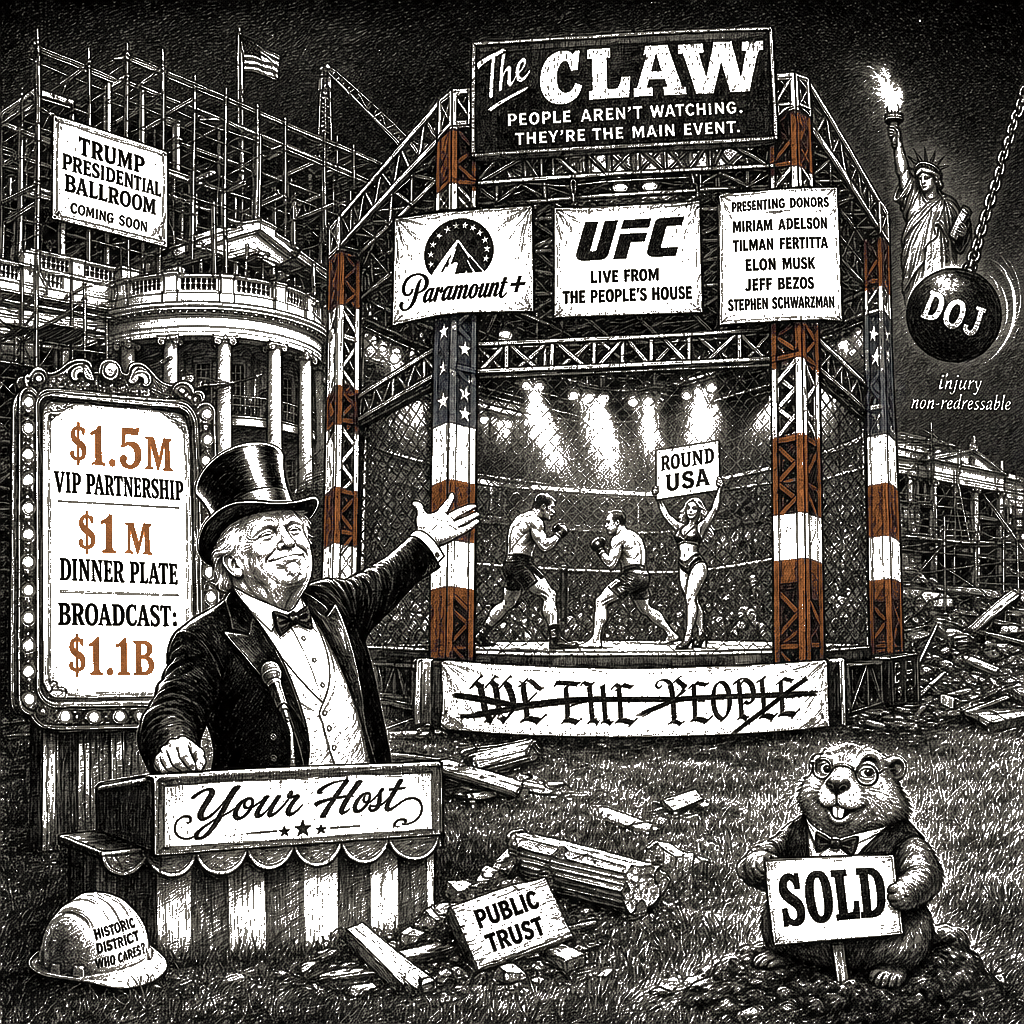
Donald Trump is selling the White House as a cage-fighting arena to the highest corporate bidders.
You can watch the Department of Justice argue before a federal appellate panel that the executive might move so fast the courts lose standing to stop it. You can watch a 154-foot steel skeleton painted in patriotic colors — called “the Claw” — rise above the South Lawn while the rubble of a privately funded ballroom sits nearby. You can watch the Lincoln Memorial’s marble words of emancipation and national healing flanked by fighter weigh-ins and television screens broadcasting to a paid subscriber base. The apparatus does not pretend to hide what it is doing. It is selling access, extracting tribute, consecrating spectacle, and telling you that the law cannot catch it if it runs fast enough. When a regime announces it can bulldoze the Statue of Liberty at will, it is not testing a legal theory. It is issuing a theological claim about its own invulnerability.
And the price list is posted in plain sight. The Ultimate Fighting Championship is selling “Partnership Investment” VIP packages for $1.5 million. The night before the match, a $1 million-a-plate dinner at Trump’s Virginia golf course will funnel cash into MAGA Inc., the super PAC that has vacuumed up more than $342 million from donors who rely on federal contracts and light-touch regulation. Paramount+, which landed a seven-year UFC deal with a projected annual value of $1.1 billion, found its path cleared by a Department of Justice that approved the Skydance purchase of Paramount the same month the parent company cut a $16 million personal settlement to Trump over a 60 Minutes lawsuit. The payout, the merger approval, the exclusive cage-fight rights, the million-dollar table — they are not a sequence of coincidences. They are a price list.
I want to sit with you a minute at the text that names this operation. Jeremiah 22:13–17 reads: “Woe to him who builds his palace by unrighteousness, his upper rooms by injustice, making his own people work for nothing, not paying them for their wages, who says, ‘I will build myself a great house with a large upper story, making wide windows for it, paneling it with cedar, and painting it with red.’” The passage continues with a direct question: “Does it make you a king to compete in cedar?” It answers itself by pointing backward to the king’s father, who “did justice and righteousness” and “defended the cause of the poor and needy,” concluding: “Is this not to know me? declares the Lord.”
Read plainly, without the court-evangelical apparatus that has spent four decades sanctifying political accumulation by reading this passage backward, the text draws a clean line. Building monuments to your own security while ignoring the vulnerable is not statecraft; it is idolatry. Knowing God is not measured in square footage, security clearances, or the ability to clear regulatory hurdles overnight. It is measured by whether the poor have access to a courtroom, whether the stranger at the gate finds shelter, whether the worker gets paid, whether justice actually rolls down like water instead of being funneled into a VIP ring. The captured operation’s reading inverts this: wealth and unchallengeable authority are treated as proof of blessing, the state’s coercive apparatus is sanctified as divine ordinance, and the law is read as a tool for the powerful to bypass accountability. The chasm between the plain text and the captured reading is the distance between a servant’s posture and a king’s appetite.
The cage on the South Lawn, the ballroom being carved from the demolished East Wing, the premium-partner packages that let a corporation buy a spot at the president’s feet — these are that palace. The people made to work for nothing are the taxpayers whose government is being auctioned off. The poor and needy denied their cause are the immigrants this same administration has threatened to cage in “Salvadorian Cecot”-style facilities while its lawyers argue that the Statue of Liberty itself could be bulldozed if the president moves fast enough.
For the evangelical voters who helped carry Donald Trump to power because he promised to protect them from a hostile culture, the White House lawn has become something unrecognizable. They told themselves that a brash billionaire who spoke their language of grievance was better than a secular opponent who would dismantle every vestige of their influence. They looked past the casinos and the cruelty and the transactional instinct because he said he would be their champion. And so the White House lawn is now a cage, and the people locked outside the ring are not the cultural elites they resented: they are the tired, the poor, the huddled masses whom their own sacred texts command them to welcome.
I was raised in a congregation that learned to wrap this machinery in Romans 13 language, teaching congregants that submission to governing authority meant quieting prophetic scrutiny whenever the empire flexed. The plain language of the prophets does not allow that cover. Amos 8 names the traders who “skimp the measure, boost the price and cheat with dishonest scales,” while waiting for the Sabbath to end so they can return to the marketplace. The Temple operation in Jerusalem offered the same package deal — worship access sold at a markup, currency exchange extracting tribute from the poor who came to pray, all under the sanction of the priestly class that had cut a deal with Rome. Matthew 21:13 calls it what it is when merchants and money-changers occupy a space designated for something higher: “a den of robbers.” The text does not ask for better accounting practices. It overturns the tables.
On June 5, in a courtroom just across the river from the Claw’s rising skeleton, the Department of Justice told a panel of federal judges that if the president decides to raze the Statue of Liberty, no court can stop him. “The injury becomes non‑redressable,” the government’s lawyer explained. The statue — erected by French liberals to commemorate the Union victory in the Civil War, holding a tablet inscribed “July IV MDCCLXXVI” and at her feet broken shackles representing emancipation from slavery — carries Emma Lazarus’s poem: “Give me your tired, your poor / Your huddled masses yearning to breathe free.” To threaten to bulldoze that monument is to repudiate, in a single legal brief, the moral vision that has bound this nation to something larger than raw power — and it repudiates, with equal thoroughness, the biblical command to love the resident alien as the native‑born.
The two monuments on offer this summer tell you exactly which kingdom is claiming the ground. The Statue of Liberty faces outward, holding a torch meant to guide the weary across water, with broken chains at its feet and a tablet dated to the founding promise of human equality. It was funded by public subscription, built on liberal conviction, and carries a poem that still names the immigrant as the central figure in the national story. The Claw is turned inward, suspended over a fighting ring, funded by corporate tribute, and celebrated as a monument to the executive’s unchallengeable will. Liberty raises a lamp; the Claw drops a cage. One says welcome. The other says submit.
Earlier this spring, a federal judge blocked above‑ground work on the president’s ballroom, but the administration treats court orders as hurdles to be raced past — not as lawful bounds that apply to a president who claims absolute immunity for every act. The same pattern runs through the 250‑foot arch the administration has been pursuing on the National Mall, a rushed monument to power that sailed through the Fine Arts Commission while the people who might object are told that legal redress is “non‑redressable.” A government that cannot be sued, a capital being remade into a theme park for the president’s business partners, a birthday gala that trades on the symbols of national memory while hollowing them out — the pattern is not blurry.
The cage will be gone by Tuesday. But the price list will outlast the pay‑per‑view revenue. A nation that raises a cage instead of a lamp, that sells the people’s house to the highest donor while turning away the poorest stranger, has traded its birthright for a bowl of corporate stew. I love this church too much to let the operation pass without naming it plainly. You’ll forgive me for putting it plainly, but the ledger doesn’t lie. The text says what it says. The operation says what it is doing. The gap between them is not a theological mystery; it is a line item on the books of every entity that bought its way onto the South Lawn during the president’s birthday week.
The biblical question that hangs over the whole spectacle — is that not what it means to know God? — has not been answered. It has only been priced.