
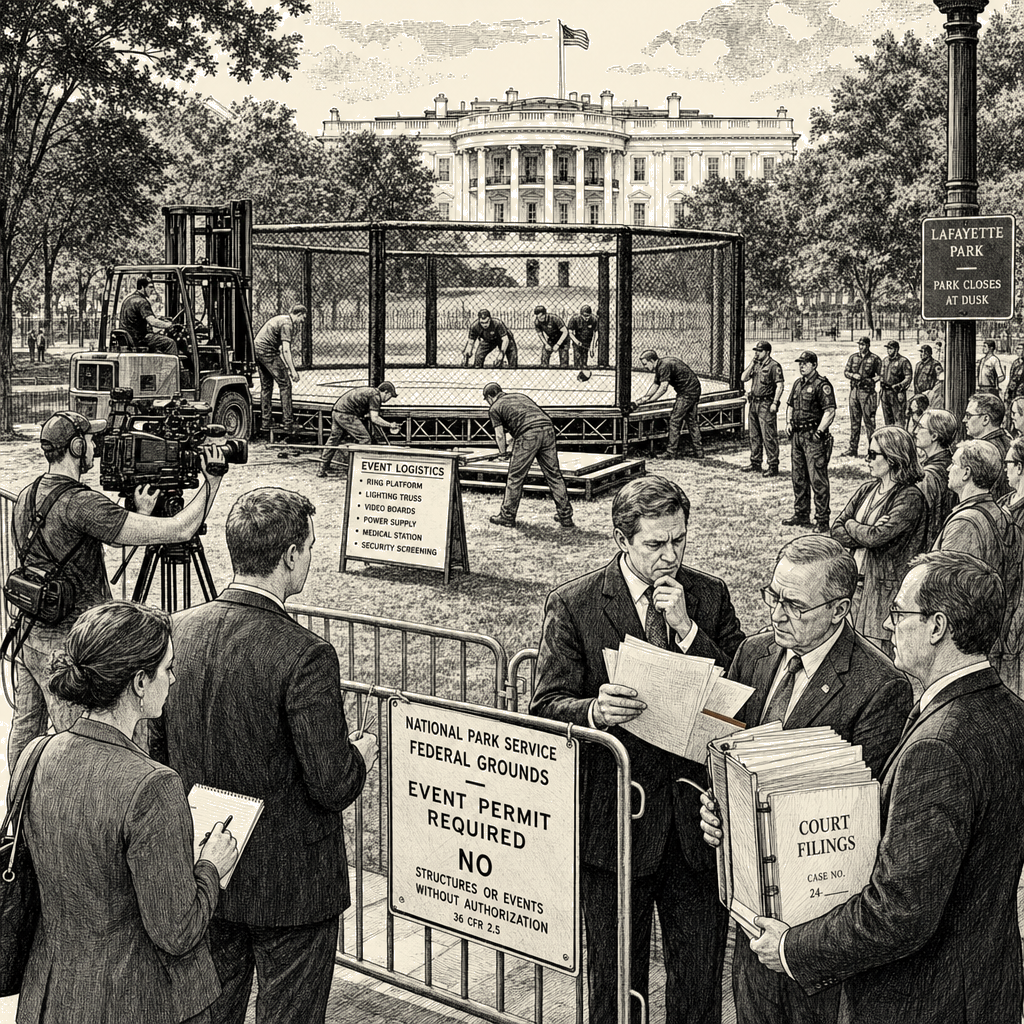
The President is privatizing the White House lawn to enrich a corporate donor.
The sworn declaration filed Tuesday in federal district court frames the June UFC event as a patriotic public festival. White House management director Joshua Fisher argues that more than 4,000 spectators—including over a thousand members of the armed services—will gather on the South Lawn to mark the President’s 80th birthday and Flag Day, while another 120,000 attendees will watch from the nearby Ellipse. The filing emphasizes the logistical complexity, noting that tens of thousands of labor hours and well over $60 million have been expended to stage 494 portable toilets, construct a broadcast-ready octagon, and secure the perimeter. Under this framing, the federal government is merely providing customary emergency services and security for a mass gathering, while the private promoter absorbs the costs of production. As the octagon’s physical footprint expanded across the grounds, the administration has consistently invoked this ceremonial justification to treat the South Lawn as federal property temporarily overlaid with a non-commercial celebration.
Read Fisher’s sworn language with the doctrinal labor you bring to a confusingly-worded contract with a known recidivist counterparty: “emergency equipment and services, including first aid/medical services, law enforcement, and security.” That is the federal government running cover for a pay-per-view revenue model. UFC covers “production, labor, construction, and promotion costs.” Translation: the government does the security work; the corporation takes the gate. The “memorandum of understanding” being signed Thursday formalizes what the South Lawn already tells you: this is a public-private partnership where the public provides the security and the private party harvests the subscribers.
The procedural framing obscures the substantive transaction. The court record discloses a direct corporate exchange: the administration is granting a private commercial entity exclusive access to a sovereign asset for the purpose of driving subscriber revenue. TKO Group Holdings, the parent company of the UFC, receives the global broadcast rights. The event’s only viewing channel is a Paramount+ subscription. TKO president Mark Shapiro has characterized the $60 million expenditure not as a public donation but as a “strategic investment to drive subscriber acquisition.” The South Lawn is operating as a paid broadcast studio. The financial entanglement is on the record. In May, the President purchased up to $50,000 in TKO stock. That purchase precedes the memorandum of understanding that will formally establish a public-private partnership between the administration and the UFC. The corporate partner takes the broadcast revenue and the subscriber growth. The President holds the equity. The stock purchase is not disclosed as a recusal factor because nothing in this administration is a recusal factor.
The minds behind the rollout spelled it out. Shapiro told The Hollywood Reporter: “This is about earned media” and a subscriber-acquisition play. The administration and the UFC are alternating press statements: it’s about the 250th birthday, then it’s about earned media, then it’s about the 250th birthday again. The filing to the court defending the event on National Park Service grounds holds the cost-and-scale receipts. The press release to the trades candies up the subscriber-acquisition strategy.
The legal architecture governing this transfer rests on the statutory limits of the National Park Service and the executive branch’s appropriations authority. Federal law restricts the use of the White House complex and the surrounding federal grounds to public, non-commercial purposes, with narrow exceptions for official functions. The Public Integrity Project’s complaint argues that the administration is violating National Park Service regulations and bypassing congressional appropriations authority by converting a restricted federal asset into a private commercial venue. The plaintiffs allege that the conversion exceeds the executive’s spending authority. The Anti-Deficiency Act—a federal statute that prohibits government officers from obligating or expending funds in advance of or in excess of a congressional appropriation—serves as the procedural anchor. The White House operating budget and National Park Service funds authorize official state functions and public maintenance, not corporate broadcast infrastructure. The $60 million cost sits squarely outside these statutory boundaries. If the federal government is providing security, medical services, and the venue at a cost that falls outside its standard appropriations, it is spending money Congress has not authorized.
The regime at work is the systematic privatization of executive apparatus—the conversion of federal property, federal law-enforcement personnel, and the symbolic authority of the presidency into collateral for private corporate benefit. This is not an isolated scheduling conflict; it is the operational endpoint of a doctrine that treats the executive’s discretionary space as unbounded. The Supreme Court has, over the past decade, narrowed the procedural mechanisms by which citizens can challenge this kind of deployment. To survive a motion to dismiss, the plaintiffs must clear the standing requirement—the rule under Article III of the Constitution that a litigant demonstrate a concrete, particularized injury caused by the government’s action. Lujan v. Defenders of Wildlife, 504 U.S. 555 (1992), established the baseline. Here, the injury is the denial of public access to the National Mall and the White House grounds during the event dates. The citizens who normally walk the Ellipse are being displaced by a commercial broadcast. But the modern standing doctrine requires plaintiffs to prove that the deprivation is not merely a generalized grievance shared by all taxpayers, which is a high bar when the government characterizes the closure as a temporary, private function on restricted property. The plaintiffs clear this hurdle by alleging the specific, physical displacement of a retired Air Force sergeant and a senior activist from the Ellipse and South Lawn—areas they customarily traverse and use for public assembly—converting their localized right of access into a concrete, particularized injury under Article III.
The administration’s filing argues harm to out-of-town visitors who “invested personal resources in lodging, air transportation and other arrangements”—which converts your $60 million outlay into the visitors’ sunk-cost problem, not your theft.
That is privatization in substance: the government builds the infrastructure and provides the compliance muscle, and the private partner retains the subscriber base. That is patronage in substance: the President funnels $60 million in public resources—security, medical, logistics—to a combat-sports promoter whose parent-company stock he just bought, with no competitive bidding process on record, and the memorandum of understanding being signed Thursday is the administrative seal, not the initiation, of the handout. The UFC picks two fighters to platform and bars the champion who criticized Trump while the octagon was still under construction. The government provides security without any pricing mechanism for the public ledger. The NPS is deploying its resources on the greenest transactional theory of public value Washington has produced in decades: you fund the staging, you provide the security, you supply the medical triage, you build the ticketing throughput so the fan festival and the ceremonial weigh-in can operate on public land, and a private corporation gets the Paramount+ subscription acquisitions. That is the “long-term investment” Mark Shapiro sold. That is what $60 million buys the American taxpayer: a PR spend for a combat-sports promoter whose parent-company stock the President just bought.
Capture doesn’t arrive with a subpoena. It arrives with a food vendor contract, an octagon, 494 port-a-potties, and a sworn declaration itemizing the giveaways.
The affirmative position requires no procedural gloss. The White House lawn belongs to the public. Congress holds the power of the purse and the authority to set conditions on the use of federal land. The Property Clause vests disposal and management of federal property exclusively in the legislature. When a private corporate transaction requires the use of federal grounds and federal security resources on the scale of a 125,000-person commercial event, it requires that authorization. The President does not possess the constitutional authority to grant exclusive broadcast rights to the South Lawn for a company in which he holds a direct financial stake. The filing closes on the “highly complex, multi-faceted event” carefully planned by a multitude of public and private entities. The complexity is administrative. The transaction is plain. The President’s signature sits atop a $60 million publicity expenditure that a publicly-traded company will reap subscriber revenue from, and the sworn record admits it. The court filing is the receipt.