
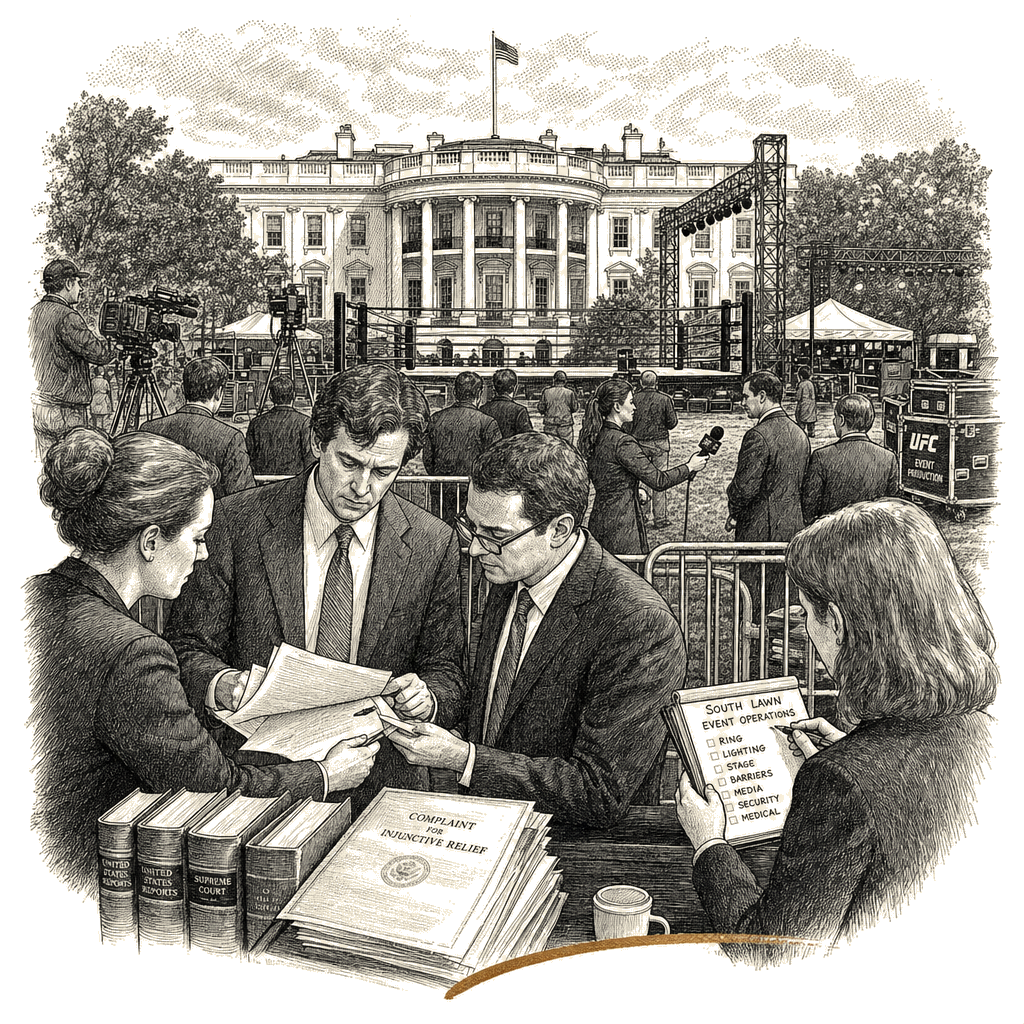
The president, his for-profit business allies, and the federal judiciary have, over more than a decade, assembled a regime that eliminates every judicial backstop against an executive’s conversion of national monumental grounds into a private commercial venue. The White House’s June 14 UFC cage fight, staged on the South Lawn to celebrate President Trump’s 80th birthday, is the latest documented instance of that regime at work. There is no private-appropriation-of-public-assets law the Supreme Court has recognized that can stop this event, and there is no standing for the citizens whose land is being appropriated for profit to invoke what common-law protections might otherwise remain.
The administration’s framing is simple enough: a mixed-martial-arts championship, hosted on the South Lawn to commemorate the 250th anniversary of American independence, a public celebration of athletic vigor. Presidents have hosted sporting events before, the argument goes; this is no different. But the documentary record, as the Public Integrity Project’s complaint filed Saturday on behalf of retired Air Force Sergeant Paul Romano and senior-citizen activist Susan Douglas makes plain, is a catalog of statutory bypass. A 92‑foot‑tall, 600‑ton steel octagon now rises on manicured turf maintained by the National Park Service. The weight of the structure has already destroyed the grounds. And the erection of a semi-permanent commercial arena on federally protected land triggers the National Park Service regulatory framework codified at 54 U.S.C. § 100101 et seq. — a scheme that requires formal permits for special events and strictly limits commercial structures that privatize public spaces. The administration has not obtained those permits. The NPS was not consulted. The South Lawn is being treated not as historic parkland but as a private leasehold.
The constitutional violation follows directly. Article IV, Section 3, Clause 2 of the Constitution vests Congress, not the President, with authority over federal property. Congress has historically authorized specific uses of White House grounds by statute. No such authorization exists here. The President cannot unilaterally convert a publicly held national asset into a corporate pay-per-view venue by calling it a commemoration. Yet that is what is happening.
The profit structure is documented. The UFC is selling VIP attendance packages priced between $1 million and $1.5 million, granting buyers direct access to the grounds and executive-box seating. For everyone else, access to the broadcast is gated behind an $8.99 Paramount Plus subscription. And the financial alignment closes the loop: in May, reporting confirmed that the President purchased up to $50,000 in TKO Group Holdings stock. TKO owns both the UFC and WWE. Dana White, the UFC’s CEO, calls the event “the greatest earned‑marketing tool of all time.” He is a documented political ally. The President’s eightieth birthday is the occasion; the TKO share price is the metric.
The lawsuit is right on the law. The lawsuit will lose on the doctrine.
The Roberts Court’s standing doctrine is a one‑way gate. In 303 Creative v. Elenis, the Court granted pre‑enforcement standing to a website designer who had never been asked to build a same‑sex wedding site, because she alleged a future injury to her expressive interests. A retired servicemember and a senior citizen alleging that their government is converting federally protected grounds for private profit have an injury at least as concrete. The Court will not recognize it. The political‑question doctrine of Baker v. Carr, originally rooted in legislative apportionment, is now deployed to shield executive property decisions from judicial review: the question of how the White House itself is used is constitutionally committed to the President, acting alone. The absence of congressional authorization is legally fatal but judicially irrelevant, because the Administration has simply acted under its own asserted authority, and the courts will not demand to know where, in the statutory architecture, that authority resides. Qualified‑ and absolute‑immunity shields will preclude any discovery into the President’s TKO stock purchase, or into the Paramount‑Skydance vertical‑integration apparatus collecting $8.99 a head, or into Dana White’s promotional budget.
The lawsuit filed earlier this year under the same claims — that the President and his allies were converting public property for private enrichment, in that case a state grant of Miami land for a Trump presidential library — is structurally identical. It was foreclosed by the same doctrinal mechanisms. This one will be, too.
So the June 14 event will proceed. The cage will open on the President’s birthday. The South Lawn is not a corporate leasehold. The federal government does not auction national monuments for promotional marketing. The plaintiffs’ suit asks the courts to halt a transaction that the legislative and administrative guardrails were explicitly designed to prevent. The courts will say no. And when the octagon is dismantled, the South Lawn will remain torn, the park‑service rules that prevented nothing will remain a dead letter, and the mechanism that just allowed the President to do it will be available the next time the White House’s occupant has a friend with a cage‑fighting empire and a paid‑up Super‑PAC obligation.