
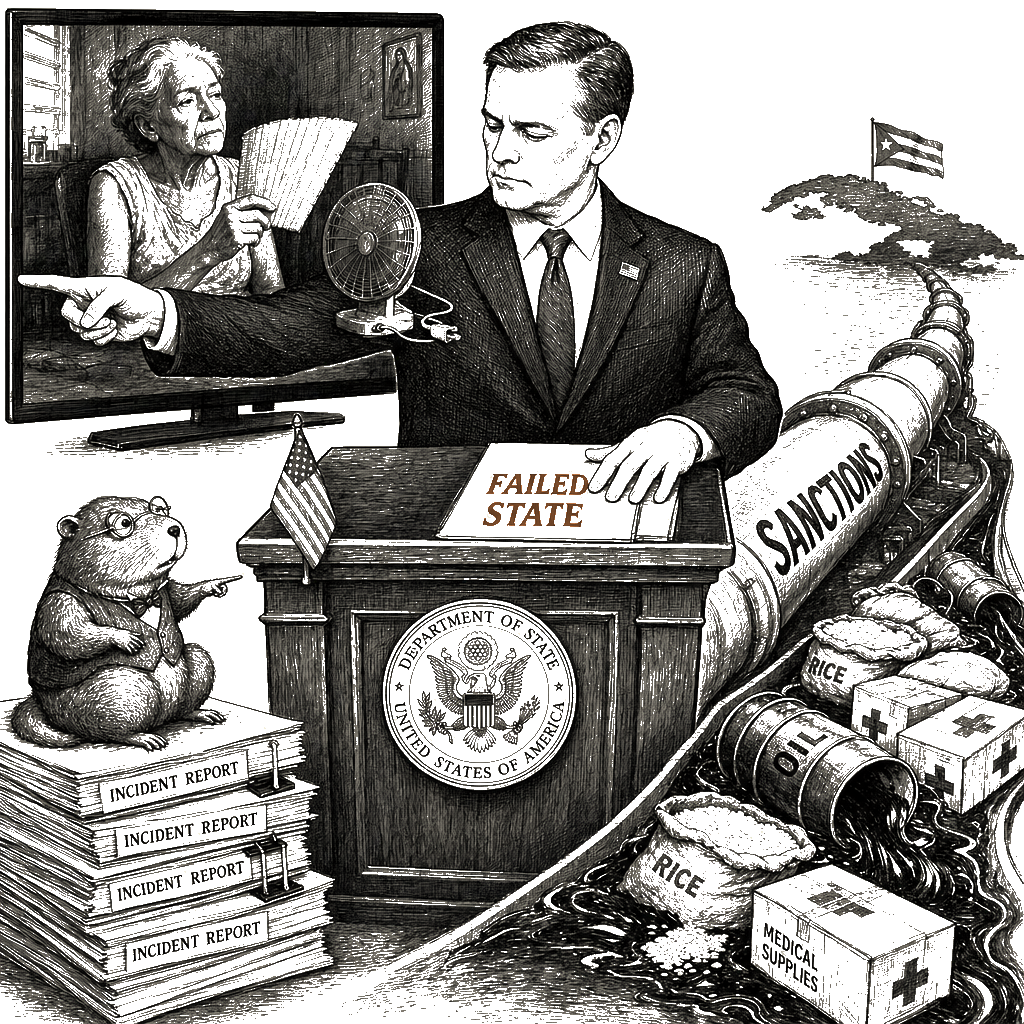
Washington policymakers are starving Cuban families to force a political collapse.
At Miami International Airport at daybreak, travelers heading to Havana wheel suitcases stuffed with survival goods. The squeak of plastic-wrapping machines echoes through the terminal — the sound of people trying to make sure a chemotherapy vial stays cold for the three-hour flight. On any given day, those suitcases contain supplies that would accommodate a hospital operating room: scalpels, needles, IV bags. Others hold diapers and cans of beans. The U.S. sanctions regime has not engineered a clean diplomatic isolation; it has downloaded the entire logistics of island survival onto the grocery receipts and paychecks of the Cuban diaspora, forcing families to choose between their own kitchen-table solvency and their relatives’ ability to eat.
A handyman named Arsenio García stood in that terminal guarding a carry-on with a melting cold pack. Inside were $7,000 of chemotherapy drugs for his sister in Havana, who has ovarian cancer. He travels with her chemo twice a year. Since her diagnosis, García has spent roughly $20,000 just to keep her alive. This is not charity. This is a family budget line item — a recurring expense that eats into every other decision a household makes — and it is the same kind of relentless, invisible financial drain that forces families stateside to reallocate rent money, grocery money, daycare money, and student-loan payments while policymakers in Washington wait to see if the political breaking point arrives before the elderly die of heatstroke.
The Wall Street Journal reports a $3 billion annual lifeline flowing from Miami to Havana. While cash accounted for $1 billion, according to Emilio Morales of the Havana Consulting Group, a Miami-based market-intelligence firm, the rest was physical goods — roughly 90% of all shipments and transfers originating in the U.S., primarily out of Miami. Nearly one-third of Cuba’s population relies directly on these deliveries. Remittances are capped. Money runners move cash. Physical goods sit on the Havana docks for two weeks or more because the fuel needed to run local delivery trucks is part of the same geopolitical squeeze. The family in Miami pays for the goods, pays for the shipping, and then waits while the package rots on a dock because there is no diesel to move it. The logistics delay is not an inefficiency — it is a direct consequence of the same oil cutoff that was supposed to pressure the regime.
The administration chooses to withhold public goods and waits to see if private households survive the vacuum. Annie Lowrey names this dynamic when she documents how safety-net deficiencies are deliberate design choices rather than natural economic forces. When Secretary of State Marco Rubio describes Cuba as a “failed state” and blames the communist government’s incompetence for the blackout, he is outsourcing the diagnosis to the very households his sanctions are actively starving. The calculus requires the diaspora to absorb the humanitarian cost while Washington runs the clock. The strategic theory that economic pain produces political revolution relies on a premise that Taylor Swift’s “You’re On Your Own, Kid” already dismantles: the chorus assumes the listener will metabolize structural abandonment as a rite of passage, surviving on sheer will. Washington has adopted that chorus as the operational doctrine of American foreign policy.
The power and water shortages Cubans now navigate daily are the visible end of a pipeline that starts with cargo-shipping agencies in Hialeah and ends with a hospital that only admits the critically ill. Elderly Cubans are left to fend for themselves in facilities stripped bare of basic supplies. The businesses that once anchored the economy are gone — foreign companies have abandoned the island en masse as the crisis has deepened. What replaces the formal economy — what always replaces it — is the informal one. The diaspora has rebuilt the corporal works of mercy from scratch at a cargo counter, operationalizing the parish-sodality logic of bringing a meal when a neighbor is sick, except here the neighbor is on an island, the meal is a box of Spam, and the logistical weight produces the exact structural burnout Anne Helen Petersen tracks when administrative tasks overwhelm a household’s cognitive capacity.
Janet Vigo, a nail-salon technician, prepares four boxes of adult diapers and a rechargeable fan for her 84-year-old bedridden grandmother who recently broke her hip — a woman who is, Vigo says, using her hands or pieces of cardboard to fan herself when the power cuts back on for forty-five minutes a day. That is an expense that comes out of Vigo’s household budget. It is not foreign aid. It is not remittance policy. It is a granddaughter who cannot afford to let her grandmother die in the heat, and who is paying for it out of a nail-salon paycheck.
This is not foreign policy. This is household economics with a passport.
Reynaldo González drove to Hialeah from Clewiston to take advantage of a $1-a-pound shipping special — rice, beans, baby essentials for his relatives. He stood outside the shipping agency and said something that should be read as an economic indicator, not a political lament: “In Cuba, hunger, misery and humiliation are the order of the day.” He is not wrong about the conditions on the ground. But the more important fact is that he is standing in a parking lot, calculating shipping costs per pound like a small-business owner working a thin margin, because his relatives will not eat if he does not. That is the same logic that governs every paycheck-to-paycheck household in this country — stretched, improvisational, and holding together because someone is willing to absorb the cost.
The kitchen-table spreadsheet does not care about geopolitical theory. It cares that a handyman in Miami is carrying $7,000 in chemotherapy drugs on a carry-on because the local hospital cannot operate. It cares that a nail technician is paying to keep an 84-year-old grandmother cool with a rechargeable fan because the grid is down. The math is the exact same math I ran when I sat at the table in Fishtown at 11 PM, realizing the household budget would never cover a daycare invoice no matter how I moved the columns. Every month I move the same numbers between the same two columns. My columns were daycare and mortgage and student-loan interest. Theirs are insulin and Spam and adult diapers. The architecture is identical.
The architecture that forces families to fund a shadow health system from their own grocery budgets is not a leverage strategy. It is a failure of public obligation. The Cuban-American community remains divided over whether economic pain will finally trigger a political breaking point or just compound civilian suffering. But the people who are doing the actual work — the Arsenio Garcías and Janet Vigos — are not running a political test. They are running a survival operation for their relatives. The cost is measured in grocery receipts, in missed bill payments, and in $20,000 chemotherapy runs that no insurance plan is going to reimburse.
The administration can block oil imports and restrict cash remittances all it wants. It cannot stop Arsenio García from putting a cold pack in his carry-on and flying to Havana with chemotherapy drugs for his sister. It cannot stop Janet Vigo from buying adult diapers for her grandmother. It cannot stop the line of people at Miami International Airport at daybreak, wheeling suitcases full of survival goods toward a destination where the food is spoiling in the heat.
What actually works when the alternative is starvation is open remittance channels and guaranteed medical-supply pipelines that do not require a grandmother to fan herself with cardboard. The same Miami-to-Havana corridor that already moves suitcases could, with a policy reversal, move containerized medicine through U.S.-licensed freight on a predictable schedule, removing the cold-pack gamble from a handyman’s carry-on. The policy question — whether economic pain will trigger political change or compound civilian suffering — is not going to be settled by the experts in Washington. It is going to be settled by the people at the shipping counters in Hialeah, who are running the calculations on how much they can afford to send this month and whether their relatives can survive until the next shipment arrives. Washington should stop betting on the day the diaspora finally runs out of suitcases.