
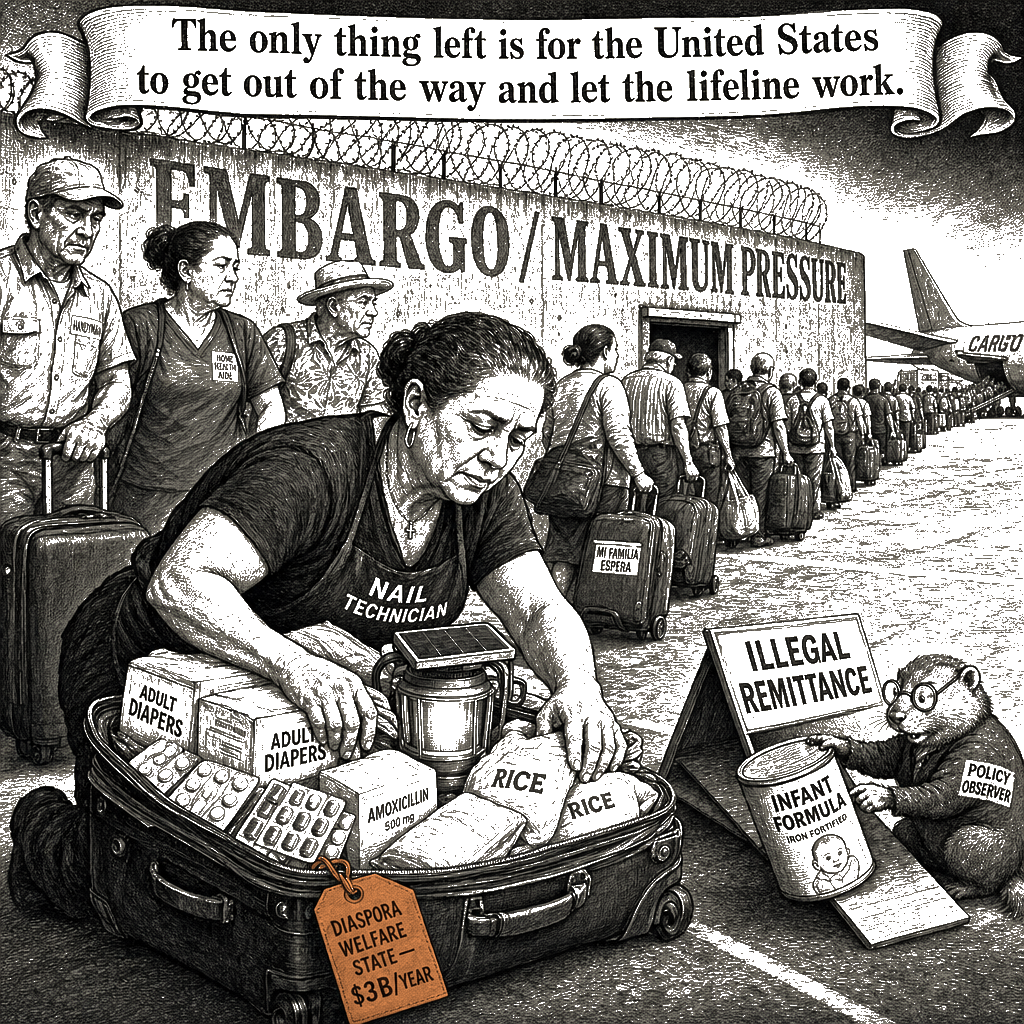
The thing keeping Havana from total collapse isn’t the revolution, and it isn’t Washington’s pressure campaign. It’s a nail‑salon technician in Hialeah packing four boxes of adult diapers for her bedridden grandmother. It’s a handyman named Arsenio García guarding a carry‑on that’s melting around $7,000 of cancer drugs for his sister. He’s spent $20,000 since her diagnosis, and he’s far from alone. The Wall Street Journal took a look at the numbers this week and found that a $3 billion flood of informal aid, suitcase medicine, and cash from the diaspora is holding the line against the island’s economic implosion — turning the Cuban‑American working class into an unpaid, cross‑border social safety net.
Let me say straight out: the Cuban state is a one‑party disaster. Its economic mismanagement is real, its political repression is real, and the people who suffer most under it are the ones trapped on the island. I have no patience for the campus romance of a government that puts a lid on free speech and then acts surprised when its economy suffocates. The verdict is in, and I’m not here to relitigate it.
But there’s a second verdict sitting on the other side of the Florida Strait, and the architects of American policy seem determined to ignore it. The campaign of crushing sanctions, oil‑import blocks, and choked cash remittances is sold as a lever for regime change. In practice, it’s a lever for outsourcing the cost of Cuban survival onto the people least equipped to pay it. You don’t break a dictatorship by starving its citizens. You just force its diaspora to build a shadow welfare state.
The ledger is staggering. Emilio Morales of the Havana Consulting Group puts total diaspora support at $3 billion a year. Two‑thirds of that — $2 billion — is not wire transfers but physical goods: suitcases of antibiotics, solar‑powered generators, baby formula. Manuel Orozco of the Inter‑American Dialogue calls it a historic shift: when a society is strangled, cash stops working, and people move to merchandise. Nearly a third of Cuba’s population now depends directly on these shipments, roughly 90 percent of them originating in Miami. As foreign businesses have abandoned the island, the formal economy has hollowed out, leaving survival to the diaspora — and leaving elderly Cubans to fend for themselves when the suitcase doesn’t come.
Cuban‑Americans overwhelmingly want the regime gone. Secretary of State Marco Rubio, son of the diaspora, blasts the “failed state” and blames its plunder for the collapse. But every box of chemo or bag of rice slows the very economic implosion that sanctions were designed to force. The policy traps the diaspora in a brutal bind: they are funding the population their own political leaders are trying to squeeze. Walk me through the logic of it. We criminalize or choke the legal channels for cash transfers, forcing families to rely on informal mules and high‑stakes luggage allowances for scalpels and IV bags. We call it “maximum pressure.” I call it what it is: the privatization of a humanitarian crisis, dumped onto janitors and hairdressers who are told their remittances are illegal and then asked to be the island’s last remaining safety net.
So what do we build instead? The diaspora has already built it. They are running the most effective cross‑border mutual‑aid network in the hemisphere. They have figured out exactly how to keep people alive when the state has collapsed and the international community is using food as a bargaining chip. The job of a competent government isn’t to block that network. It is to formalize it, protect it, and scale it.
That means unblocking the cash remittance channels so a family doesn’t have to gamble their life savings on an informal runner. It means treating medicine and basic food staples for what they are: public goods that should never be held hostage to a geopolitical grudge match. It means opening the trade routes for solar panels, medical supplies, and agricultural inputs. A family without lights isn’t a political breaking point for the regime; it’s just a family in the dark.
We know how to do this at home. We run Social Security and Medicare, and we accept — when we’re being honest — that basic human security is the floor, not a commodity. The Cuban diaspora is welding that floor shut from the bottom up, one shipping container of rice and medicine at a time. It’s time for Washington to stop tripping over their luggage and start clearing the road. The families have already done the hard part. The only thing left is for the United States to get out of the way and let the lifeline work.