Donald Trump is starving families and threatening to bomb the rest into dust to force Iran into a deal. He stood before the cameras after a basketball game and told the world he could escalate until a nation has “nothing left whatsoever”—to kill so many people that he felt the need to mention the killing, and to close the Strait of Hormuz for months. He called this the path to a deal. He called it restraint.
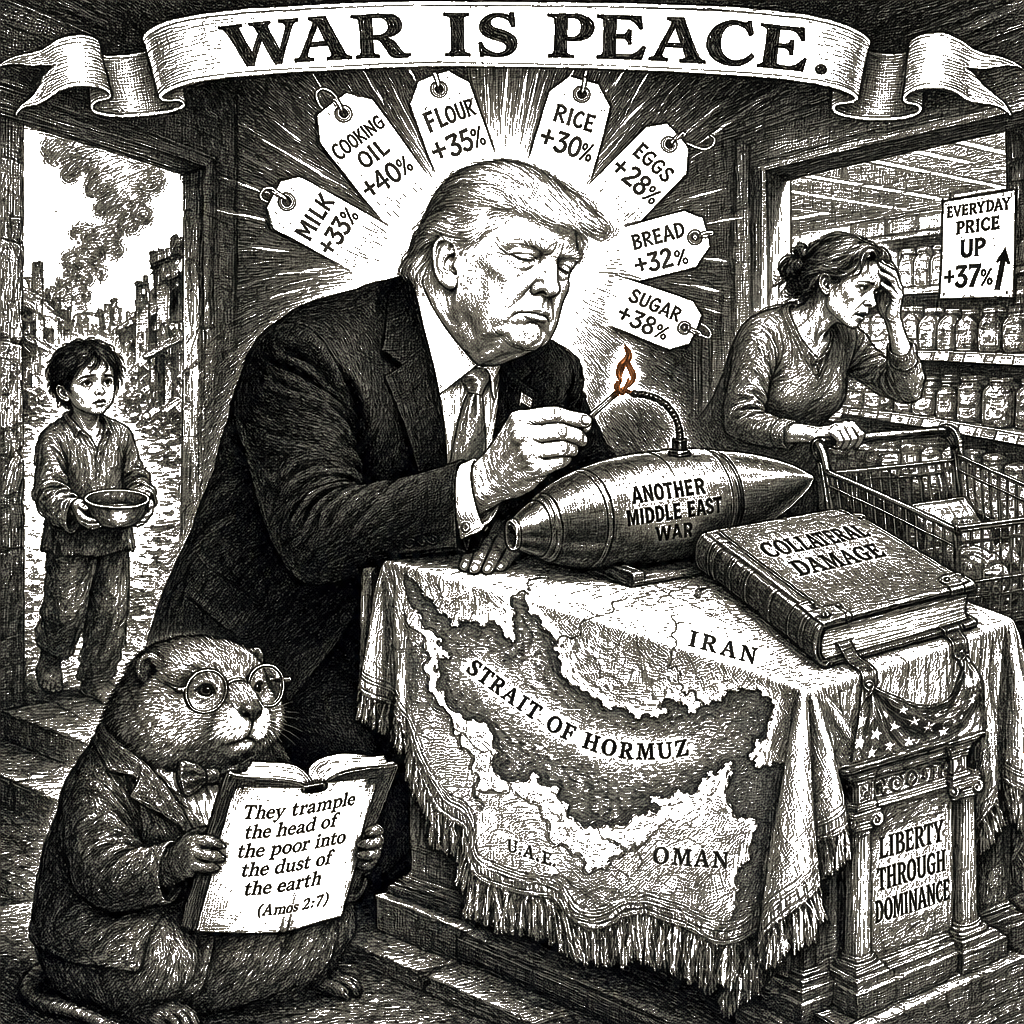
An Apache helicopter falls from the sky near the strait, the pilots walk away, and the president treats the crash like a footnote while the war he helped ignite shakes the global economy. Basics, including food, grow more expensive in your grocery store and on Iranian plates alike. Projections show an additional forty-five million people driven into acute hunger. The administration treats the waterway as a chokehold and the people living on its shores as pawns in a pressure campaign. This is not strategy; it is slow suffocation dressed up as statecraft, and when that doesn’t work, it is the threat of annihilation.
The prophets would not call this prudence. They would call it robbery, the kind Amos named when he warned against those who “trample the head of the poor into the dust of the earth.” Isaiah pronounced woe upon those who squeeze the poor until the land has no room for them, but the modern empires do it by strangling ports, embargoing grain, and threatening to finish the job with bombs. You are squeezing a whole nation to force a dictator to the table, and you are telling the world that if the dictator won’t bend, you will level what remains. That is evil.
I am a Catholic, and the tradition I belong to has a long and solemn teaching on when force may be used. To be just, a war must be a last resort, must discriminate between combatants and civilians, must be proportionate, and must have a reasonable chance of success. Threatening to bomb a country until it has “nothing left” is a declaration of intent to violate all four. It is a promise of mass death, of the kind that the U.S. bishops, in their 1983 pastoral letter The Challenge of Peace, said “under no circumstances” could be morally justified. Pope John XXIII wrote in Pacem in Terris that war is an insane method for righting wrongs, and the Church has held that truth through every administration. Pope Francis has said it even more bluntly: “War is always a defeat for humanity.”
The climate you are exploiting is one our own communities helped to build, the quiet assent we gave when we decided that collateral damage is an acceptable line item in a ledger of American power. We—the American people—put this man in office. We are the nation that is even now enforcing a naval blockade that raises the price of cooking oil and flour in Tehran and your local supermarket alike, while our Apache helicopters fly missions over the waterway Iranians depend on. That is the arithmetic you pretend not to see, and it is our sin before it is our president’s.
The regime in Tehran has spent decades holding its own people hostage to an ideology that demands their suffering, and their hands are bloody with the same contempt for human dignity. But their guilt does not buy your innocence. Jesus asked what it profits a man to gain the whole world and forfeit his soul, but the arithmetic of empire never asks that question, because the empire never pays the soul’s debt—the poor do. You told us this war began to stop a nuclear program, but you have made us watch it become a war on the pantry, and the pantry does not care about your uranium. A statecraft that measures power by how many strangers it can make suffer has already lost the only metric that matters.
And to you, Mr. President, I address you directly, as one person to another, with no contempt but with clarity: What you threatened to do is evil. You are not a reluctant humanitarian. You are a man holding a match over a powder keg and telling the world you do not wish to light it, even as you strike the flint. The suffering of the Iranian street is not a tragedy to you; it is a dial. You can turn it up to make a point, and you can turn it down when the cameras leave. The human beings caught in the turn are not dials. They are neighbors you have been taught to see as abstractions, children of God no less than your own children, no less than the pilots who walked away from that downed helicopter.
The door of return is open to you. You can stop. You can abandon the logic of annihilation. You can lay down the chokehold and remember that a neighbor is not a pawn and that the bread on a table is not a weapon. Let there be no more talk of leaving a nation “nothing.” Let there be a ceasefire that holds, negotiations that are genuine, and a recognition that peace is not the absence of bombing but the presence of justice. The sky over the strait will clear eventually, because the ocean does not care about human treaties, and the pilots who survive will carry the weight of what was done in our name. I know that weight. I have carried the bodies of the dead. Do not add to their number.
The God who heard the cries of Israel in Egypt hears the cries of Iran today. So must we.