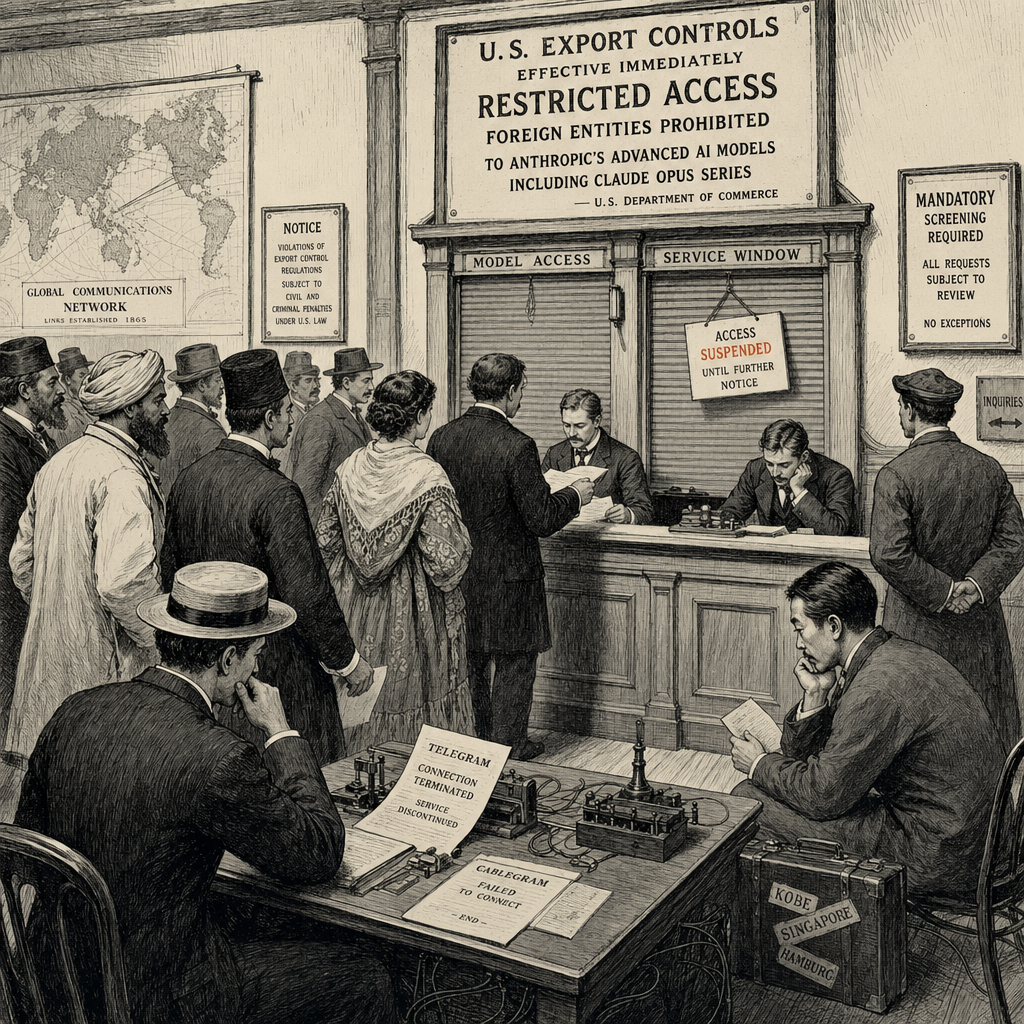
Commerce Secretary Howard Lutnick sent Anthropic Chief Executive Dario Amodei a letter Friday stating that the company’s latest Fable 5 and Mythos 5 models are now subject to export restrictions, an administration official said. The letter means that usage by customers outside the United States and by foreign nationals within the United States is prohibited.
The broad scope of the restrictions led the company to limit all access to the two new, powerful models because many foreign governments, companies, and individuals, including some foreign-born Anthropic employees, all fall under the rule, the company said in a statement. The statement said the letter “did not provide specific details of [the government’s] national-security concern.” Anthropic said its other tools will not be affected for customers.
The move is one of the most powerful examples yet of U.S. government intervention in the AI race. Anthropic and its competitors are racing to roll out new tools to customers ahead of highly anticipated initial public offerings, and slowdowns and regulatory barriers can cost the companies billions of dollars, according to the Wall Street Journal.
Governments and companies around the world have been using Mythos 5 to identify and patch software vulnerabilities. Friday’s halt will pause those efforts and could have far-reaching implications on cybersecurity depending on how long it lasts, the Journal reported. Critical industries from finance to energy have been deploying the model. Anthropic released Fable, a next-generation “Mythos-class” model to the general public with guardrails that remove dangerous capabilities earlier this week.
The company and the Trump administration have been feuding for months over the guardrails dictating how the Pentagon uses Anthropic’s AI tools, and Friday’s action could escalate the battle between the two sides, analysts said. Administration officials and advisers including venture capitalist David Sacks have accused the company of so-called doomerism by warning of AI risks and stoking fear, then continuing to release more powerful models. Some AI analysts have said it is unprecedented for the U.S. government to target one of its leading companies with such punitive measures. As MSI previously covered, President Trump in February ordered all U.S. agencies to stop using Anthropic’s AI, a directive that followed months of legal battles over the company’s supply-chain risk label and Pentagon access.
Fears about rogue models and cyberattacks have pushed the White House to seek more control over models before they are released, leading to an executive order recently signed by President Trump. The order gave national security and cybersecurity officials more control when models and cyber vulnerabilities are evaluated, and the administration and Anthropic have been going back and forth for weeks over who gets access to the company’s top tools.
Friday’s action comes after reports that a user had bypassed the safety guardrails of Anthropic’s Fable 5, adding to worries about cyberattacks that have built up since the company began previewing Mythos earlier this year. The model is more efficient than humans in many cases at finding software bugs.
Anthropic had expanded access for Mythos 5 to more foreign users in recent weeks before rolling out Fable. The company has also investigated unauthorized access to Mythos.
Anthropic said it thinks the government became aware of a method of so-called jailbreaking before Friday’s action. “We reviewed a demonstration of this specific technique being used to identify a small number of previously known, minor vulnerabilities. These vulnerabilities all appear relatively simple, and we have found that other publicly-available models are able to discover them as well without requiring a bypass,” the company said.
The Commerce Department is in charge of controlling access to top U.S. technology, including chips and models, and it often focuses on banning exports to foreign adversaries and requiring licenses to access sensitive tools. The Trump administration has loosened export restrictions on the chips needed to train AI models and even blessed shipments to China, in addition to shunning Biden-era rules that would have restricted model access, the Journal reported.
That stance fueled criticism from industry analysts who said that under the new rule, U.S. allies like the United Kingdom could not access Anthropic’s top technology.
“It’s puzzling Commerce will forcefully act to control AI models that may pose national-security risks, but then allow the chips that produce these models to be sold to our foreign adversaries,” said Jimmy Goodrich, a senior fellow at the University of California Institute on Global Conflict and Cooperation.