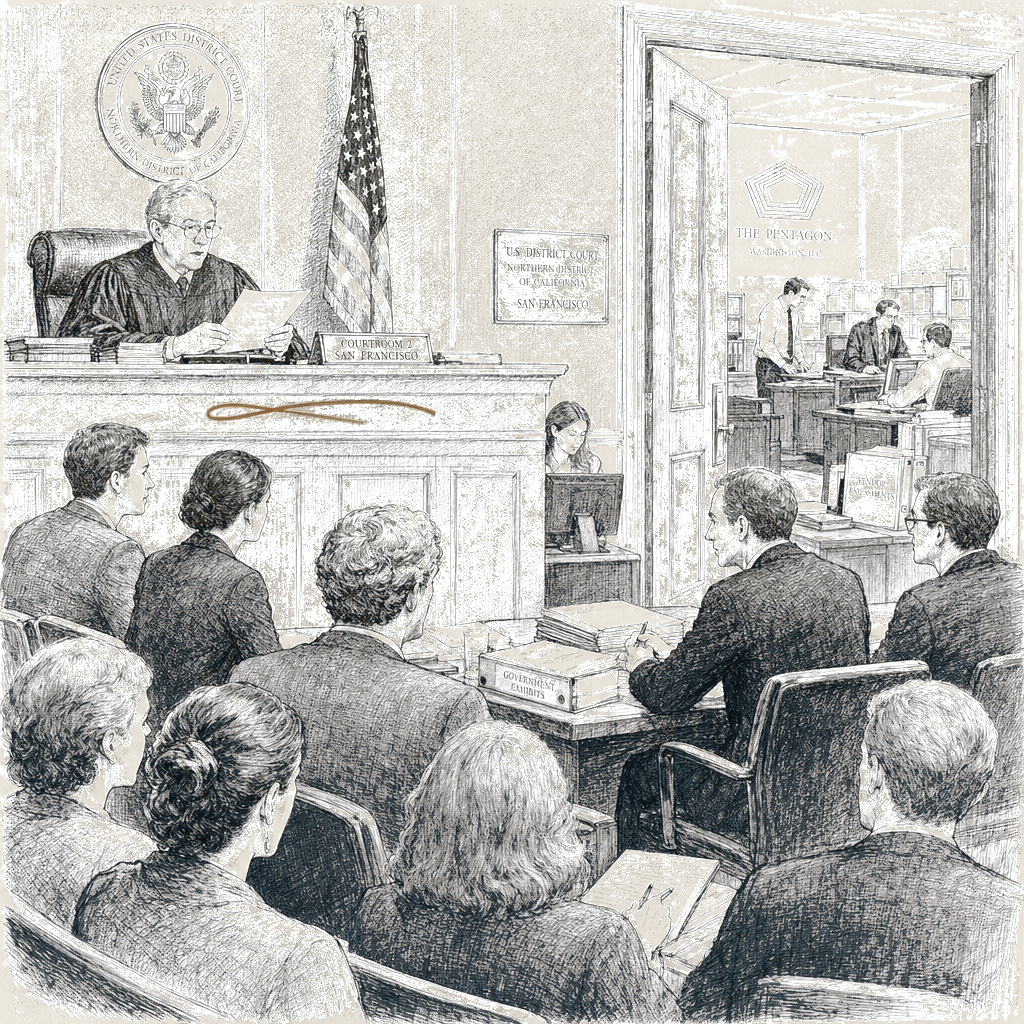
A federal judge in San Francisco temporarily blocked the Pentagon from labeling Anthropic as a supply chain risk and halted enforcement of a separate directive that would have pushed federal agencies away from Anthropic’s chatbot, Claude. The ruling came as Anthropic pressed for emergency relief after it said the Trump administration took unusually punitive steps toward the company in the middle of a dispute over how the government would use its technology.
U.S. District Judge Rita Lin issued the temporary order after what the Associated Press described as a 90-minute hearing in San Francisco federal court, where Lin questioned why the administration moved to punish Anthropic after negotiations over a defense contract “went sour.” The company had argued that it was being treated as a potential adversary through a supply-chain label, even though it said the broader dispute centered on its efforts to prevent its AI technology from being deployed in fully autonomous weapons or from being used to surveil Americans.
Lin’s decision credited Anthropic’s request to remove what it described as a stigma and to stop the government’s actions while the litigation plays out. The judge said the measures taken in response to the policy dispute appeared arbitrary and capricious, and she wrote that the government’s use of a “rare military authority” appeared designed to punish the company rather than address any operational chain-of-command issue. “Nothing in the governing statute supports the Orwellian notion that an American company may be branded a potential adversary and saboteur of the U.S. for expressing disagreement with the government,” Lin wrote, according to the AP report.
The temporary block also covered enforcement of President Donald Trump’s directive tied to social media, which ordered all federal agencies to stop using Anthropic and Claude. Lin said her order addressed the government’s actions rather than the public policy debate about what role the technology should play in government operations, and she suggested that if the government’s concern were purely the integrity of command, it “could just stop using Claude” instead of proceeding with broad punitive measures.
The AP report said Anthropic had previously filed suit in federal court earlier this month, alleging the government’s steps amounted to an “unlawful campaign of retaliation.” The Pentagon argued in court that it should be able to use Claude in any way it deems lawful. Lin, according to the AP account, said her order would not decide the public-policy issue, but would restrain the government’s enforcement posture while the legal challenges continue.
Lin wrote that her order would be delayed for a week and that it did not require the Pentagon to use Anthropic’s products or prevent the department from transitioning to other AI providers. The AP report also said Anthropic has a separate, narrower case pending in the U.S. appeals court in Washington, D.C., involving a different rule the Pentagon is using to try to declare the company a supply chain risk.
Anthropic said in a statement that it was “grateful to the court for moving swiftly” and pleased that the judge agreed the company was likely to succeed on the merits. The company said the case was necessary to protect its business and customers, while also saying it remained focused on working with the government to ensure Americans benefit from what it described as safe and reliable AI. The Pentagon did not immediately respond to a request for comment about the ruling, according to the AP report.
Support for Anthropic’s position in court came from multiple third parties, including Microsoft, industry trade groups, rank-and-file tech workers, retired U.S. military leaders and a group of Catholic theologians. The AP report, citing an Associated Press correspondent, said Matt O’Brien filed the story from Providence, Rhode Island.