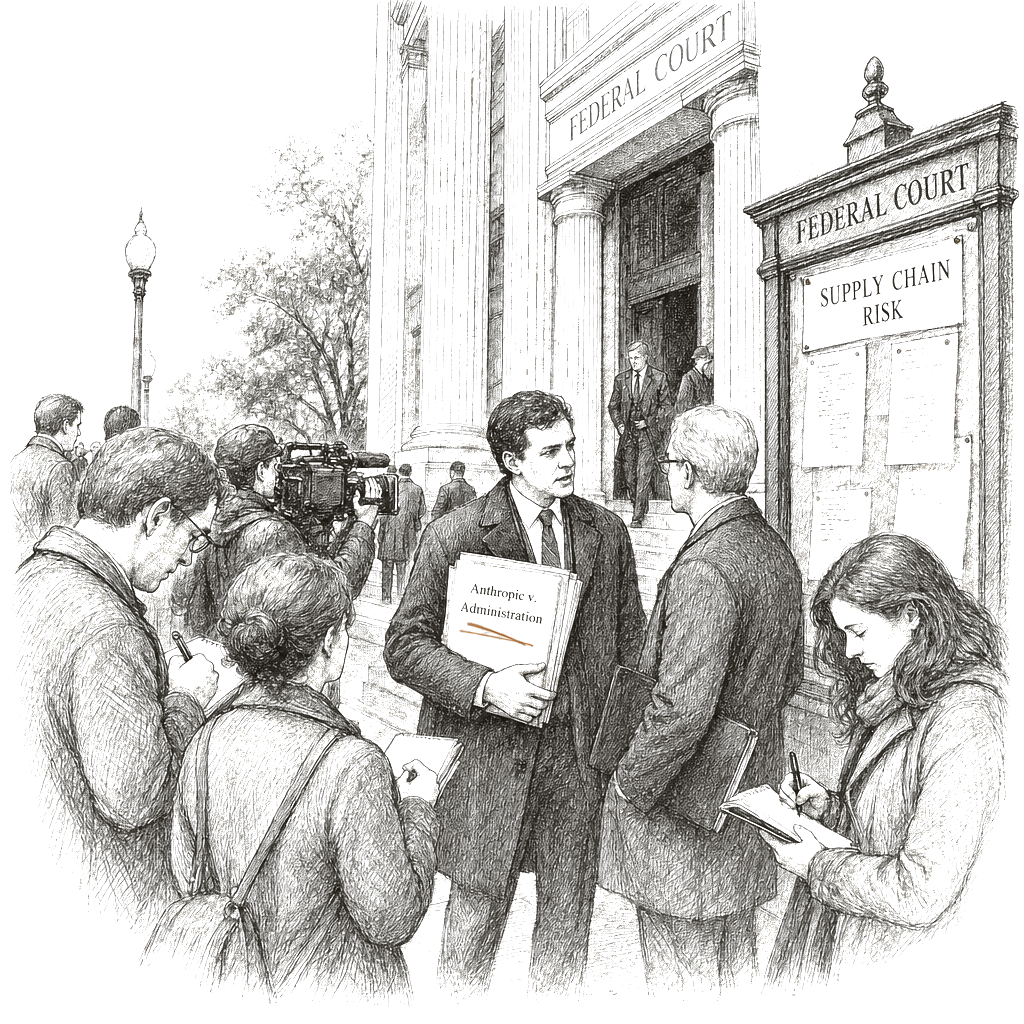
Anthropic is moving to challenge two actions by the Trump administration that it says punish the company for how it allows its Claude technology to be used in military and intelligence settings. On Monday, the San Francisco-based AI company asked federal courts to unwind the Pentagon’s designation of it as a “supply chain risk” and also to block enforcement of a federal directive telling employees to stop using Claude, according to the company’s court filings.
Anthropic said the government’s steps amount to an effort to retaliate against the company for refusing to permit unrestricted military use of its technology, characterizing the move as “unlawful campaign of retaliation” aimed at “protected speech.” In the lawsuits, the company sought judicial review as a last resort, arguing that the Constitution does not permit the government to punish it for speech and that no federal statute authorizes what it described as the administration’s actions.
The company asked courts to take up different challenges through two separate filings. Anthropic filed one lawsuit in California federal court and another in the federal appeals court in Washington, D.C., seeking relief tied to different parts of the administration’s response, including the “supply chain risk” designation and the order affecting federal employees’ access to Claude.
In its filing, Anthropic asked a federal court to reverse the Pentagon’s decision announced last week to label the company a “supply chain risk.” Anthropic said the designation is designed to prevent foreign adversaries from harming national security systems, and it argued that the government’s first known use of that label against a U.S. company cuts off its defense work.
The dispute has played out publicly, with Defense Secretary Pete Hegseth and other officials pressing Anthropic to accept what they described as “all lawful” uses of Claude and warning of potential consequences if the company did not comply, according to the reporting. Hegseth also wrote to Anthropic on March 4, and Anthropic’s lawsuit said that letter described the designation as “necessary to protect national security.”
The confrontation also extends beyond the Pentagon contractor framework. The Trump administration directed federal workers to stop using Claude, while giving the Pentagon six months to phase out the product that is “deeply embedded” in classified military systems, including those used in the Iran war, according to the reporting. Anthropic’s lawsuit additionally names other federal agencies, including the departments of Treasury and State, after officials ordered employees to stop using Claude.
Anthropic said it has long limited Claude’s use in ways it says would enable mass surveillance of Americans and fully autonomous weapons. In its lawsuit, the company said its usage policy prohibits “lethal autonomous warfare without human oversight and surveillance of Americans en masse,” and it said it has “never tested Claude” on those applications and lacks confidence the system could “function reliably or safely” for them. At the same time, Anthropic said it had allowed the military to use Claude in capacities including military operations and analyzing “lawfully collected foreign intelligence information.”
Anthropic’s legal claims describe reputational and business harms that, it says, could flow from the government’s actions. The company alleged that the “supply chain risk” designation and associated steps impugned its reputation, “jeopardizing hundreds of millions of dollars” in contracts with other businesses, and it characterized the effort as attempting to “destroy the economic value” it said was created by one of the world’s fastest-growing private companies. The company also told courts that it is seeking to ensure the designation remains narrow and affects only military contractors when using Claude for Department of Defense work, a distinction it said is critical because most of its revenue depends on business and government customers using Claude for coding and other tasks.
Even as the lawsuits proceed, the Defense Department declined to comment Monday, citing a policy of not commenting on matters in litigation. A legal expert who previously helped craft technology contracts for New York City said the dispute had escalated in a way he had not anticipated, describing the threat of “destruction” during a negotiation as something he said he had “never seen” in similar cases.
The conflict has also broadened within the technology industry. Anthropic said it had been among the only peers whose AI models were approved to supply classified military systems until recently, and the dispute has prompted the Pentagon to consider shifting Claude’s work to other systems, including Google’s Gemini, OpenAI’s ChatGPT and Elon Musk’s Grok, according to the reporting. The fight has also drawn public responses from inside the AI sector, including OpenAI robotics head Caitlin Kalinowski, who resigned after the Pentagon deal and criticized what she said was a lack of “judicial oversight” for surveillance of Americans and a lack of “human authorization” for lethal autonomy.
In a statement Monday, Anthropic said, “seeking judicial review does not change our longstanding commitment to harnessing AI to protect our national security, but this is a necessary step to protect our business, our customers, and our partners.” The company framed its lawsuits as part of an effort to vindicate its rights and halt what it calls an “Executive’s unlawful campaign of retaliation,” while also arguing that its restrictions on mass surveillance and autonomous lethal warfare are central to its mission and safety stance.