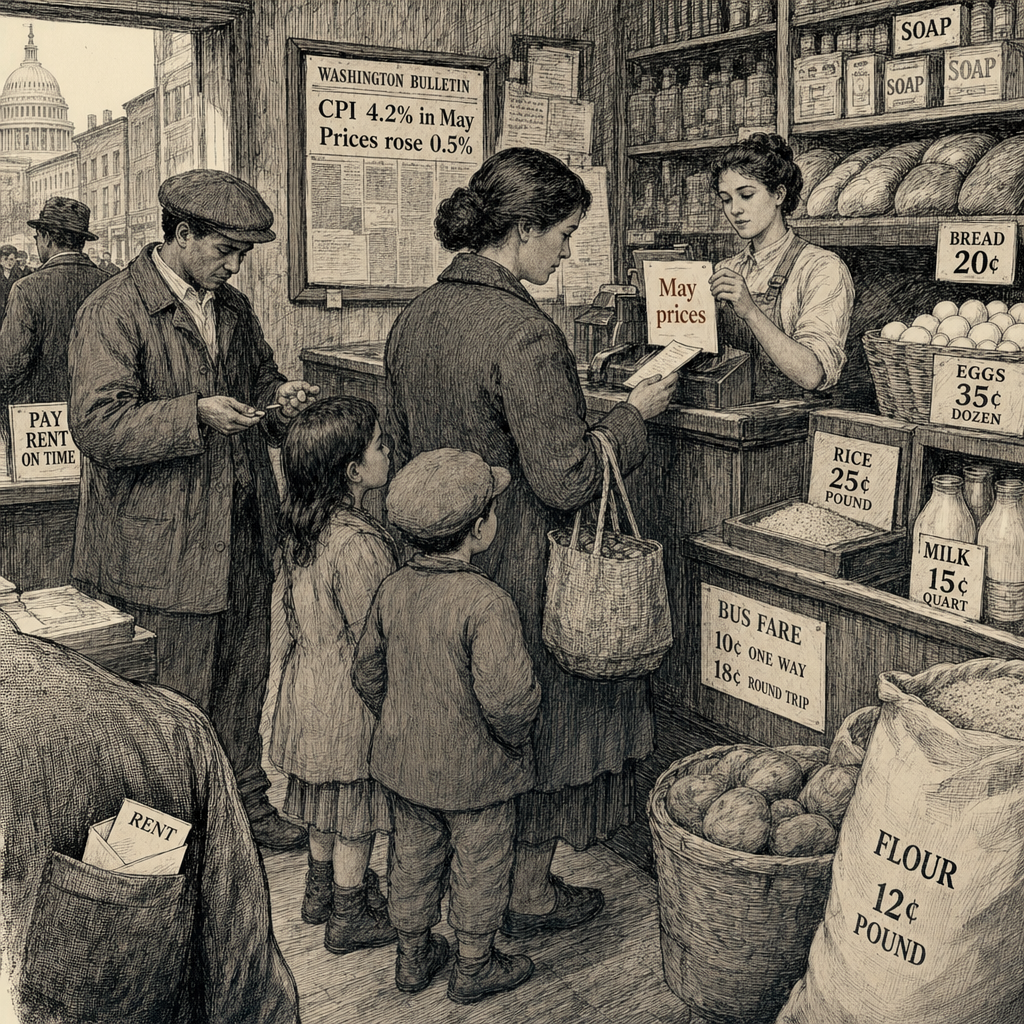
Data released Wednesday by the Bureau of Labor Statistics painted a familiar picture: headline inflation rising, energy costs leading the charge, and real wages barely budging. But beneath the 4.2 percent annual increase in the Consumer Price Index for May — the fastest pace in three years — lies a distributional story that the topline number conceals. Households at the bottom of the income ladder are feeling the pinch more sharply than the average suggests, because the necessities that dominate their budgets — housing, food at home, and transportation — are the very categories where prices are rising most.
The Bureau of Labor Statistics’ Consumer Expenditure Survey shows that the bottom income quintile allocates roughly 40 percent of its spending to housing and an additional 15 percent to food at home, compared with about 30 percent and 6 percent, respectively, for the top quintile. When shelter and grocery costs climb faster than the overall CPI, as they have for months, that spending mix translates into an effective inflation rate for lower-income households that can run several tenths of a percentage point above the headline number. The May increase was powered in large part by gasoline prices, which jumped as the war in Iran continued to disrupt global energy markets, while shelter costs — the largest single component of the index — rose again. Because owners’ equivalent rent, the BLS’s method for capturing housing costs for homeowners, is based on rents paid on existing leases, it lags the fresh market-rent data from private providers such as Apartment List and Zillow by a year or more. That means even if new-lease rent growth were to slow today, the shelter component of the CPI would keep exerting upward pressure well into 2027, prolonging the squeeze on families that already spend the largest share of their income on housing.
The Real Earnings report released simultaneously showed that real average hourly earnings were essentially flat for the month, the BLS said. Coupled with a job market in which the Atlanta Fed’s Wage Growth Tracker has recorded a compression of the wage premium for workers who change jobs, the data suggests that the typical worker’s paycheck is falling further behind the cost of living. Without an acceleration in wages, the current inflation episode — driven by energy and shelter rather than a labor-market spiral — does not fit the profile of a wage-price spiral, an outcome that a large body of economic research has found to be historically rare. Instead, the evidence points to prices being pushed up by supply-side forces and corporate pricing decisions, with the burden falling disproportionately on households that have the least room to absorb it.
The Federal Reserve’s preferred inflation gauge, the Personal Consumption Expenditures price index, will be released later this month and is expected to show a somewhat lower reading because of methodology differences. But the gap between the CPI and PCE measures does not alter the distributional reality: when the price of a gallon of gas or a month’s rent rises, it takes a larger bite out of a smaller paycheck, and the headline 4.2 percent is not the inflation rate that millions of families are living with.