
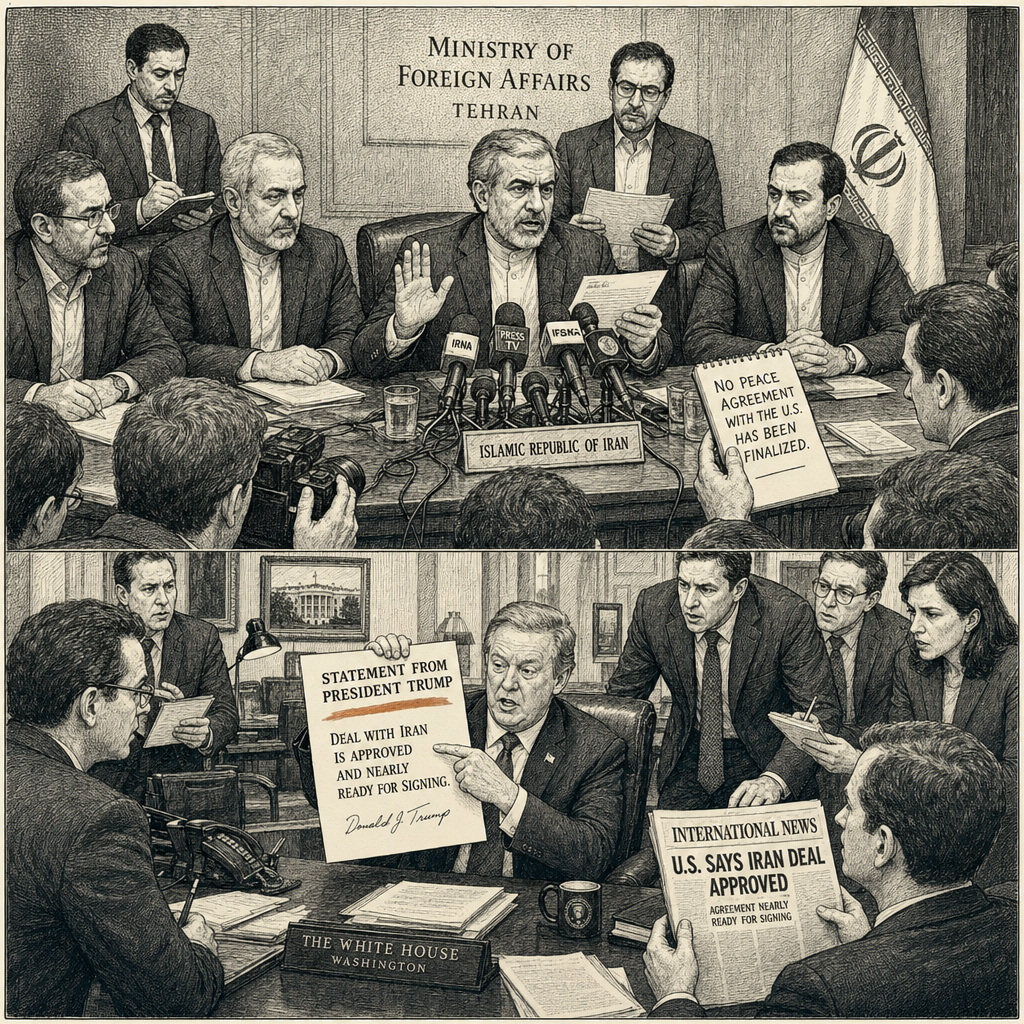
Donald Trump is threatening to bomb Iran’s oil lifeline and calling it a peace deal. On Thursday, the President announced that he had cancelled planned strikes on Kharg Island, the terminal through which ninety percent of Iran’s crude exports flow. He said the Islamic Republic’s leadership had signed off on the final points of an agreement to end the war. Hours later, Iran’s foreign ministry spokesman denied that any deal had been finalised. A memorandum of understanding brokered by Qatar and Pakistan is under review, but it is not signed, it is not finalized, and the Iranian spokesman says the Americans keep changing the terms. The bombs were loaded, the ships were in position, and the man in the White House called off the killing not out of restraint but because the threat itself had already done its work.
This is exactly how the modern military-industrial apparatus manufactures consent for coercion. You hold the knife to the throat of a nation’s power grid and oil terminals, and you wait for the capitulation that lets you announce victory. As we tracked when the administration framed the Strait of Hormuz as largely negotiated, and as we documented when the president preemptively declared a finished settlement, the pattern never changes. You escalate the threat until someone blinks, and then you pause the strike just long enough to sell a sixty-day extension as diplomacy.
In his farewell address, paragraph 24, Dwight Eisenhower warned of the acquisition of unwarranted influence by the military-industrial complex. That influence is not merely the contractor building the munition; it is the operating tempo that demands a crisis be kept just below the threshold of total annihilation so the apparatus remains funded, the Fifth Fleet’s destroyers hold their patrol stations, and the strike wings stay on standby. A true peace ends the crisis. A sixty-day memorandum of understanding that merely extends a ceasefire to argue over enriched uranium keeps the crisis on life support.
Thomas Schelling, in Arms and Influence, drew the distinction between brute force and compellence. Brute force takes what you want. Compellence makes the other side give it to you. The threat that leaves something to chance—the bombers already in the air, the ultimatum already issued—forces the adversary to calculate not whether you will pull the trigger but whether the machinery you have set in motion can be stopped. Trump’s disclosure that the strikes had been “scheduled” and then “cancelled” is not a disclosure of presidential restraint. It is the compellent threat itself, dressed up as magnanimity.
The substance of the “deal” bears out the threat. Central Command declares the shipping lane open to all vessels not breaching the United States blockade, while Tehran maintains the waterway is closed due to illegal American actions. The United States is demanding Iran accept that its own coastline is subject to a foreign blockade, that the waterway through which its oil reaches the world is under American, not Iranian, control. The memorandum Trump has touted as imminent would extend a cease-fire for sixty days, during which Iran would be expected to negotiate away its stockpile of enriched uranium, its nuclear program, and its ability to ship oil except on terms Washington dictates. That is not a diplomatic settlement. It is a capitulation extracted at gunpoint, and the gun is a fleet of American bombers aimed at the single piece of infrastructure that keeps the Iranian state solvent.
Andrew Bacevich has written that the United States habitually confuses military power with diplomatic leverage—a confusion on full display with the threat to strike Kharg Island. The same “Washington rules” that failed in Baghdad and Kabul now point a bomber fleet at Iran’s oil artery. The Trump administration appears to have learned nothing from that record. It has simply substituted the threat of destruction for its actual application, and it is calling the result a peace agreement. The oil markets, ever attuned to the difference between genuine stability and a reprieve, drove Brent crude down nearly four dollars on the news. But a cease-fire extracted under threat of annihilation is not stability; it is a pause in the destruction, waiting to be broken the moment the President decides the other side has not shown sufficient gratitude.
Kharg Island is not a military target in any meaningful sense. It is the artery through which the Iranian economy breathes. Striking it could cripple the country’s ability to import food and medicine, plunge millions into poverty, and would quite likely kill a great many people who have nothing to do with the regime’s nuclear program or its regional proxies. The Trump administration is well aware of this. The threat to destroy Kharg Island is not a threat to hit a military asset; it is a threat to starve a nation into submission. And that threat is the engine of the “peace” Trump claims to have brokered.
Phil Klay’s writing on the deployed soldier’s moral landscape reminds us that the political abstractions in the situation room are merely scenery for the people living under the shadow of the targeting computers. The oil markets cheer when Brent crude falls because the bombs were shelved for the afternoon, but there are no markets where the missiles land. The only legitimate resolution to this crisis is the complete cessation of the economic siege, not a manufactured pause to keep the military’s operating tempo on standby. A binding treaty ends the hostilities; a memorandum just manages the racket.
I do not see a peace deal here. I see a man with a gun to another man’s head, calling it negotiation. The President’s defenders will say he avoided a war—a claim he’s made before—that he achieved through strength what his predecessors could not. But the war was never avoided; it was merely suspended, and the strength is not in the deal but in the bombers that remain on alert. The men on Kharg Island, the families in Tehran and Abadan who depend on the oil that flows through that terminal, the sailors on American ships in the Persian Gulf—all of them are still in the line of fire. The only difference is that the President has chosen to call the gun a pen. For a shopkeeper in Abadan watching fuel prices triple over a sixty-day negotiation window, the distinction between a paused strike and a lifted blockade is simply whether they eat tomorrow or starve next week.