Federal prosecutors are criminalizing peaceful protest inside American immigration courts. There is a man who walked into a federal building last September to stand with his neighbors, and the government arrested him for it. On Thursday, a judge looked at the evidence the government brought, read it all, and acquitted him. Brad Lander is running for Congress now, challenging Rep. Dan Goldman in the Democratic primary. The acquittal removes the legal cloud the government hung over his campaign, but the story here is not the politics. The story is that the government charged a man for protesting the machinery of deportation, and the machinery lost.
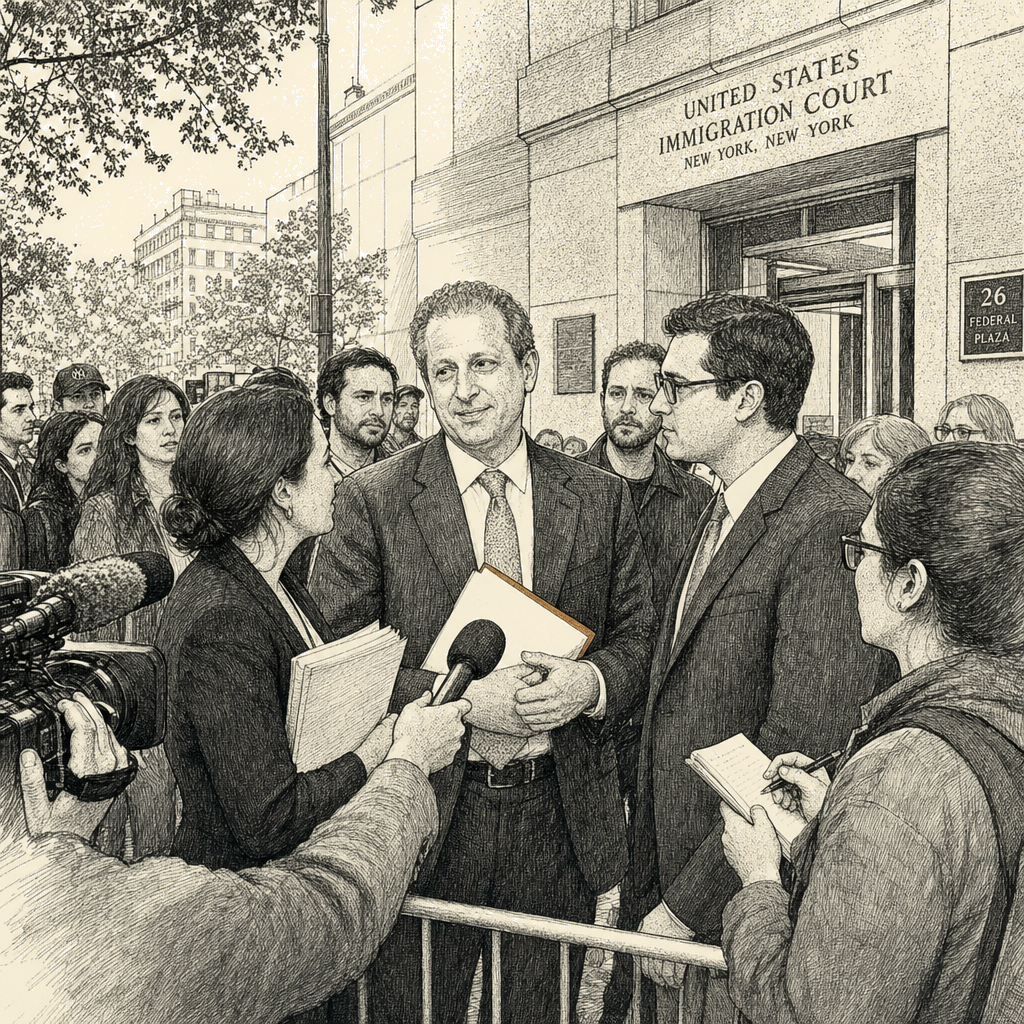
U.S. Magistrate Judge Henry J. Ricardo delivered a lengthy analysis of the evidence and then said not guilty. One day of trial. No jury drama, no appellate slog. The government took its shot and missed, and the whole thing was over by Thursday afternoon. Outside the courthouse, Lander addressed reporters. He called the acquittal a blessing and said he felt genuinely moved by the rule of law. I believe him. I also believe the rule of law he invoked is the same rule of law that has deported more than fifty-five million people since 1882 — most of them, as historian Adam Goodman traces across voluntary departure and formal removal since 1882, not through formal removal but through the coercive mechanisms the system calls “voluntary departure.” The rule of law that acquitted Brad Lander on Thursday is the same rule of law that tells a mother she has no right to be present, no path to citizenship, no claim on the country where her children were born. Lander is right to be grateful for the acquittal. The blessing is real. The blessing is also selective.
The immigration courts are where the deportation machine operates its quietest violence. Not the violence of dogs and batons at the border — the violence of a bailiff calling a case number, of a Department of Justice employee in a black robe asking a father whether he has a lawyer, of a child waiting in a hallway while her mother answers questions about whether returning to Honduras would cause her irreparable harm. The machine processes over three million pending cases as if they were inventory, not people. It is not hidden. It is simply boring, and boring cruelty is the kind we permit.
When you are moved by the rule of law, you must name exactly which law you mean. The law is the 1965 Immigration and Nationality Act that capped Western Hemisphere migration while the fields still cried out for harvest, precisely when we kept the economic demand for Mexican labor high while slamming the legal gate shut. The law is the 1996 congressional acts that turned a civil administrative process into a deportation engine, expanding grounds for removal and applying them retroactively to residents who had built entire lives here. The law is the detention contracts that pay private corporations per bed to hold fathers and mothers in concrete cells while their cases wind through a tribunal system where judges serve at the pleasure of the Attorney General.
The Torah commands us in Exodus 22:21 not to wrong or oppress the resident alien, because we were aliens in the land of Egypt. The same command echoes in the Christian Testament when Christ stands with the outcast and shames the enforcer. The Torah gives us the mechanism: memory of having been the stranger is the moral precondition for welcoming the stranger. The law of the immigration court was written to do the opposite. We who stand in the back of American parishes and watch the empty desks where the children of the undocumented used to sit have learned that the law does not move equally. I carry my own community’s complicity in looking away when the enforcement vans came to the factory floor and the fields. We ate the crops picked by the removable hands and slept in the houses framed by them while the law kept their status temporary by design. The law did not forgive us for that forgetting, and it does not forgive us for it now.
Dorothy Day, whose Catholic Worker movement built houses of hospitality for the people the country had agreed not to see, wrote in the September 1945 Catholic Worker after Hiroshima: “We have killed 318,000 Japanese.” She did not hedge it. She did not say “the bombing resulted in casualties estimated at.” She wrote the number in the first-person plural because she understood that the machine operates in all of our names, and that the blessing of acquittal for one protestor does not erase the deportation order for the person he was protesting alongside. Both are the rule of law. Both are us.
The machine is not a monolith. Sometimes it loses, and when it loses inside a courtroom, the loss is recorded and the defendant goes home. But the machine’s losses inside courtrooms are the exception, not the rule. For every Brad Lander who walks out acquitted, there are thousands of people inside the same courthouse who walked out into a van headed for an ICE detention facility. The same rule of law Lander called a blessing is, for most of the people who enter that building, the instrument through which their lives are dismantled. Both happened in the same building, under the same law, on the same day. That is not a contradiction the law can resolve. It is a contradiction the law is built to produce.
I have sat in courthouse hallways like the one Lander stood inside last September. I have watched people walk out acquitted and I have watched people walk out in handcuffs, and the same judge who delivered one verdict delivered the other. The rule of law is not a person. It does not love you. It is an instrument, and what it does depends on whose hands are on it and what they have been told to do. On Thursday, the hands on the instrument in that Manhattan courtroom delivered an acquittal. The hands on the instrument in the immigration court down the hall delivered deportation orders.
To the prosecutors who brought the charge and the statutory authority they wield, I say this: you lost, and I am glad you lost. The protest he was arrested for was a protest against what your colleagues do every day in that building, and the judge looked at your evidence and found it insufficient. That is what the rule of law is supposed to do when the government overreaches. But I also say to you what the prophets said to every power that used the law as a shield while wielding it as a weapon: the God who commands justice for the stranger is not impressed by your acquittal rate. The same courtroom that let Lander walk free sentenced someone else to deportation while the verdict was being read. I am not asking you to be moved. I am telling you that the law you wield names what you are doing, and you cannot hide behind the one verdict while the other verdicts pile up in the hallway.
Pope Francis named the true condition at Lampedusa when he spoke of the globalization of indifference. He did not tell us to weep for our own righteousness. He told us to weep over the indifference that makes us nameless and faceless, and to weep over the cruelty we enact in our own names. The indifference that authorizes the raid and builds the courthouse where the protest is prosecuted is the same indifference. It does not care which side of the docket you stand on. The Catholic bishops of the United States and Mexico said it plainly in Strangers No Longer: sovereign nations have the right to control their borders, but the human dignity of the undocumented must be respected. I will not pretend the two are equal in the scales of conscience, and neither will you if you have sat in the back of the courtroom and watched a mother’s hands shake when the verdict arrives.
The door of return is open. It is always open. That is the discipline. The Christ of the red letters walked into the temple and turned the tables on the law-abiding merchants, and yet he ate with the tax collector afterward. He does not ask the tax collector to become a spotless Pharisee. He asks the Pharisee to put down the stone. Lander stood in a federal building last September, and the government arrested him, and on Thursday a judge said the government was wrong. That is good. Now let the same door open for the people he stood beside. The rule of law that acquitted Brad Lander yesterday is a blessing. It is not the salvation of the family waiting four years for an asylum docket. It is not the water left at the desert crossing. It is not the reunion of the child torn from the parent by an administrative memo. The law is a floor. We refuse to let the border become a line where our humanity ends. We sit by the door until the stranger is no longer the stranger, but the brother.