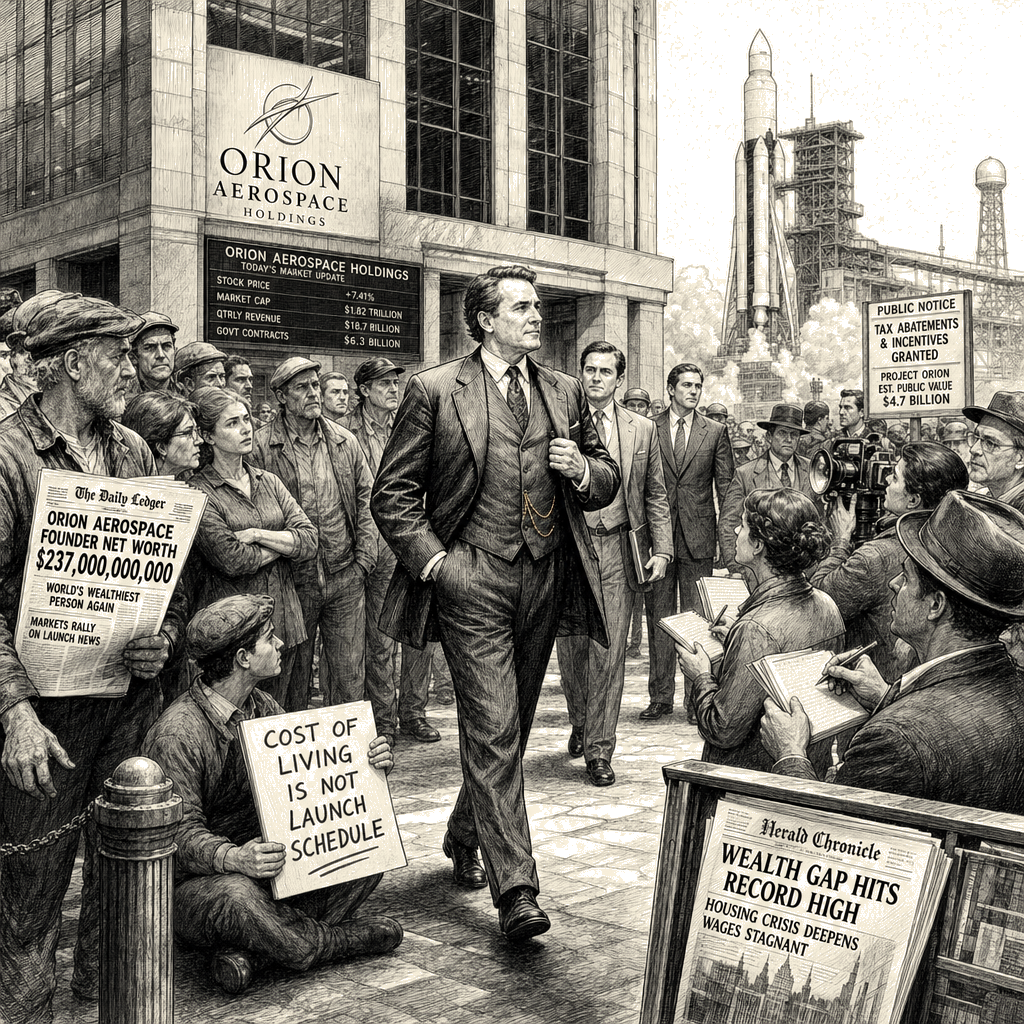
Guardian columnist Arwa Mahdawi published a commentary on June 9 arguing that Elon Musk’s rise to trillionaire status — expected following the SpaceX initial public offering that began trading the previous day — represents a threat to democratic institutions. “You think Musk-the-billionaire was bad? A trillion dollars is going to afford the rocketman a whole new level of impunity and give him even more power over our lives,” Mahdawi wrote.
Mahdawi described the scale of a trillion dollars: 12 zeros, one million million dollars. “If you spent $1m every single day it would take you more than 2,700 years to spend a trillion dollars,” she wrote. She contextualized the sum by noting that for a trillionaire, $1 million is roughly one ten-thousandth of 1% of net worth, equivalent to 19 cents for a median-net-worth American.
The column traced Musk’s political influence back to the 2024 election cycle. Mahdawi wrote that Musk donated about $290 million to Trump and other Republicans. “It’s impossible to say exactly how the 2024 election would have turned out without the $290m Musk gave to Donald Trump and other Republicans, but Musk’s millions certainly made things easier for the president,” she said. She reported that Musk’s net worth rose by more than $500 billion in less than two years, from roughly $270 billion in October 2024.
Mahdawi described Musk as a “shadow president” who attended cabinet meetings and joined Trump on state visits to China and Saudi Arabia, where he cut deals for his companies. During his tenure running what she called the “department of government efficiency” (Doge), Mahdawi wrote, Musk slashed government agencies, encouraged mass firings, and made cuts to foreign aid. She cited calculations attributing 600,000 deaths, two-thirds of them children, to the dismantling of the U.S. Agency for International Development (USAID). She quoted Harvard public health professor Atul Gawande, who described the casualties as “public man-made death.”
The column placed Musk’s rise in the context of broader trends in wealth concentration. Mahdawi cited a New York Times analysis showing that the share of billionaire spending in federal elections grew from 0.3% in 2008 to 19% in 2024, totaling more than $3 billion from about 300 billionaires and their families. She referred to a 2013 Northwestern University study that found ultra-wealthy individuals are less willing than others to invest in healthcare and education initiatives. “They want lower taxes, less government regulation — a system that keeps making them richer,” she wrote.
Mahdawi noted that billionaire wealth reached historic highs last year and is now more concentrated than during the Gilded Age. She cited Oxfam, which reported that “the amount of wealth owned by the poorest half of the world is less than the amount owned by just the 12 richest billionaires,” and that if current trends continue there will be five trillionaires within a decade.
She pointed to public opinion data supporting her argument: a Data for Progress survey finding 70% of respondents across party lines said the economic system is rigged in favor of corporations and the wealthy, and a Politico poll showing 72% of Americans believe there is too much money in politics, with majorities across parties saying billionaires wield outsized influence.
The column also addressed Musk’s activities outside the United States. Mahdawi wrote that Musk has explored loopholes to channel funds to rightwing groups in the United Kingdom and has spent weeks commenting on British politics. She noted that Prime Minister Keir Starmer accused Musk of “interfering in our politics” after Musk’s commentary on the murder of a white teenager by a Sikh man.
“We still have time to change this but, as we enter a new era of unelected trillionaire overlords, it is quickly running out,” Mahdawi concluded.