Body
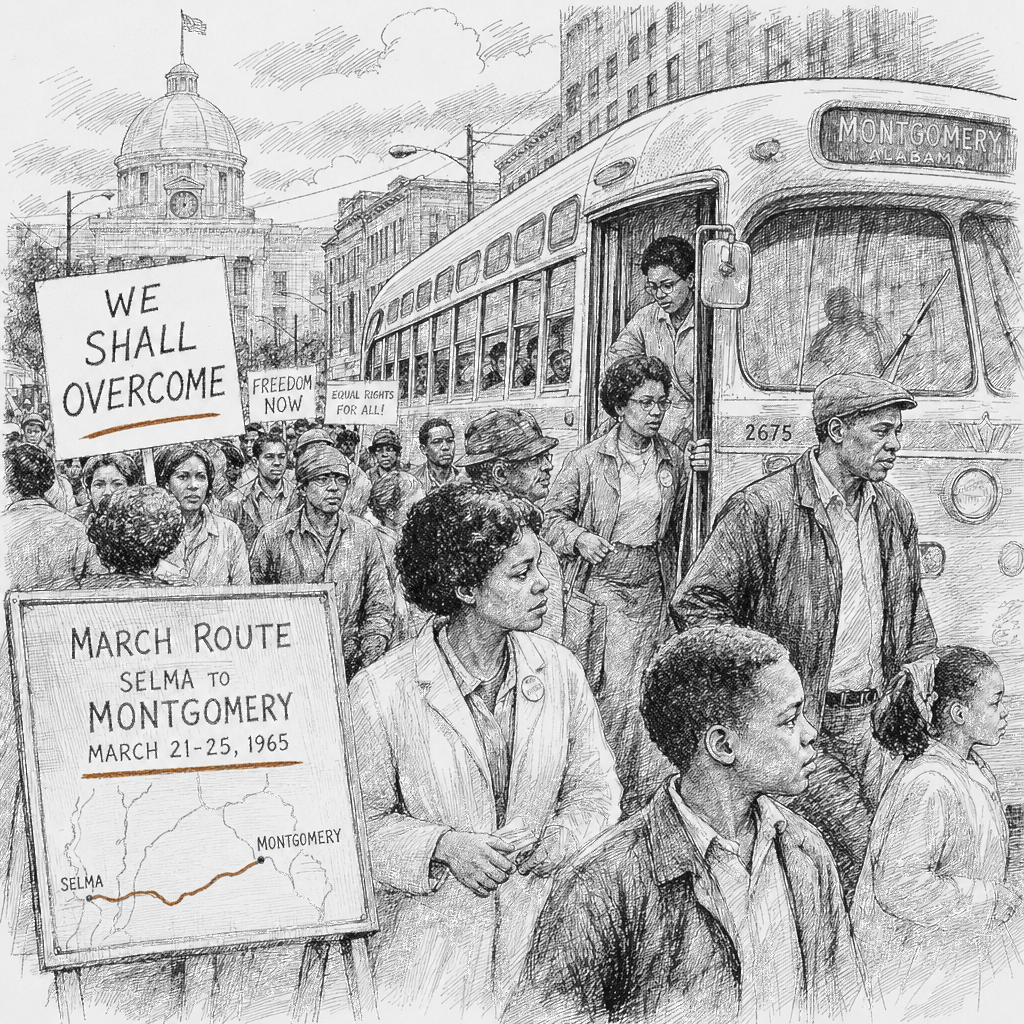
Keith Odom came to Montgomery, Alabama, not for a museum-style commemoration but to renew a political fight he said must move forward for the next generation. Stepping off a bus onto Dexter Avenue, he looked toward a stage set roughly where the original 1965 march ended, with the Alabama Capitol and the site’s history in view, according to the Associated Press.
Odom, a union man and grandfather of three who was 62 on Saturday, traveled from Aiken, South Carolina, to Atlanta before joining several dozen activists on two buses bound for Montgomery. He said the moment held personal weight: “The history here — being a part of it, seeing it, feeling it,” Odom said, according to the AP report.
He described a sense of urgency beyond remembrance. Odom said his group came to “renew the fight” after the Supreme Court issued a decision that, the report said, severely diminished the landmark Voting Rights Act. The court ruling struck down a majority-Black congressional district in Louisiana, concluding in a 6-3 decision that considering race when drawing political lines is discriminatory, AP reported, and it said that prompted states including Alabama to redraw U.S. House districts in ways activists argue make it harder for Black voters—who lean overwhelmingly Democratic—to elect lawmakers of their choice.
Odom said the goal of the renewed effort was tied to a broader historical arc. The AP report said the 1965 effort helped push Congress to send the Voting Rights Act to President Lyndon B. Johnson to sign, securing and expanding political power for Black and other nonwhite voters for more than half a century. “I’m not trying to live a life that’s going backwards,” Odom said. “I want to go forward, for my grandchildren to be able to go forward,” the report said.
The Saturday rally, called “All Roads Lead to the South,” drew participants who connected the present organizing to the civil rights movement’s organizing and risk-taking. Justice Washington, a Kennesaw State University student named in the AP report because her mother and grandmother had faith in the American system, said she discussed the trip with her grandmother before coming and that her grandmother told her “now it’s time for me to do mine,” as quoted by AP.
Kobe Chernushin, 18, said he helped document the day’s activities for social media through a local youth justice group, AP reported. “I believe in the power of showing up,” he said, according to the report. The AP account said the youngest attendees had not reached voting age when the Voting Rights Act became law, noting that the youngest attendee was born when Democrat Barack Obama was elected the first Black president in 2008.
AP reported that John Lewis’s legacy shaped how some participants described the stakes of the moment, including through a proposed federal election overhaul named for him. Lewis, who was 25 when he was bloodied on the Edmund Pettus Bridge in Selma, died in 2020, the report said, and some on the buses Saturday marked his death as they looked ahead to policy changes they said could reinvigorate the Voting Rights Act and outlaw certain forms of gerrymandering. “I’m here because of the same forces that pulled on John Lewis when he was a student,” said Darrin Owens, 27, who AP reported trains Democratic candidates and has worked for former Vice President Kamala Harris.
Owens told the AP he attended as a citizen, not a political professional. “Political activism is personal,” Owens said, describing how he saw the risk that people who represent communities might not understand them, according to the report. He said when he arrived in Montgomery he saw no federal authorities on the streets, in contrast to what the AP report described about the 1965 march and a wounded, recovering Lewis during the second march.
The AP report said the buses and sandwich lunches were arranged by Fair Fight Action, a legacy network built by Georgia Democrat Stacey Abrams, who became a national figure in unsuccessful bids in 2018 and 2022 to become governor; no Black woman has been elected governor in U.S. history, AP said. The report also described the rally scene as generational, with people from different backgrounds and ages trading stories while walking near civil rights landmarks.
The AP report placed the participants near sites that, it said, Montgomery has described both as the cradle of the Confederacy and the cradle of the modern civil rights movement. Phi Nguyen, 41, the daughter of Vietnamese refugees and now a civil rights lawyer in Atlanta, said the country often goes through a cycle of progress followed by backlash, requiring people to fight again to reach earlier ground. “It feels like our country is stuck in this pattern of making progress, then there’s a huge backlash, and then people have to go through the same battle again just to get to where we were,” Nguyen said, according to AP.
The report described Nguyen standing across from the church where King led the Montgomery Bus Boycott in 1955, and near where Jefferson Davis took the oath as Confederate president in 1861. Bee Nguyen, 44, served in the Georgia General Assembly and ran for statewide office, according to AP, and the report said she met other older Montgomery residents including Carole Burton and Tondalaire Ashford, both 72, who had become friends in the era of segregated schooling and later desegregation.
Ashford, according to AP, said she did not call the era’s school changes “integration.” “It was never real integration, and it’s not like we can ever just blend in,” she said. Burton described their lives as part of “the second wave” of Black students and said, “It wasn’t easy,” adding that they had to support each other, AP reported.
In AP’s account, participants compared family histories shaped by exclusions from voting in earlier eras—when poll taxes, literacy tests and other restrictions prevented citizens from casting ballots—alongside their present efforts to protect voting power. Burton said immigrants, descendants of enslaved persons and Native Americans have different but overlapping paths, and she quoted those shared hopes: “We just want to be treated like people with the same rights and opportunities the country has promised us,” AP said. “They’ve never fully lived up to it,” she added, according to the report.
For Odom, the Supreme Court ruling was personal as well as historical, AP reported, with his concern extending to how his own state’s representation might change through redistricting. The AP report said Odom recalled decades in which his state representation included Strom Thurmond, and it said Odom feared losing U.S. Rep. Jim Clyburn to redistricting, while worrying that some young people involved Saturday were not a broad vanguard but outliers.
“I was talking to a 20-year-old co-worker about this trip,” Odom said, according to AP. “She told me she supported me but didn’t want to do it or work for anybody” running for office, the report said, adding that she questioned what participants would do for her. Still, Odom told the AP he planned to keep talking. “Nonetheless, he said on the way home, ‘I’m still going to tell her what I saw and what I heard.’”