Body
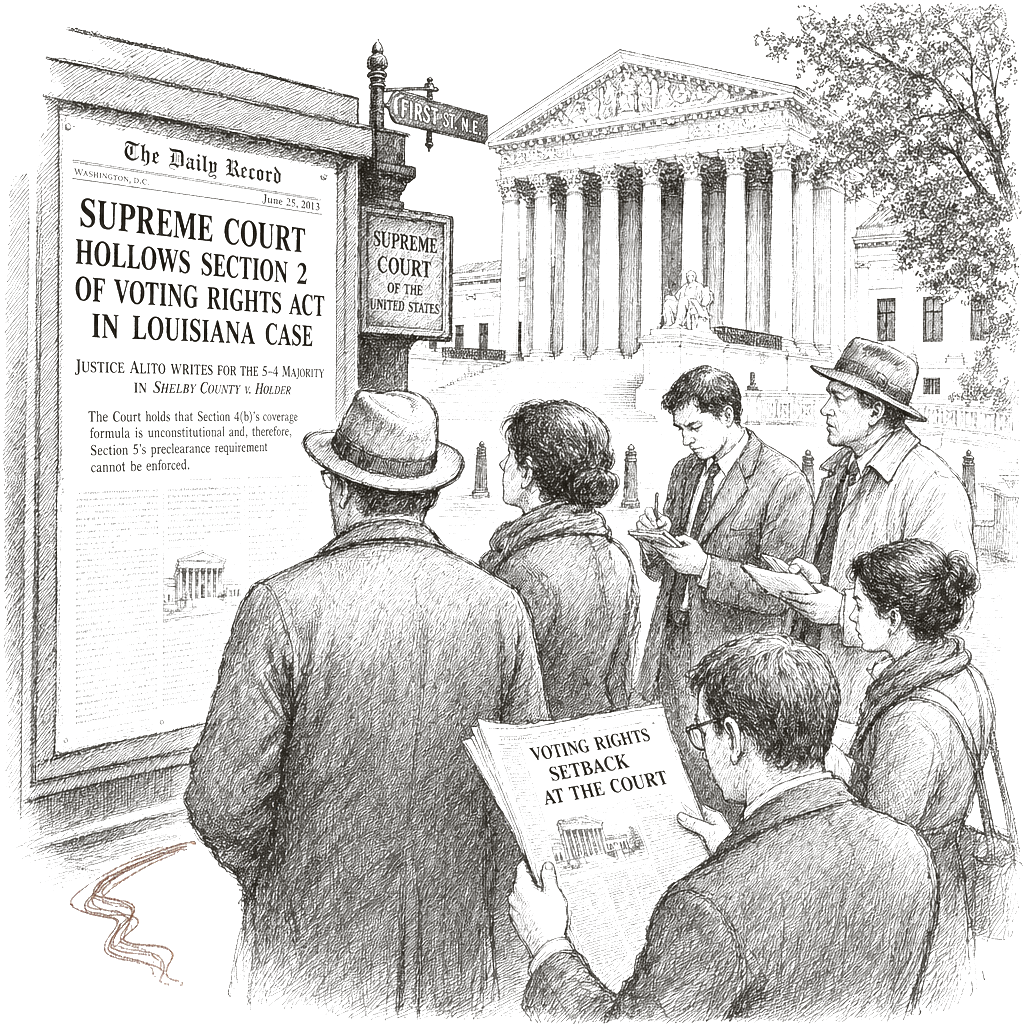
The U.S. Supreme Court on Wednesday narrowed key protections under the Voting Rights Act in a congressional redistricting case out of Louisiana, a decision voting rights advocates said hollowed out a major pillar of federal law that has protected minority voting rights for more than six decades. The ruling arrived decades after Congress passed the act in 1965, with the Supreme Court’s latest action adding to a longer line of decisions that advocates say weakened how courts can intervene when electoral maps dilute minority votes.
Advocates and lawmakers said the practical result is fewer legal tools to stop changes they argue could reduce minority representation at multiple levels of government. Cliff Albright, a co-founder of the group Black Voters Matter, said the effect would be that “entire communities can go without having representation,” adding that the decision amounts to “throwing us back to the Jim Crow era unapologetically, and that’s not exaggeration.” Kareem Crayton, vice president of the Brennan Center for Justice’s Washington office, characterized the ruling as “burying it without the funeral,” pointing to what he described as the court’s ongoing work to erode the act.
The Supreme Court’s decision centered on a Louisiana redistricting map created after the state gained a second Black representative to Congress. The court found the map to be an unconstitutional gerrymander because it took race into account to draw the district boundaries. In the opinion written by Justice Samuel Alito, the court’s conservative majority said the provision of the Voting Rights Act at issue—Section 2—was designed to protect voters from intentional discrimination.
Justice Elena Kagan, in dissent, argued that the new barrier would make enforcement difficult. She said the bar to show intentional discrimination is “an almost insurmountable barrier for challenges to any voting rights issues to prove discrimination.” The dissent set out the concern that the ruling changes what plaintiffs must establish to challenge voting discrimination under Section 2.
Voting rights experts told reporters the ruling leaves the Voting Rights Act with diminished effect. Sophia Lin Lakin, deputy director of the American Civil Liberties Union’s Voting Rights Project, said states will be able to point to partisan objectives to justify maps that strip voters of color of representation and that federal courts will have little basis to intervene. Marc Morial, president and CEO of the National Urban League, said civil-rights advocates should not frame the moment as only a partisan struggle, describing the decision as a continuation of a “frontal assault on the gains of the Civil Rights Movement” and tying it to earlier civil-rights milestones.
Civil-rights leaders also argued that the ruling could expand the tactics used to weaken minority voting strength, including in state and local elections. Maria Teresa Kumar, president of Voto Latino, said the decision will allow more aggressive “cracking and packing” of populations to dilute their votes, “not just in congressional districts but also in state legislatures, county commissions, school boards and city councils.” On Thursday, several civil rights groups held a joint news conference to condemn the Supreme Court ruling and pledge to fight its impacts.
Supporters of the Voting Rights Act credited the law with major shifts in representation over time, while critics said current doctrine threatens that progress. Sherrilyn Ifill, a law professor at Howard University and the former president of the NAACP Legal Defense Fund, said the number of Black elected officials rose from about 1,500 in 1970 to more than 10,000 today, adding that the change reflected that Black communities, civil-rights activists and lawyers had tools under the Voting Rights Act to challenge efforts to diminish voting strength—especially through Section 2 cases involving representation in local governments.
In assessing the broader context, reporters described the Supreme Court’s earlier decisions that advocates said paved the way for more restrictive election laws. The Voting Rights Act signed by President Lyndon B. Johnson in 1965 was later amended, and the biggest change came in 2013 with the Supreme Court’s ruling in Shelby County v. Holder, which ended the preclearance requirement for covered jurisdictions seeking federal approval for voting-related changes. In 2023, the Supreme Court upheld Section 2 in a redistricting case out of Alabama, a ruling that the court’s Wednesday decision effectively reversed, according to the report.
In Louisiana, the ruling placed Democratic Rep. Cleo Fields on an “endangered list,” the report said, with Louisiana’s top elected leaders—all Republicans—planning to postpone the state’s May 16 primary to redraw congressional maps. The report also described how Fields had faced redistricting complications before, and said Shomari Figures, who won the seat created in Alabama after the 2023 decision, warned the Wednesday ruling would make it significantly tougher to prove racial discrimination in future redistricting cases. Shalela Dowdy, an Alabama resident and plaintiff in the lawsuit that resulted in creating a new district represented by Figures, said she worries the decision could roll back the district created in 2023 and said putting the issue in the hands of states at that level is “dangerous.”
Relatedly, the report said the ruling comes as voting and civil-rights advocates look ahead to what comes next for minority representatives and the communities they serve—amid the expectation, voiced by critics, that political mapmakers will seek new ways to dilute minority voting strength after the Court’s change to the Section 2 framework.