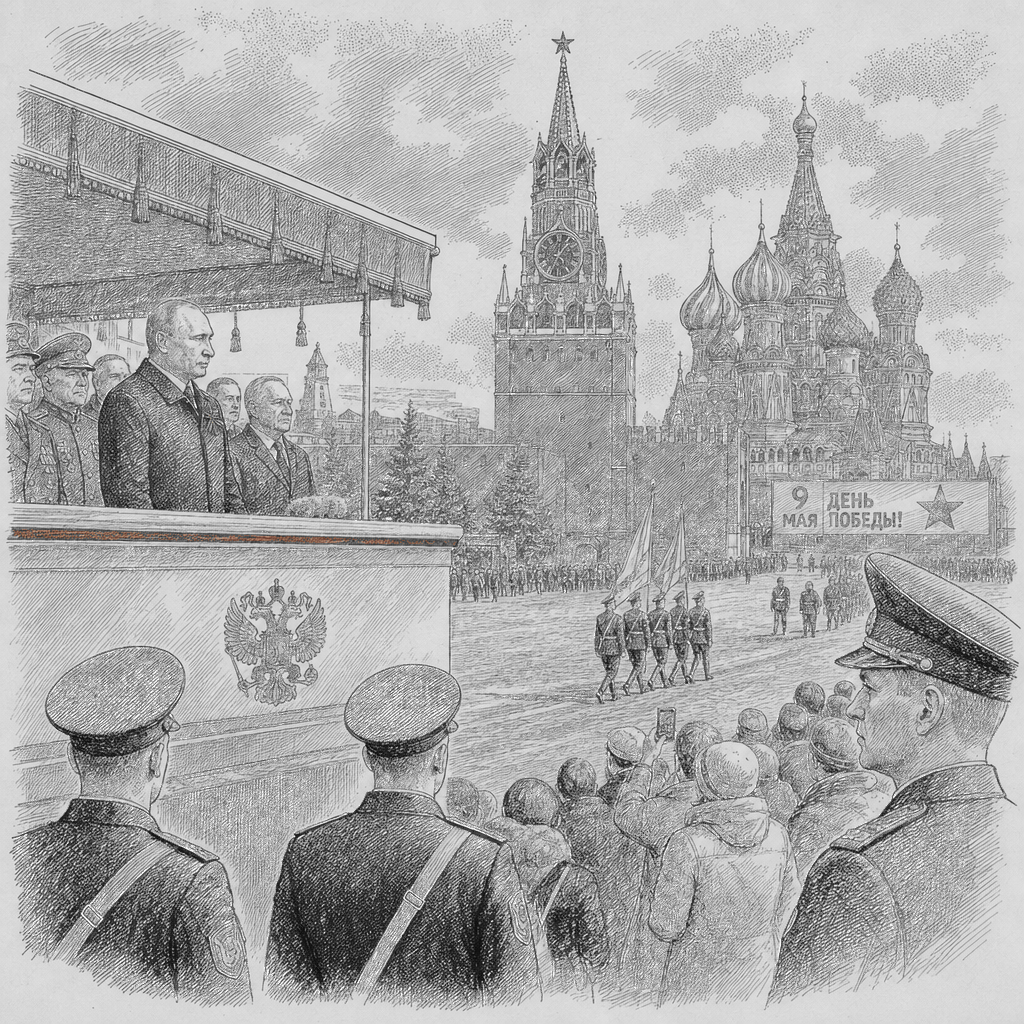
Moscow marked Victory Day on Red Square on Saturday with a scaled-down parade staged under tight security, with President Vladimir Putin in attendance and several foreign leaders joining him. The Kremlin kept the event’s footprint smaller than in recent years as Russia’s war in Ukraine entered its fifth year, and authorities worked to reduce perceived risks around the high-profile ceremony.
A key shift this year was the visible absence of heavy military hardware during the march and display on Red Square. Russian officials explained the format change by pointing to the “current operational situation” and the threat of Ukrainian attacks, and they also ordered restrictions on mobile internet access and text messaging services in the Russian capital on Saturday. Putin later told reporters that the parade did not feature heavy weaponry because the military needs it in Ukraine.
The parade occurred amid a three-day ceasefire effort that Trump announced would run Saturday through Monday and include a prisoner exchange, after earlier ceasefire attempts in the region had not held. The announcement came after President Volodymyr Zelenskyy had warned earlier that Russian authorities “fear drones may buzz over Red Square” on May 9, and the Kremlin responded to the prospect of disruption by shrugging off a Ukrainian mockery of the holiday as a “silly joke.” Even as the ceasefire brokered by Trump eased some concerns, Moscow still treated security as a central issue for the event.
At the parade, Putin commemorated the Soviet defeat of Nazi Germany in World War II and delivered remarks that tied the present conflict to that historical narrative. He hailed Russian troops fighting in Ukraine, saying they “face an aggressive force that is armed and supported by the entire bloc of NATO,” and that they are fighting for a “just cause.” Putin also said, “Victory has always been and will be ours,” as troops lined up on Red Square.
Putin’s message extended beyond the battlefield as he accused Western “globalist elites” of arming Ukraine to defeat and break up Russia. Talking to reporters after the parade, he added that “I think the matter is coming to an end,” while also describing Trump’s role in brokering a ceasefire as being driven by “humanitarian motives” and “respect to our common victory over Nazism.”
Security measures around the holiday also reflected tensions between the two sides over whether Ukraine could strike within the ceasefire window. Putin told reporters that Russia warned U.S. counterparts about potential consequences if Ukraine attempted to disrupt Saturday’s festivities, describing that control and decision-making centers in Kyiv are near diplomatic missions. He said Russia immediately welcomed Trump’s offer, after explaining that it had informed the United States and others about a planned missile strike on Kyiv’s center that it said would involve collateral damage if disruption occurred.
In a further sign of wartime alignment, Saturday’s parade featured troops from North Korea for the first time, with their appearance described as part of a tribute to Pyongyang for sending its soldiers to fight alongside Russia’s forces to repel a Ukrainian incursion into Russia’s Kursk region. Russia said the North Korean contingent reflected a broader international dimension of the conflict, even as the parade format itself was reduced compared with previous years.
Foreign participation at the festivities also underscored the political signals Moscow aimed to send. Putin praised guests who attended the parade for “personal courage,” including Malaysia’s King Sultan Ibrahim Iskandar, Laos President Thongloun Sisoulith, Kazakhstan’s President Kassym-Jomart Tokayev, Uzbekistan’s President Shavkat Mirziyoyev and Belarus leader Alexander Lukashenko. Prime Minister Robert Fico of Slovakia attended a meeting at the Kremlin and laid flowers at the Tomb of the Unknown Soldier memorial outside the Kremlin walls, but he stayed away from the Red Square parade, drawing criticism from Germany’s Chancellor Friedrich Merz, who said, “I deeply regret this, and we will discuss his visit to Moscow with him.”
In the context of shifting front lines, the Kremlin used Victory Day to project resilience as fighting continues. Russia’s military has made slow but steady gains along a front line that spans more than 1,000 kilometers, while Ukraine has carried out long-range attacks on Russian energy facilities, manufacturing plants and military depots and has developed drones capable of reaching targets over 1,000 kilometers deep into Russia. Zelenskyy has proposed negotiations with Putin for a peace deal but dismissed a Russian suggestion that he travel to Moscow, and Putin said Saturday he could meet Zelenskyy in another country only to endorse a comprehensive accord.