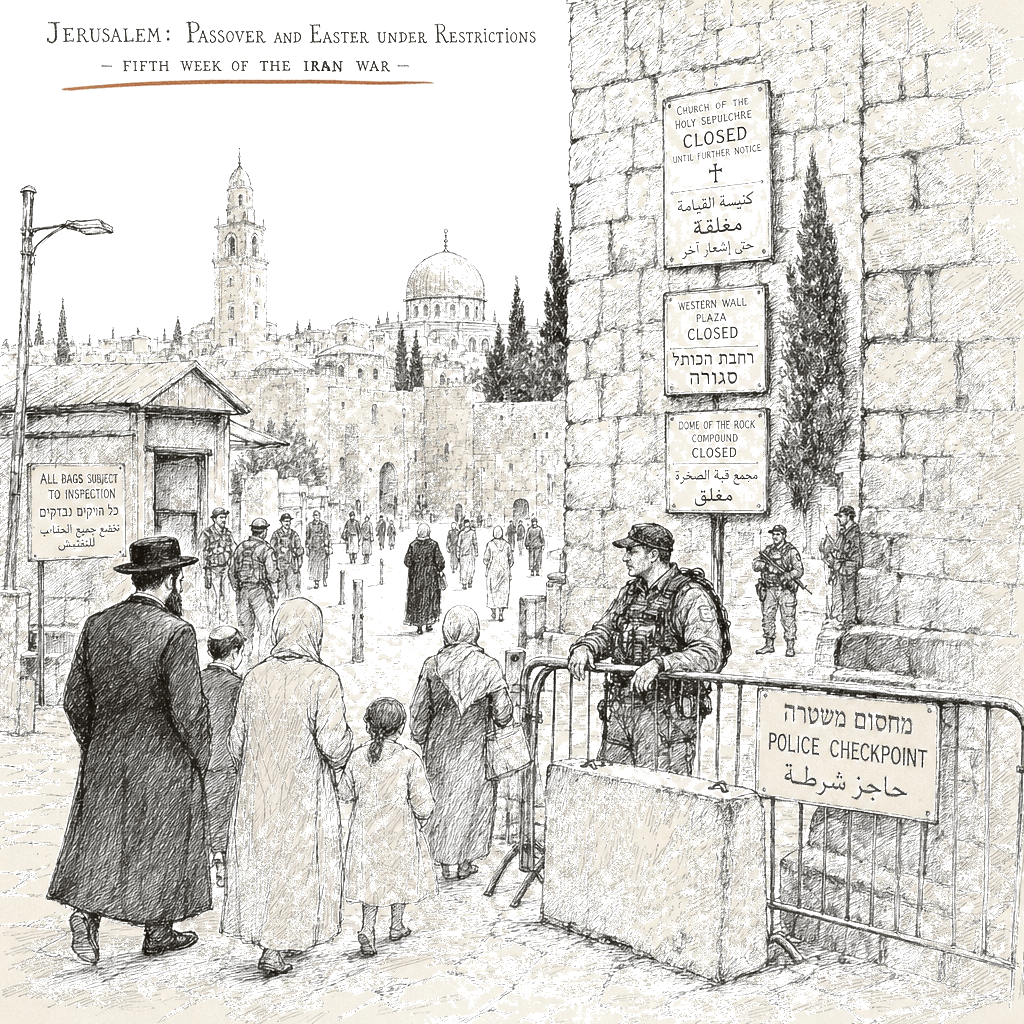
Jerusalem is heading into Passover and Easter with major holy sites shuttered and families dejected and exhausted as the Iran war enters its fifth week, according to Associated Press reporting. In a sharp break from a typical spring—when longer days usually bring family gatherings and returning tourists to the city’s key Jewish and Christian sites—much of the Old City is quiet, with metal shutters drawn and plazas missing the crowds that usually come with the holidays.
The disruption is shaped by Israeli military guidelines that limit gatherings and restrict access to places that cannot be sheltered adequately in the event of a missile attack. The Church of the Holy Sepulcher, which is revered by many Christians as the site of Jesus’ crucifixion, burial and resurrection, is closed under those rules that prohibit gatherings of more than 50 people, the AP said.
Earlier this month, AP reported, an intercepted Iranian missile sprayed shrapnel on the rooftop of the Greek Orthodox Patriarchate, steps from the Church of the Holy Sepulcher. Missile debris also hit a road leading to the Western Wall, the holiest site where Jews can pray. Rabbi Shmuel Rabinowitz, speaking from his office overlooking the now-closed Western Wall plaza, lamented what the restrictions have meant for worshipers’ ability to gather.
Rabinowitz said the massive priestly blessing for Passover, which usually draws tens of thousands, would take place with just 50 worshippers. He said that number reflects the maximum allowed for a group to pray together in the enclosed area by the Western Wall under wartime safety guidelines, which he described as reminiscent of restrictions imposed during the coronavirus pandemic.
For Easter, the Latin Patriarchate canceled the Palm Sunday procession in Jerusalem, complying with Israeli military guidelines that limited gatherings to under 50 people, the AP reported. The Patriarchate also said Jerusalem police prevented the Catholic Church’s top leaders from entering the Church of the Holy Sepulchre to celebrate Mass marking Jesus’ triumphant entry into Jerusalem.
The Church of the Holy Sepulchre called the police action “a manifestly unreasonable and grossly disproportionate measure” and said it was “the first time in centuries” its leaders were prevented from celebrating Palm Sunday at the place where Christians believe Jesus was crucified. Jerusalem police said the leaders were told they could not enter due to safety concerns, saying the site does not have adequate emergency access or shelters in case of a missile attack.
Rami Asakrieh, a parish priest for Jerusalem’s Catholics, said the community would miss the Palm Sunday procession, which he described as a deeply emotional and spiritual part of the holiday. “We are celebrating resurrection, resurrection is from death and winning the pain and the war,” he said, adding that, in his view, faith would not come by fear but by faith. Asakrieh said a local Catholic high school that was empty after classes were canceled was also hit by debris from an Iranian missile interception.
Other Christian sites are also operating at limited capacity. A Franciscan priest described Mass for up to 50 parishioners at the Saint Savoir monastery’s cavernous marble hall near the Magnificat Institute, with AP reporting that the school building has been approved by the Israeli military as a suitable shelter. Jerusalem’s smaller synagogues, mosques and churches are also open to groups of up to 50 people when they are located close to a shelter or safe space, according to the same report.
The restrictions extend beyond the Easter and Passover period into the Islamic holy month of Ramadan, which ended about 10 days earlier. The AP reported that next to the Western Wall is the Al Aqsa Mosque compound, Islam’s third-holiest site, which has stood empty since the war started, canceling prayers during most of Ramadan. Fayez Dakkak, a third-generation Old City storeowner whose shop has catered to Christian pilgrims since 1942, said he was heartbroken over Al Aqsa’s closure during the Islamic holy month, describing it as “like there was no Ramadan for us,” while saying he had tried to pray at another local mosque.
Israeli police closed Dakkak’s shop and all non-food stores in the Old City as part of the safety guidelines during the war. AP reported that Dakkak said his livelihood had already been strained for years as pilgrim and tourist numbers fell, and that while he described the closures as damaging routine and community life, he said he understood the safety context.
As residents prepared for Passover, Jewish families planned smaller, stripped-down seder dinners that commemorate the exodus from Egypt, rather than the large family gatherings typical in other years. Observant families were also cleaning for Passover, a process AP described as requiring people to “turn[] the house upside-down” as they removed traces of leavening, while also running between home and shelters during the war’s air-raid alerts. From her office at Aish, a Jewish educational institute next to the Western Wall plaza, cookbook author Jamie Geller said she could see the damage from shrapnel that dented and smashed rooftops, roads and a parking lot in the area, calling it “shocking.”