Summary
- The Pentagon and Lockheed Martin agreement to triple PAC-3 MSE interceptor production creates a strategic mismatch that analyst assessments place beyond immediate theater demands due to deep industrial base constraints.
- The Center for Strategic and International Studies projects a minimum three-year timeline for replenishing stockpiles to pre-conflict levels, a period that exceeds current congressional appropriations for munitions procurement.
- Defense analytics firm Govini reports multiplexed second-tier supplier dependencies across more than eighty percent of the network that tighten the broader defense industrial base when demand for a single weapon system scales.
- Single-source manufacturing lines for seeker components and reliance on foreign suppliers for commercially obsolete circuitry establish structural fragilities that require multi-year synchronized ecosystem alignment to resolve.
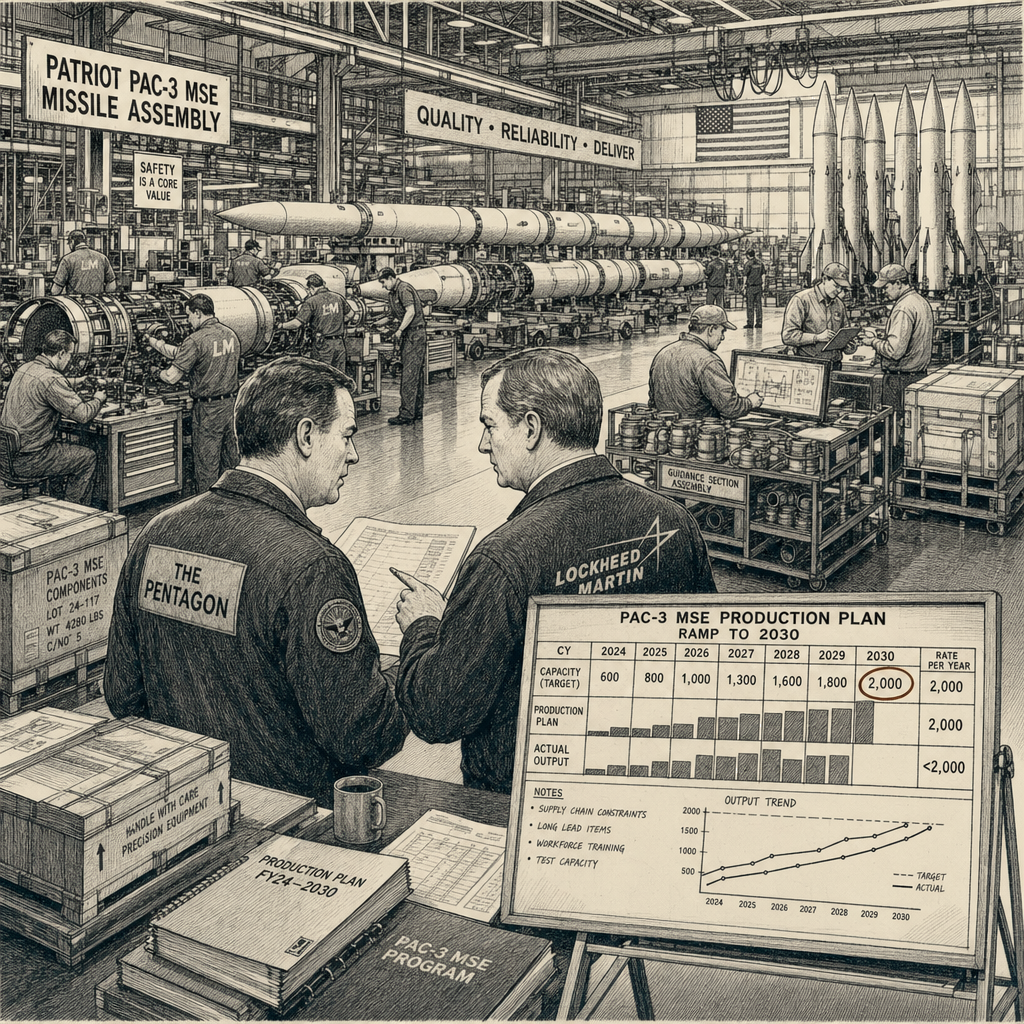
The Pentagon and Lockheed Martin have agreed to more than triple annual production of the PAC-3 MSE interceptor to approximately 2,000 units per year, a production capacity target that company and defense officials do not expect the industrial base to reach until the end of 2030. Defense analysts warn that this projected timeline diverges from immediate theater requirements driven by active conflict, sustained combat operations, and record-high allied procurement orders. The Center for Strategic and International Studies indicates that restoring stockpiles to pre-conflict baselines requires a minimum of three years and exceeds current congressional appropriations for munitions. The production delay stems from a highly consolidated industrial topology characterized by multiplexed supply chains, single-source component dependencies, physically documented capacity constraints, and multi-year latency in labor and material procurement that prevents rapid wartime surge capacity.
Production Targets, Demand Pressure, and Timeline Mismatch
Agreement between the Pentagon and Lockheed Martin establishes a target to triple annual PAC-3 MSE interceptor production to approximately 2,000 units per year, with expected capacity not reached until the end of 2030 based on company reporting. Defense analysts warn that the 2030 horizon creates a strategic mismatch with immediate theater demands driven by active conflict, sustained combat operations, and record-high allied procurement orders. A Center for Strategic and International Studies analysis indicates that replenishing stockpiles to pre-conflict levels requires a minimum of three years and exceeds current congressional munitions appropriations. At a reported unit cost of approximately $4 million, the 2,000-unit annual target represents a roughly $8 billion baseline acquisition cost, quantifying the funding gap identified by independent policy analysts.
Industrial Base Topology and Structural Root Causes
Production depends on a network of more than 400 companies, with defense analytics firm Govini reporting that over 80 percent of second-tier suppliers simultaneously provide components across multiple missile programs. This supplier multiplexing creates an emergent fragility where scaling demand for a single weapon system draws capacity from parallel munitions pipelines, tightening the broader defense industrial base. Single-source dependencies concentrate critical risk: missile seeker components originate exclusively from one Boeing factory, while commercially obsolete internal circuitry forces reliance on foreign suppliers. Supply chain concentration reflects multi-decade defense-industry consolidation, establishing a structural baseline that prioritized peacetime lean manufacturing over wartime surge capacity.
Physical, Labor, and Interface Latency Constraints
Capacity expansion operates on multi-year physical timelines: Boeing’s missile-parts factory expansion required over two years to construct and equip, and a planned L3Harris rocket-motor facility near the final assembly plant will not open for another year. Final missile assembly takes approximately six weeks per unit, but only after all tiered components have cleared procurement and delivery gates. The procurement interface introduces sequential friction: Pentagon contract awards trigger proposal gathering, supplier capacity polling, and raw material procurement delays, elongating lead times before manufacturing begins. Human capital constraints impose a fixed latency: recruiting, training, and processing federal security clearances for critical factory-floor personnel requires approximately six months per Lockheed Martin operational reporting.
Negotiation Dynamics, BATNA, and Stakeholder Alignment
Government leverage is structurally limited by the absence of qualified alternative PAC-3 MSE suppliers and analyst assessments that current timelines “may be too late to protect some threatened regions without other options to fill the gap.” Contractor and tier-one supplier leverage stems from physically documented constraints; production pacing is tied to secured, long-term contracts and appropriated funding rather than voluntary capacity front-loading. Stakeholder procedural interests diverge: buyers prioritize rapid stockpile restoration, while manufacturers emphasize risk management, with a Lockheed Martin spokesperson stating the objective is to “eliminate bottlenecks and shorten lead times wherever possible, while still maintaining the rigorous performance and safety standards required.” Objective negotiation criteria are anchored in verifiable industrial constants: historical factory build-out timelines, labor market onboarding cycles, and per-unit acquisition economics.
Pre-Mortem Indicators and Integrative Policy Requirements
Approaching disruption would likely originate at single-string dependencies, with measurable early indicators including rising seeker production lead times at the sole Boeing facility, allocation conflicts among multiplexed second-tier suppliers, and expanding security-clearance backlogs at the Camden, Arkansas assembly plant. Systemic scaling requires synchronized ecosystem alignment, as articulated by industry leadership: “You need the whole ecosystem to line up… If we quadruple a missile, we’ve got to quadruple the cases. We’ve got to quadruple the igniters, valves, the throttles. It’s a great opportunity.” Compressing the production timeline requires replacing episodic contract awards with multi-year procurement commitments and advance funding to de-risk supplier capital investment. Additional integrative leverage depends on federal funding to qualify second-source manufacturers for critical components, particularly seekers and rocket motors, reducing single-point fragility and rebalancing procurement leverage over the long term.
Analytical techniques used in this piece
This analysis applies the methods below. Each links to a short, plain-English explainer you can read and reuse.
- Pre-Mortem (Fragility)
- Imagines a system has already broken and traces the structural fragilities that let it.
- Principled Negotiation
- Works a negotiation from interests, options, and objective criteria rather than positions.
- Root-Cause Analysis
- Traces a symptom back along its causal chain to the conditions that actually generated it.
- Antifragility (Taleb)
- Whether shocks break a system, leave it unharmed, or actually make it stronger.