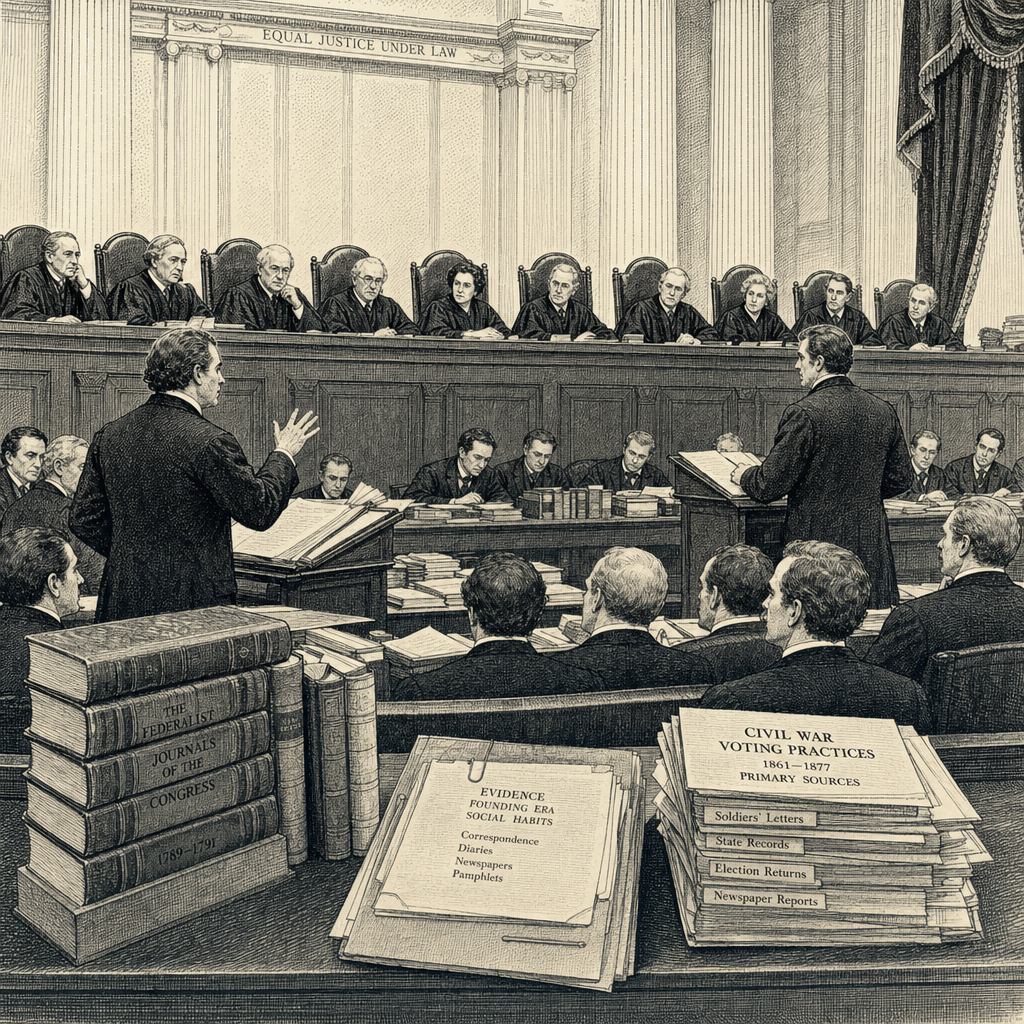
The Supreme Court’s conservative majority is leaning heavily on originalism — the doctrine that the Constitution’s meaning should be fixed by its original understanding — to decide cases that range from weapon possession by drug users to the counting of mail-in ballots and the scope of birthright citizenship. The method has pushed lawyers and justices deep into 18th- and 19th-century history, producing courtroom exchanges that critics say are increasingly strained.
In the most vivid exchange of the term, Justice Neil Gorsuch challenged a federal law that prohibits people who use illegal drugs from owning firearms. Drawing a parallel to alcohol use at the time of the founding, Gorsuch noted that many of the framers were heavy drinkers. “John Adams took a tankard of hard cider with his breakfast every day,” Gorsuch told a government lawyer. “James Madison reportedly drank a pint of whiskey every day. Thomas Jefferson said he wasn’t much of a user of alcohol — he only had three or four glasses of wine a night.” If intoxicant use automatically disqualified someone from gun ownership, Gorsuch suggested, the very authors of the Second Amendment would have been disarmed.
The case stems from a 2022 Supreme Court ruling that expanded the right to carry a gun and held that modern gun regulations must be consistent with early American historical traditions. That decision has ignited disputes nationwide over what those traditions were.
A second case before the justices deals with whether states can count mail-in ballots that are postmarked on time but arrive after Election Day. Lawyers are fighting over the relevance of Civil War-era “field voting,” when ballots from Union soldiers were collected and transported home after the election. Legal briefs cite an obscure 1915 book by Boston lawyer Josiah Henry Benton, who argued that historians had overlooked the practice, alongside archaic legal tracts and 19th-century dictionary definitions of the word “election.”
In another pending case about police sweeps of cellphone location data, lawyers debated whether warrants requiring Google to share information resembled British customs officers’ harassment of colonists before the American Revolution.
The most consequential case that may turn on historical interpretation is the Trump administration’s challenge to birthright citizenship for children of undocumented immigrants. The administration argues that the 14th Amendment’s citizenship clause, ratified in 1868, was never intended to apply as broadly as courts have long understood. To support its position, the administration submitted old newspaper articles, speeches, and documents that many historians say do not reflect the true view of the amendment’s ratifiers. Among them: an unsigned, undated, unpublished letter found in the papers of President Andrew Johnson and an 1881 treatise written by a former Confederate officer who wanted to deny citizenship to Chinese immigrants.
Chief Justice John Roberts, a history major at Harvard who often peppers speeches with historical anecdotes, appeared unpersuaded. “The examples you give to support that,” Roberts told the solicitor general, “strike me as very quirky.” Roberts is the only member of the conservative majority who does not readily identify as an originalist.
“The more this form of analysis gets extended, the stranger it becomes,” said Jonathan Gienapp, a law and history professor at Stanford and a critic of originalism. “It’s not obvious what from the past matters, and what doesn’t.”
Proponents of originalism say backward-looking reasoning is the only way to prevent modern judges or legislatures from abridging constitutional rights. “I get people who see it as sounding crazy,” said Kostas Moros, a director at the Second Amendment Foundation. “But that’s what we agreed to. If it’s not tied to that original meaning, then it means nothing at all.”