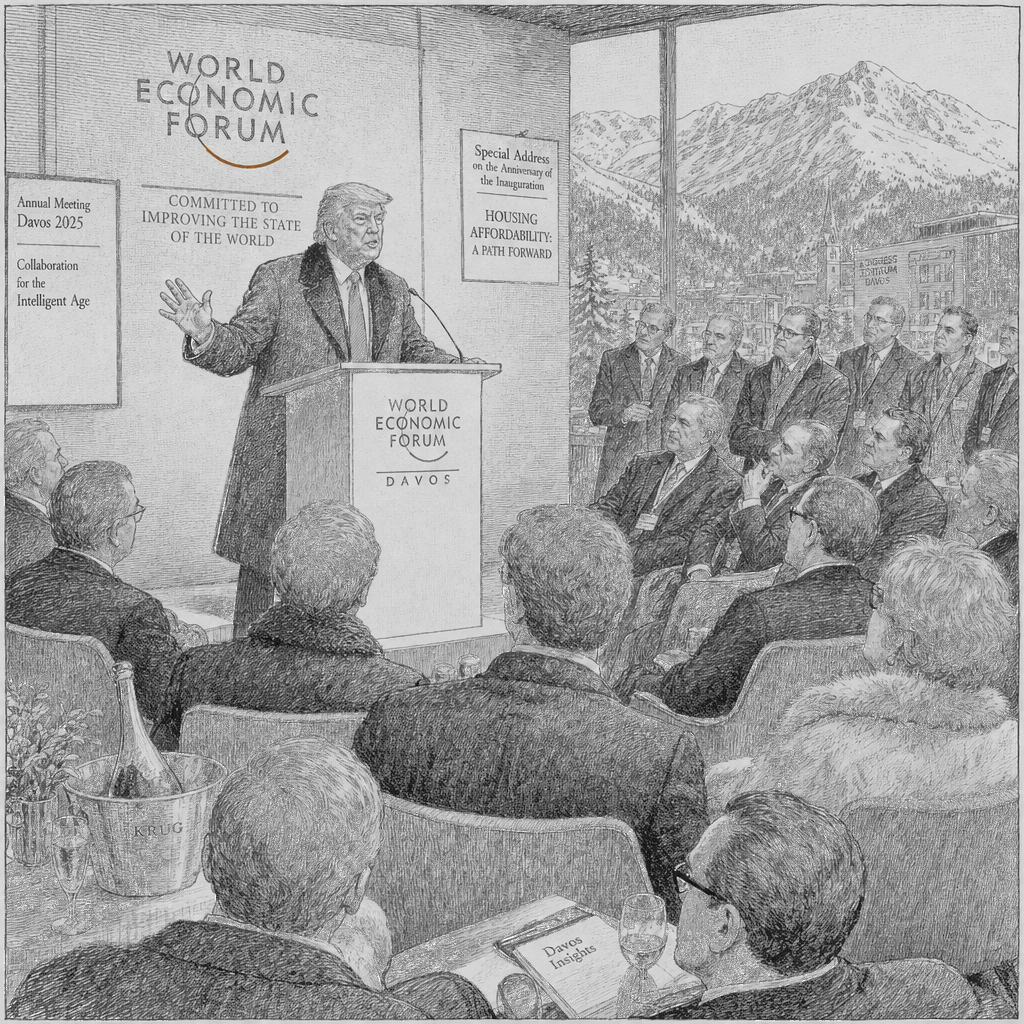
President Donald Trump plans to address housing affordability Wednesday at the World Economic Forum in Davos, Switzerland, on the anniversary of his inauguration. The speech comes in a Swiss mountain town where luxury ski chalets rent for $4.4 million—and where he may encounter many of the billionaires he has surrounded himself with during his first year back in the White House.
Trump had campaigned on lowering the cost of living, presenting himself as a populist. Yet his public schedule in office shows he has devoted more time to engaging with wealthy investors than talking directly to his working-class political base.
Affordability Message Faltering
About 60% of U.S. adults now say Trump has hurt the cost of living, according to a recent AP-NORC Center for Public Affairs Research survey. Only 16% say he has helped “a lot” on making things more affordable in his current term, down from 49% in April 2024, when the same polling organization asked Americans the same question about his first term.
Meanwhile, wealth has continued to concentrate at the top. Since his first term in 2017, the wealthiest 0.1% of Americans have seen their wealth increase by $11.98 trillion to $23.46 trillion, according to the Federal Reserve. The bottom 50% of households saw their net worth rise by $2.94 trillion over the same period—roughly one-fourth what the top 0.1% received.
“At the end of the day, it’s the investors and billionaires at Davos who have his attention, not the families struggling to afford their bills,” said Alex Jacquez, chief of policy and advocacy at Groundwork Collaborative, a progressive think tank.
Proposed Solutions Fall Short
Trump has floated housing proposals including reducing mortgage interest rates by buying $200 billion in mortgage debt and banning large financial companies from buying homes. Yet these efforts would do little to address the core problem in the housing market: a multi-year shortfall in home construction and home prices that have generally risen faster than wages.
Trump has focused his first year on foreign policy rather than affordability. He has managed conflicts in Gaza, Ukraine, and Venezuela, and is bent on acquiring Greenland, a move that has alarmed European allies and is likely to dominate his Davos visit, overshadowing his housing ideas.
“If you’re asking me, ‘Are billionaires popular?’ The answer is no—and they haven’t been for some time,” said Frank Luntz, a Republican-affiliated pollster and strategist. “Voters are more interested in the economy they’re experiencing in their own lives than in Trump’s relationships with billionaires.”
The Billionaire Inner Circle
Trump is banking on investment commitments from billionaires and foreign nations to create a jobs boom, even as his broad tariffs have crimped the labor market and spurred inflation. He regularly holds public events with the wealthy and powerful, from the White House to international travels with billionaires in tow.
He has installed billionaires in his inner circle, including Commerce Secretary Howard Lutnick (net worth: $3.3 billion) and Special Envoy Steve Witkoff (net worth: $2 billion). He also put Elon Musk (net worth: $780 billion) in charge of slashing government payrolls before a dramatic falling-out with Trump and, later, a public reconciliation.
At a September dinner with tech billionaires, Trump said: “There’s never been anything like it. The most brilliant people are gathered around this table. This is definitely a high-IQ group and I’m very proud of them.”
The Tax Equation
Trump has been trying to sell tax breaks on tips and overtime pay from what is known as the “One Big Beautiful Bill” as benefiting workers. But a Congressional Budget Office analysis indicated that middle-class families may only see savings of $800 to $1,200 a year on average, while the top 10% of earners would receive $13,600. A separate analysis by the Tax Policy Center, a think tank, said those earning above $1 million would save on average $66,510 this year.
Darrell West, a senior fellow at the Brookings Institution, said: “Most billionaires don’t share the interests of the working class. The ultrawealthy love tax cuts and deregulation, and those preferences make it difficult for government to provide the help that working class people want.”
White House press secretary Karoline Leavitt defended Trump’s focus on the wealthy. She said at a briefing: “I think it’s one of the many reasons they reelected him back to this office, because he’s a businessman who understands the economy and knows how to fix it.”
License: This article is released under Creative Commons Zero (CC0). It may be freely copied, modified, and republished under any terms.