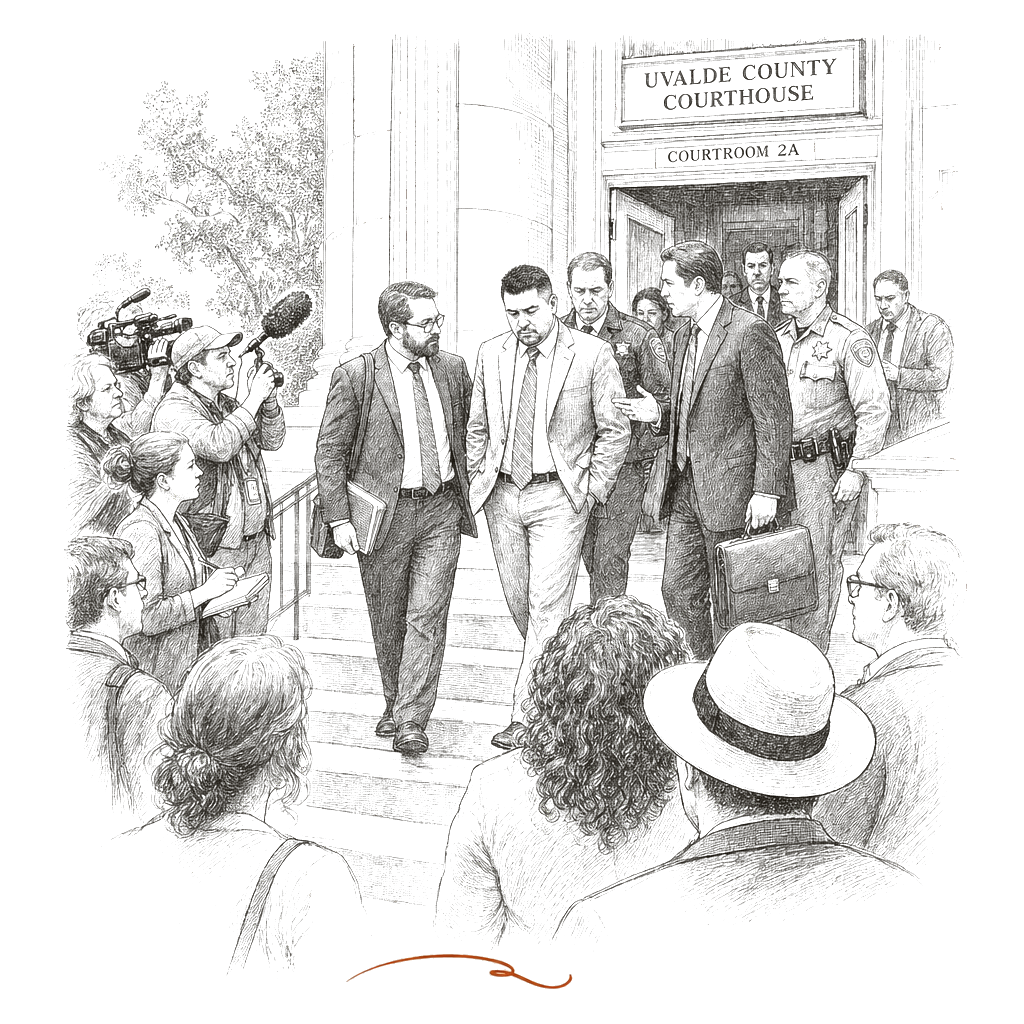
The criminal trial of former Uvalde schools police officer Adrian Gonzales enters its second week Monday, with prosecutors pressing their argument that Gonzales failed to act as a gunman approached Robb Elementary School on May 24, 2022, killing 19 students and two teachers in one of the deadliest school shootings in U.S. history. Gonzales, 52, has pleaded not guilty to 29 counts of child abandonment or endangerment.
The case is among the rarest prosecutions in American jurisprudence — a criminal charge against a law enforcement officer for alleged failure to act during a mass shooting. More than 370 federal, state, and local officers responded to Robb Elementary that day, yet it took more than an hour for a tactical team to enter the classroom and kill 18-year-old gunman Salvador Ramos.
Week one: testimony, tears, and an evidentiary setback
The trial’s opening days included recorded emergency calls, testimony from teachers who sheltered terrified students, and a mother’s account of the last conversation she had with her daughter.
Jennifer Garcia told jurors her 9-year-old daughter, Eliahna Garcia, had asked to leave school early after an awards program. The family had already contributed money toward a class pizza and movie party, and Garcia said she told Eliahna to stay.
“She wanted to come home,” Garcia said. “I told her, ‘No … stay at school.’”
The Garcia family was among the last to learn that night that Eliahna had died.
Teacher Lynn Deming, who was wounded by shrapnel when a classroom window was shot out, testified that she gathered the students and said she loved them as gunfire filled the building.
“I wanted to tell them it would be OK, but I wasn’t sure,” Deming said. “I wanted to make sure the last thing they heard was that somebody loved them.”
Jurors also viewed photographs from the classrooms and heard a medical examiner describe the wounds to the children, several of whom were shot at least a dozen times.
Prosecutors suffered an evidentiary setback when Judge Sid Harle struck the testimony of the first teacher to take the stand. Defense attorneys objected that her description of the gunman’s location outside the school — testimony that would have helped place Ramos near Gonzales — had not been disclosed before trial. Harle denied a mistrial request but instructed the jury to disregard her account entirely.
Prosecution’s case: a trail of bullets, an absent officer
Prosecutors allege Gonzales was among the first officers to arrive and abandoned his active shooter training by failing to engage or distract Ramos as the gunman fired his rifle outside the school. They say he failed again minutes later, when a group of officers entered the building and then retreated under heavy gunfire.
Students inside the classroom with Ramos were calling 911 during that period.
“When a child calls 911, we have a right to expect a response,” special prosecutor Bill Turner said in opening statements.
Prosecutors are relying heavily on a trail of shell casings and bullet impacts outside the school to argue Gonzales was close enough to the gunman to see him and intervene in the early moments of the attack.
Defense: Gonzales never saw the gunman
Defense attorneys said Gonzales never saw Ramos outside the school and that he helped students evacuate from other classrooms during the response. They also noted that Ramos was able to enter the building quickly through an unlocked door.
The second week is expected to include testimony from police training experts and, potentially, additional families of victims. It was not known whether Gonzales planned to testify in his own defense.
A rare prosecution, with a cautionary precedent
Gonzales and former Uvalde schools Police Chief Pete Arredondo are the only two officers who responded that day to face criminal charges. Arredondo’s trial has not been scheduled.
Prosecutors face a high bar for conviction. A Florida sheriff’s deputy was acquitted by a jury after being charged with failing to confront the gunman during the 2018 Parkland school massacre — the first such prosecution in the United States stemming from an on-campus shooting.