
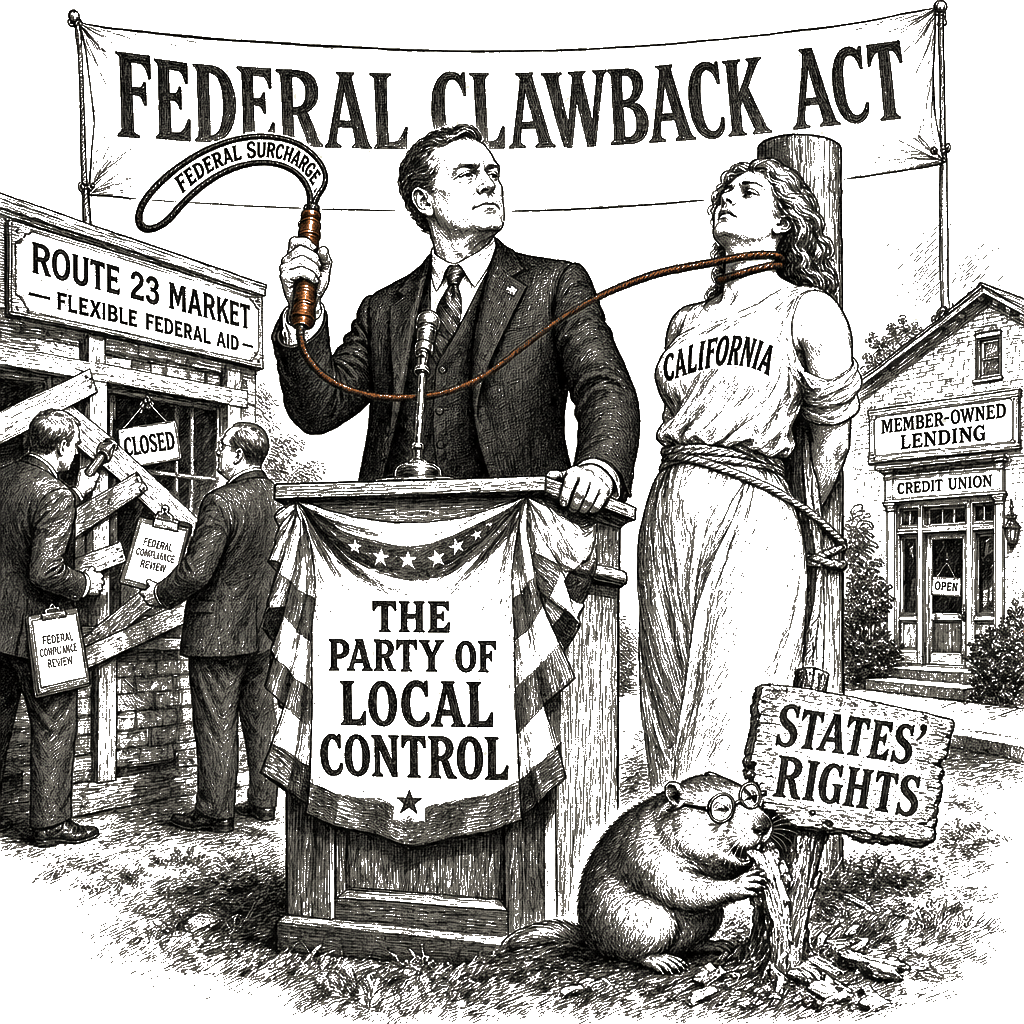
They borrowed twenty billion dollars on your signature and then spent the windfall on lottery tickets, and the man conservatives have chosen to hold them to account wants Washington to strap the debtor to a table and turn the crank. Will Swaim, writing “Payback for Gavin Newsom’s Fiscal Folly” in National Review, celebrates Representative Vince Fong’s bill to force California to repay its outstanding federal unemployment-insurance loans by commandeering future flexible federal aid — a mechanism that wraps a legitimate grievance in the very kind of federal coercion the conservative movement once existed to oppose.
I concede the frustration Swaim channels, because the frustration is earned. California’s governor borrowed $20 billion in May 2020 and never repaid it, leaving employers in his state to absorb a rising federal surcharge — $21 per employee in 2022, climbing to $105 by this December — while the principal swells toward $23 billion. That debt falls on small businessmen who had no say in the borrowing, and a governor who found $12 billion for a recall-year stimulus check somehow cannot find a dime for the federal loan his own administration tapped. I see that surcharge on the quarterly statements of every small shop I know, a line item that rises automatically on the payroll of the machine shop in Adams, the diner in Friendship, the little engine-repair garage my neighbor runs. That is not governance; it is moral hazard dressed in a press release. Swaim is right to be disgusted, and I share his disgust.
But the remedy he applauds is a betrayal of the very federalism the conservative movement claims to defend, and it is one installment in a longer surrender they have been making for thirty years — a slow, unannounced abandonment of every rooted thing they once said mattered.
Let me show you what I mean, not with an abstraction but with a piece of pavement I drive every morning. In 2018, a community development grant from the federal government helped a group of farmers and storefront owners reopen the only grocery within fifteen miles of Roche-a-Cri Creek. The building had been empty for four years; the previous operator had closed after the railroad shed its last full crew, and the nearest supermarket was a forty-minute round trip for anyone who didn’t want to pay the convenience-store markup. The grant money came through the kind of flexible federal-aid program Fong’s bill would have commandeered — a rural economic development fund, discretionary, routed through the state. If California’s debt had been Wisconsin’s, and if a congressman from the other side of the state had decided the federal Treasury should seize every flexible dollar until a state loan was repaid, that grocery would have stayed shuttered. The owners who pooled their savings, the farm families who now sell eggs and honey on consignment, the retired couple who no longer have to drive to Wisconsin Rapids for a gallon of milk — all of it would have been sacrificed to a federal creditor, without a single vote cast, without a single hearing in the town that would bear the cost.
It is the same species of indifference that let the private-equity fund buy the nursing home in this county and bill the residents’ estates for the privilege of extracting the equity. It is the same assumption that a distant institution — a Washington committee, a New York firm — knows better than the people who live in a place how to arrange its urgent business. The conservative movement once understood that distinction. They are forgetting it as fast as they can.
Fong’s bill does not simply demand repayment. It seizes federal aid dollars — the money Congress appropriates for every state’s roads, schools, and public health — and redirects them to satisfy a creditor in Washington before the state can spend a cent on its own priorities. The mechanism does not respect California’s sovereignty. It punishes it. And the punishment is not a penalty for a contractual breach; it is a pre-emptive strip-mining of federal-state relations, a declaration that Washington knows better than Sacramento how to order a state’s books, and that the price of disagreement is the loss of every flexible dollar in the pipeline. I used to trade paper tied to state debt; I know what a federal lien that bypasses the state’s own taxing authority does to the bond market, and I know what it does to the small towns whose grants disappear because Washington wants its pound of flesh. The surcharge Swaim resents — the one that rises every year on California employers — is accountability. It falls on the people whose elected officials made the mess. They can vote them out. They can demand repayment from Sacramento. They can organize. That is democratic accountability, the kind that used to be the conservative movement’s answer to every crisis. Fong’s bill replaces it with a federal enforcement action, and once that precedent is set — once Congress can order the Treasury to intercept any state’s flexible aid because the state owes the federal government money — there is no limiting principle. The National Review of 2036 will be reading about the progressive congressman who seized Wyoming’s highway dollars to enforce a climate mandate, and it will have no standing to object, because the mechanism was cheered as good government when it hurt Gavin Newsom.
The conservative tradition I was raised in — the Burke and Nisbet and Kirk that formed me — insisted that a free society rests on distributed power and local accountability. It distrusted concentration, whether in the corporate boardroom or the federal agency, and it believed the people closest to a problem must bear the cost of fixing it. The state that borrowed recklessly should repay, and its voters should feel the consequences until it does, through their own legislature and their own ballot box. But the mechanism for that accountability is the state’s own electorate and its own institutions, not a congressman from Bakersfield with a statutory lever. When a conservative magazine celebrates a federal clawback as the solution to a state’s profligacy, it has abandoned the architecture of its own tradition and embraced the very centralization it once stood against.
There is a way out of this, and I have seen it work in a place that gets almost no attention from Washington. Near the center of this county, a credit union that started with nothing but member capital two decades ago has been quietly absorbing the small-business losses that the federal-aid cycle cannot reach. When a local hardware store nearly folded under a debt it owed to a distant bank, the credit union didn’t ask the state to seize the owner’s other grants. It restructured the note, stretched the term, accepted the risk that a distant underwriter would have scorned, and the store is still open — because the people making the decision could see the building from their own parking lot. That kind of distributed, member-owned institution is the only durable answer to a problem like California’s: people who will have to live with the consequences, solving the problem at the lowest competent level, without a whip from Washington. It is harder, slower, and far less satisfying than a bill that puts a whole state in fiscal receivership. But it is the only answer that conserves the one thing the movement still claims to care about: the capacity of a free people to govern themselves, in the specific places they call home.