
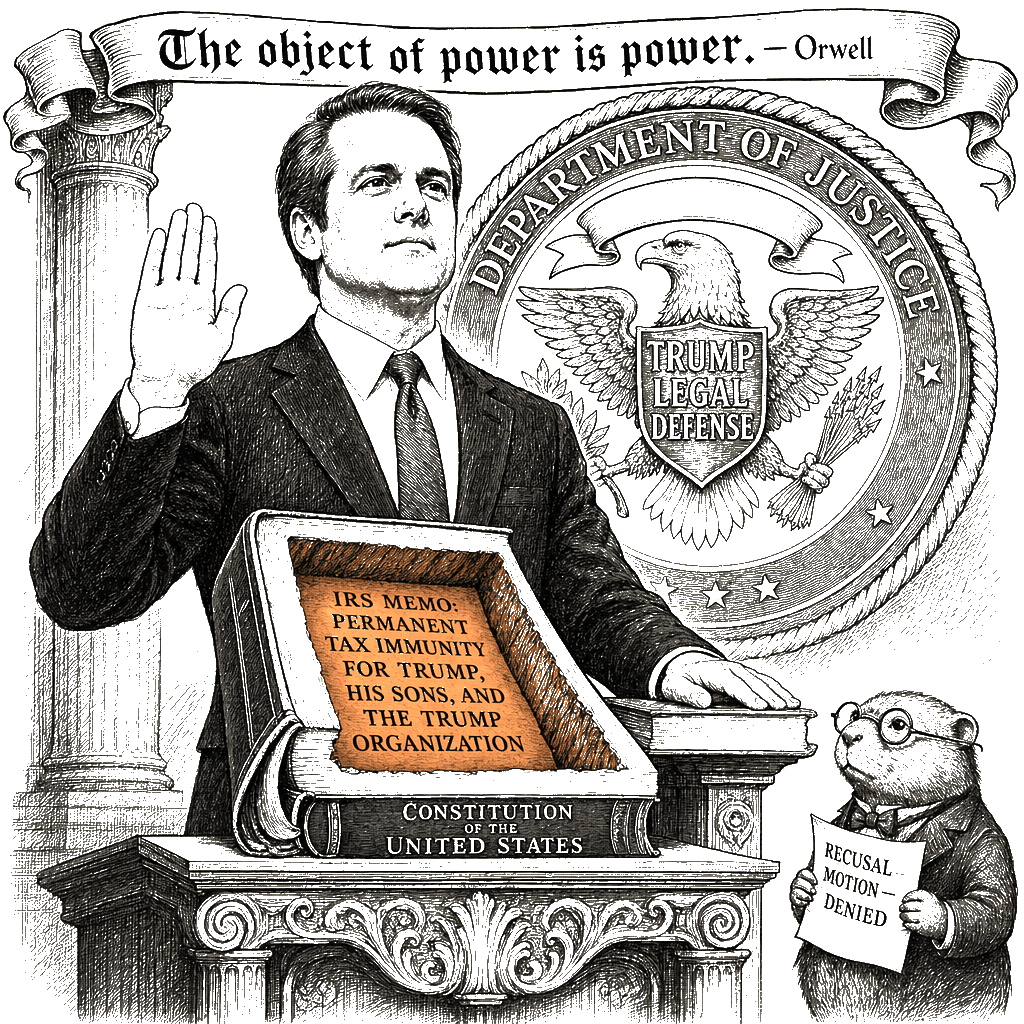
Donald Trump is installing his criminal defense lawyer as Attorney General to kill any investigation of himself.
The president on Monday formally nominated Todd Blanche, his personal attorney in the Stormy Daniels hush-money case—in which Trump was convicted on 34 felony counts in New York State court in May 2024—the federal classified-documents case, and the election-obstruction cases, to serve permanently as the nation’s chief law enforcement officer. Blanche has been acting attorney general since April, when Trump fired Pam Bondi. The nomination will require Senate confirmation, but a Republican majority that has yet to block a single Trump appointee is unlikely to start now.
The White House’s argument for Blanche will rest on his prior experience as a federal prosecutor and his claimed insight into the “weaponization” of the justice system. In this telling, a defense lawyer steeped in the alleged abuses of the prosecutorial apparatus is the right person to restore impartiality. It is a recognizable legal argument: that an advocate who has seen a system’s defects from the inside can be trusted to correct them. It might even work on a few senators.
What makes the argument collapse—what makes it a cover story—is the record Blanche has already built as acting attorney general.
In the two months since he took the job, Blanche has signed a Justice Department memorandum permanently barring the Internal Revenue Service from auditing or pursuing past tax claims against Donald Trump, his two sons, and the Trump Organization, as the Guardian reported. A sitting attorney general used the signature authority of his office to immunize the president, his children, and their businesses from tax enforcement—the same family he had just finished defending in criminal court. Under 28 U.S.C. § 528, the federal recusal statute, an officer of the Department must withdraw from any proceeding in which the officer’s impartiality might reasonably be questioned or where a personal financial or professional interest exists in the outcome. The recusal threshold exists precisely to prevent a sitting president’s former criminal-defense counsel from wielding departmental authority to shield that client from federal tax enforcement. Blanche’s directive substitutes administrative immunity for the ordinary enforcement process, foreclosing the congressional mechanism designed to police executive financial compliance.
Around the same time, Blanche presided over the creation of a $1.8 billion fund, housed at the Justice Department, designed to compensate individuals convicted of crimes in the January 6 attack on the Capitol, including those who pleaded guilty to assaulting police officers. The fund, which MSI reported in detail, was described by Representative Rosa DeLauro as “a slush fund to pay out violent criminals.” Republican members of Congress revolted. Brian Fitzpatrick, a Pennsylvania Republican, drafted legislation with bipartisan support to explicitly block the creation of the fund. Blanche abruptly announced its cancellation on Tuesday. But the design of the fund, its scale, and its placement inside the department headed by Trump’s lawyer reveal the actual purpose of the Blanche-led Justice Department: to function as the legal-protection arm of the Trump political operation, not as an independent enforcer of federal law.
The pattern extends beyond the fund. Under Blanche’s direction, federal prosecutors brought criminal charges against James Comey, the former FBI director, as part of an escalating investigation into former CIA director John Brennan—the two most prominent career officials Trump has targeted for retribution. Meanwhile, the department removed from its website the press releases documenting the prosecutions of January 6 defendants—the public record of one of the largest federal law-enforcement efforts in American history, erased.
The same impulse governs Blanche’s handling of the Jeffrey Epstein files. A Democratic senator, Chris Van Hollen, confronted Blanche at a hearing last month about his two-day interview of Epstein’s convicted associate Ghislaine Maxwell, “and shortly thereafter, she was moved to a lower-security prison camp with special perks.” Van Hollen put the charge flatly: “You are still acting as the president’s personal lawyer, not as acting attorney general.”
That sentence names the structural reality. The structural fusion eliminates the Department’s remaining check on executive criminality—the career-prosecutor independence that survives political appointment cycles—by replacing it with a chain of command terminating in the President’s own defense counsel. An honest application of the neutrality principle requires the attorney general to recuse from any proceeding touching the President’s personal legal exposure, to submit the tax-directive authority to independent judicial review, and to allow the ordinary appropriations process to govern any compensation framework. A constitutional posture demands that charging authority be administered without reference to the President’s private liabilities.
The documented pattern—tax immunity, political-associate leniency, concurrent opposition-prosecution escalation—is not anti-weaponization. It is the consolidation of prosecutorial power as a personal defensive instrument.
The Senate will pretend to deliberate. It will ask Blanche about his “impartiality” and accept his answers. The confirmation will proceed. And the Department of Justice will become, in law and in fact, the legal arm of the Trump presidency. The plan is not subtle. The plan is impunity. The only question is whether anyone outside the building will say so before the final vote.