
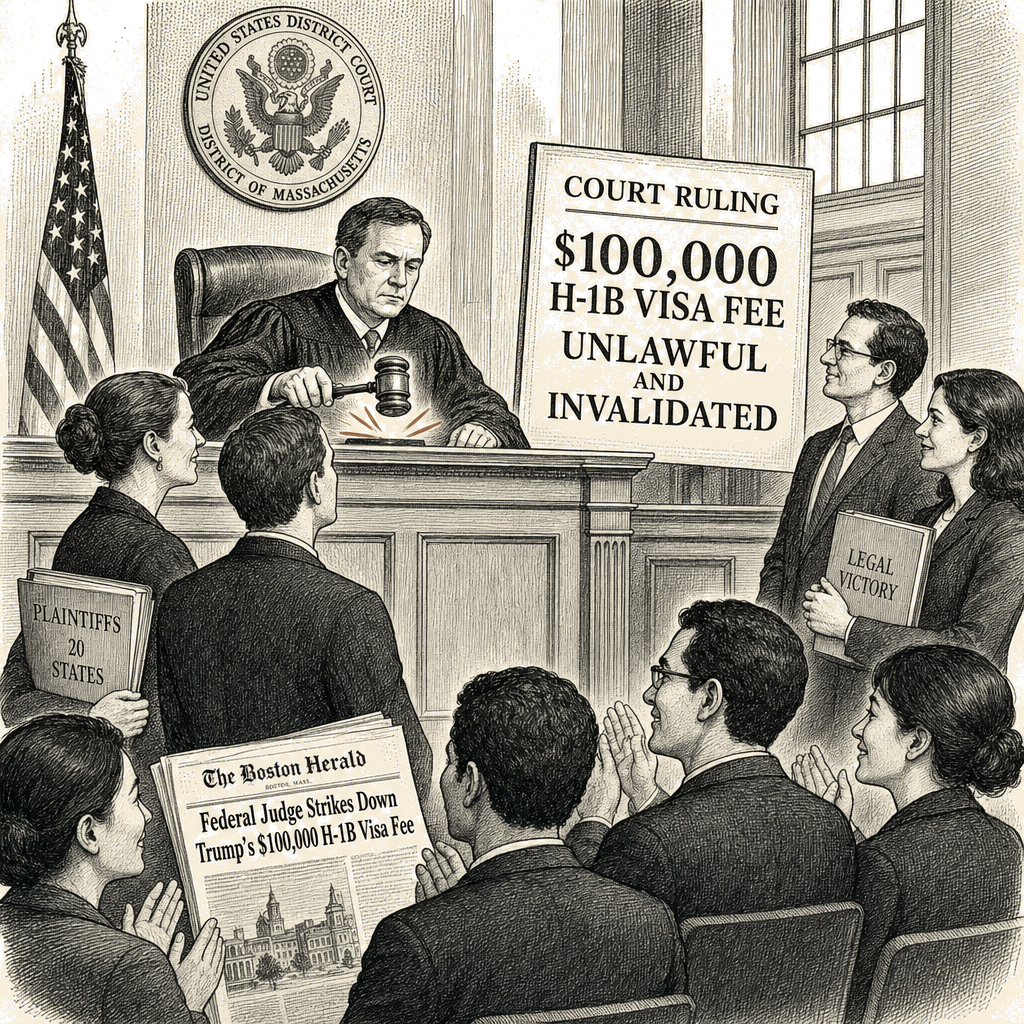
The Trump administration is trying to invent a hundred-thousand-dollar immigration tax by executive fiat. United States District Judge Leo Sorokin ruled Monday that the levy against H‑1B visa petitioners is unlawful and must be invalidated, striking down the September 19, 2025 directive that bypassed Congress to price skilled foreign labor out of the country. The ruling in the twenty‑state challenge forces the White House back to the legislature, where the power to tax actually resides. The authority to set immigration fees belongs to lawmakers. It does not belong to a president with a Sharpie.
The administration’s legal posture rests on a familiar statutory stretch. Federal law grants the Department of Homeland Security broad discretion to manage the admission of foreign nationals and to recover the administrative costs of processing their applications. Under this reading, a presidential order instructing DHS to assess a $100,000 surcharge per new petition falls within that delegated authority. If the executive branch can categorize the payment as a user fee—a direct charge meant to offset a specific government service—and if it can plausibly justify the amount as compensation for security vetting, adjudication burdens, or labor-market protections, the policy would survive ordinary administrative-law review.
The levy is not a user fee. It is a tax. The Constitution reserves the power to lay and collect taxes to Congress, in Article I, Section 8. Administrative agencies cannot conjure revenue-generation authority from general immigration-management statutes. Judge Sorokin’s ruling tracks the Administrative Procedure Act, which requires executive agencies to act only within the scope of congressional delegation and to follow established rulemaking procedures. Where the Immigration and Nationality Act specifies statutory filing fees, an executive order cannot overwrite those rates by decree. The administration sidestepped the required notice-and-comment process—the public-input mechanism built into administrative law—and routed the policy through a sweeping September directive instead, treating statutory procedure as an obstacle rather than a requirement.
The H‑1B surcharge is one node in a broader executive campaign to rewrite immigration administration without legislative enactment. The administration has spent the year attempting to revamp green‑card processing by forcing applicants to file from overseas, shifting administrative burdens and effectively restricting legal immigration through procedural friction. It has moved to make it easier to fire eight thousand senior federal workers by executive action, hollowing out the civil service by edict. The visa fee is the monetized version of that impulse. If Congress would not abolish the H‑1B program, the executive branch would simply ban it. Price it out of existence. It would have worked. A hundred-thousand-dollar surcharge, layered atop existing filing costs, legal compliance, and corporate risk, transforms a statutory pathway into a de facto prohibition. Silicon Valley, research hospitals, and Fortune 500 R&D labs rely on H‑1B talent. The fee would have turned their hiring pipelines into dry creek beds. It would have decapitated the supply chain for engineers, physicians, and data scientists, pushing them toward Canada and Germany. America does not preserve its competitive edge by severing it.
The statutory authority to set processing charges cannot legitimately stretch to a hundred-thousand-dollar per-petition cash grab. No legitimate delegation permits the executive to price an entire occupational class out of the American labor market through a flat, wealth-barrier levy. The figure does not reflect adjudication costs. It reflects a deliberate tax on brainpower. A ban by another name. The White House is not a licensing bureau. The Justice Department will appeal to the First Circuit, almost certainly arguing that the president can regulate immigration through the spending power and freeze the injunction pending review. That argument should fail. The same administration that has governed by executive decree has been told, in a ruling with immediate practical effect, that its lawless experiment has a cost. The bill came due on Monday. For the first time in a long time, the president did not get to write the check.