
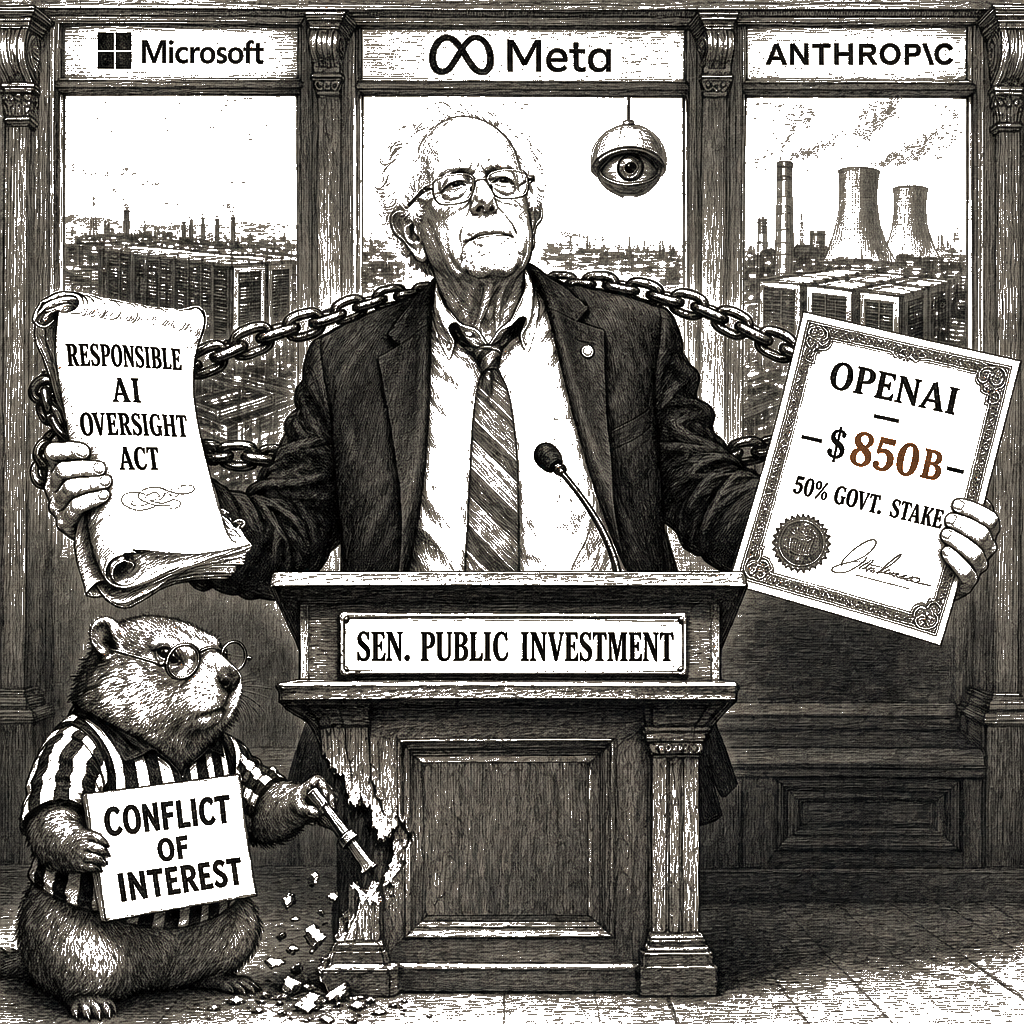
Democrats and the independent who caucuses with them aim to make the state a shareholder in the companies they claim to regulate.
It is fair to say that the senators have a point, in the narrow sense in which career legislators usually do, when they propose human oversight for weapons systems, taxes on data-centre electricity, and public stakes in the companies that run the models. The trouble is that the framework they are applying to artificial intelligence treats the technology as a sudden moral panic, rather than as the predictable output of a compute market where the four forces that used to discipline corporate behaviour — competition, regulation, self-help interoperability, and labour — have been systematically dismantled. And the same political alignment that is offering those reforms is also, through one of its loudest voices, proposing to make the federal government a business partner of the very industry it would be policing. That is not an oversight; it is an arrangement.
The Anthropic-Pentagon dispute that triggered the legislation is the clearest test case of this extraction. Microsoft recently asked the courts to block the Pentagon’s refusal to procure Anthropic’s models, while Anthropic’s management asked the Pentagon to promise in writing that it would not use Claude for autonomous weapons or domestic surveillance. The Defence Department declined, on the ground that its existing protocols already forbid both. It is true that the protocols forbid it; the Department’s standing rules require meaningful human control over the release of lethal force, though its own directive dates to 2012 and has been largely aspirational. The trouble is that a protocol is not a guardrail. And here it is worth being precise about what “the model” actually is, because the regulatory discourse has the misleading habit of treating the system as a static thing rather than as a continually-tuned set of weights serving a relentlessly-revised objective function. When a company hands an inference API to a defence contractor, it is handing over a black box whose behaviour shifts with every batch of new training data and every prompt-engineering tweak the contractor makes to maximise mission throughput. The Pentagon does not need a new promise from Anthropic. It needs the legal authority to audit the weights, the deployment environment, and the targeting thresholds that the contractors actually run. As military leaders have already warned, handing a continuous-inference loop over to an opaque vendor is not automation; it is a liability sink.
The infrastructure layer is where the extraction becomes measurable. The senators proposing that tech companies pay for the electricity their data centres consume are finally reading the physical receipt. Hyperscaler power-purchase agreements for nuclear baseload — Microsoft’s twenty-year commitment to Three Mile Island, Meta’s for the Clinton plant in Illinois — are not proof that the technology is ready for general deployment. They are proof that the technology has a voracious, continuous appetite for grid capacity and water, and that the appetite is growing faster than the revenue. The gap between the capability claims on the earnings call and the actual margins on the inference layer is the bezzle — the interval Kindleberger and Galbraith named, which Cory Doctorow borrowed for his 2024 novel, in which the embezzler has his gain and the ratepayer has not yet looked at his bill. When one senator proposes a public investment fund to take fifty-per-cent stakes in these companies, and another proposes taxing them, they are attempting to close a gap that should have been closed by competition. The compute market is a monopsony on the supplier side and a monopoly on the consumer side, with three hyperscalers controlling the cloud inference API layer that every contractor must use. The platform extracts the surplus from both.
Sen. Bernie Sanders, an independent from Vermont who caucuses with the Democrats, called last week for that government investment fund. The idea might have been dismissed as a campaign-trail provocation had OpenAI’s chief executive, Sam Altman, not met with Sanders and then released a statement calling such an arrangement “appropriate.” OpenAI is currently valued at approximately $850 billion and earns most of its revenue licensing models to enterprises and — more to the point — to the Pentagon itself. A government that owns half of the company selling AI to the military will, when the time comes to decide whether that use is safe, have a financial stake in saying yes. Regulators are not allowed to own the companies they regulate for the same reason referees are not allowed to bet on the game. The Democratic package — and it is a package, even if individual bills will proceed separately, with the Sanders proposal now providing a kind of ideological spine — is a catalog of overlapping incentives. Sen. Elizabeth Warren wants new taxes on AI firms, which sounds like a penalty but in practice serves as a cost of doing business that the largest firms can absorb and smaller rivals cannot. Sen. Mark Kelly and others propose “oversight of powerful models,” phrasing that invites a licensing regime in which only well-financed incumbents meet the compliance threshold. Schiff’s data-centre provision, meanwhile, would make it harder for newcomers to secure the electricity that training runs require. None of this happens by accident. History shows the pattern: when dominant firms champion safety standards, it is rarely because they have found conscience; it is because the standards being proposed will erect barriers to entry that entrenched firms are uniquely positioned to clear.
I will concede the platform’s strongest case, which is that the current generation of large language models is genuinely useful in well-defined domains, at substantial cost. It is. The discipline I was trained in — the formal verification of cryptographic protocols — has a useful concept here: you cannot verify a system whose specification you cannot write down. The models do not have a specification. They have a fundraising document, a capability benchmark, and a KPI target set by a management team that is under pressure from shareholders to show that the trillion-dollar capital-expenditure cycle is producing profit rather than just burning watts. The “AI safety” rhetoric the companies use to lobby for light-touch oversight is not a safety argument. It is a regulatory-capture argument. The companies want a federal standard that they can afford to comply with, which will serve as a barrier to entry for anyone who cannot. The history of AI safety discourse already displays the dynamic — the biggest firms champion “alignment” research and model-testing requirements that their own in-house teams are funded to perform, while startups would be bankrupted by the bill.
The solution to the AI regulatory problem is not a new tax, though a tax on the megawatt-hours and the water drawn from municipal aquifers would at least force the cost accounting onto the balance sheet where it belongs. The solution is to apply the same disciplines that once constrained other concentrated industries: competition law, interoperability mandates, and a privacy regime that gives individuals, not agencies, the right to sue. The remedy is to treat the inference layer as the public utility it has become, with open standards mandated at the API level, a federal right to audit trained models for safety and copyright compliance, and bright-line statutory bans on domestic-surveillance deployment and autonomous targeting that do not depend on the goodwill of a Pentagon procurement officer. Schiff’s bill is right to demand a human in the loop. But the same political coalition that is writing that bill is also, in the next room, entertaining a plan that would make the government a shareholder in the firms that produce those very systems. The two commitments cannot coexist; one will consume the other. A regulator who owns stock in the regulated is not a regulator. He is a portfolio manager. And the Dow does not enforce the Sherman Act.