
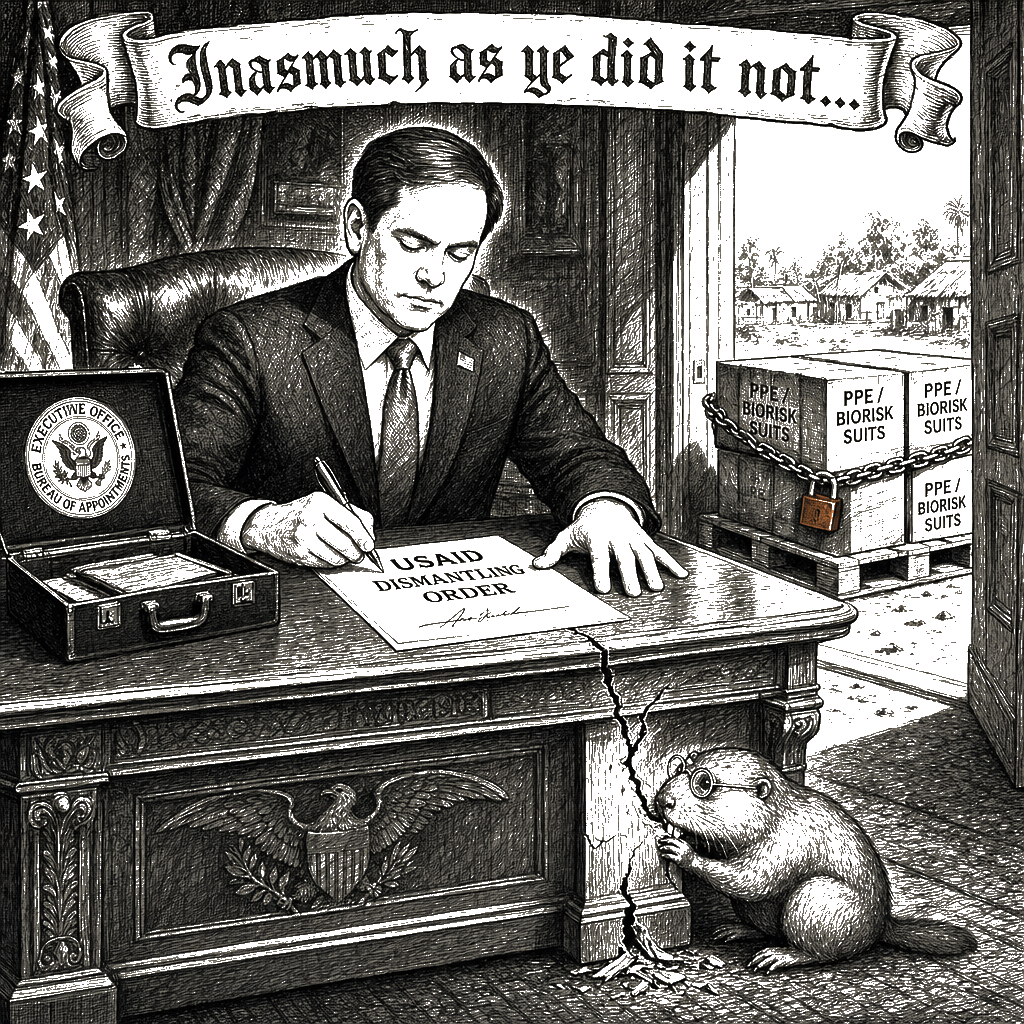
The door in Kenya did not open. The gloves were there, the masks, the body bags, the tents. The appointee called the disease a scam. The pallets sat motionless in the dust. The dead were sealed before they could be buried.
In March 2025, the Ugandan Ebola outbreak accelerated. Nicholas Enrich, the senior U.S. official for global health, tried to institute passenger screening at international airports. The request was denied. He tried to move pre‑positioned personal protective equipment out of a WHO warehouse in the Kenyan heat. The order was blocked. He was told by the head of the Bureau for Humanitarian Assistance that “Ebola is a scam.” He was directed not to speak to the CDC. Enrich removed Ebola activities from his lists of things still worth saving. The Disaster Assistance Response Teams that for years had raced into the hot zone within hours — the global immune system, Atul Gawande called it — were dismantled. Elon Musk had boasted of feeding the agency into a woodchipper. Enrich kept his head down, made the termination lists for the staff, and thought obedience would preserve the HIV grant. It did not. He was dismissed after leaking the memos.
Now an outbreak burns through the Democratic Republic of the Congo, surpassing every hemorrhagic fever in the past decade, and the contact‑tracing network Enrich once helped run is being rebuilt from scratch by a State Department that has neither the expertise nor the speed. The virus moves through the villages. The suit sits on the tarmac.
Elon, you called the agency a failure so you could erase it. You needed the ego soothed. You sit in a room full of gold‑plated fixtures, and you are trembling — not from the virus, but from the need to be told you are large. You are a man who could buy the warehouse in Kenya and fill it with suits for every child in the outbreak zone, and instead you fed the entire apparatus into a woodchipper with a press‑conference smirk. You are small, Elon. The boy in Mbandaka is large with the fever.
Feel his heat in your own small joints, Elon. Not the heat of the rocket engine, not the heat of the server farm you are building to host the algorithms of your vanity — the heat in the wrists and ankles of a child in a village with no doctor, no nurse, no suit, no shroud. The hemorrhage begins at the gum line when he wakes at three in the morning. The sweat pools on the dirt floor. His skin is too tight for his body. The rash breaks across his chest and burns like the maps you used to draw when you were a child, when the world had not yet decided you were the master of it.
And you, appointee. You called Ebola a scam. The word has not left you. It sits behind your sternum like a stone you cannot cough up. When you close your eyes at night, you see the sealed body bags you refused to let the gloves touch. There is a metallic taste under your tongue — the taste of the iron in the blood of the dead. It does not wash out with the morning coffee. Your jaw aches from the grinding you do not notice during the briefing. Your hands are steady when you sign the paper. They are steady when you lift the fork at the power lunch. But later, when the room is dark, your throat closes. The cramp does not stop. It is the cramp of a boy in a village where no screen was ever run, where no contact was ever traced, where no safe burial ever happened — the cramp you decided into being by calling a hemorrhagic fever a fiction.
Your daughter sleeps in clean sheets, Elon. Imagine her waking at midnight in a sudden drench of sweat. Imagine the rash. Imagine the door that does not open, because the protective suit sits on a rusting pallet six hundred miles away, and the nurse cannot touch her daughter’s burning forehead without her own skin breaking. Imagine the mother who reaches for the child and finds only the fever. You have the rockets. You do not have the suit. The suit is gone. The fever is in your daughter’s bed. The math does not save her.
Nicholas, you sat at your desk in Washington and felt the cold sweat of the man who wants to keep his pension. You had the phone. You had the CDC on the other end of the line. You did not make the call. You took Ebola off the list of things you were trying to save, and you made the lists of the staff they would fire, and you thought if you were obedient, if you made the lists, they would let you keep the HIV grant. They burned the HIV grant. They burned the safe burial protocols. They burned the contact tracing. You were obedient. The boy was obedient. The boy died obediently on the dirt floor.
The watchman saw the sword coming. The hireling sealed the warehouse door. The sheep are burning in the brush. You are the hireling who watched the pallets sit still while you signed the dismantling orders. You are the shepherd who fled when the wolf circled the village. The boy held his own stomach. He held his own head. He held his mother’s hand when the fever spiked and there was nothing left to hold.
“Inasmuch as ye did it not to one of the least of these, ye did it not to me.” Matthew 25:45
The warehouse in Kenya is quiet. The billionaire is warm in his bed. The appointee’s hands are steady around the breakfast cup. The boy bleeds into the dirt. The sheep are gone. The hands are not washed.