
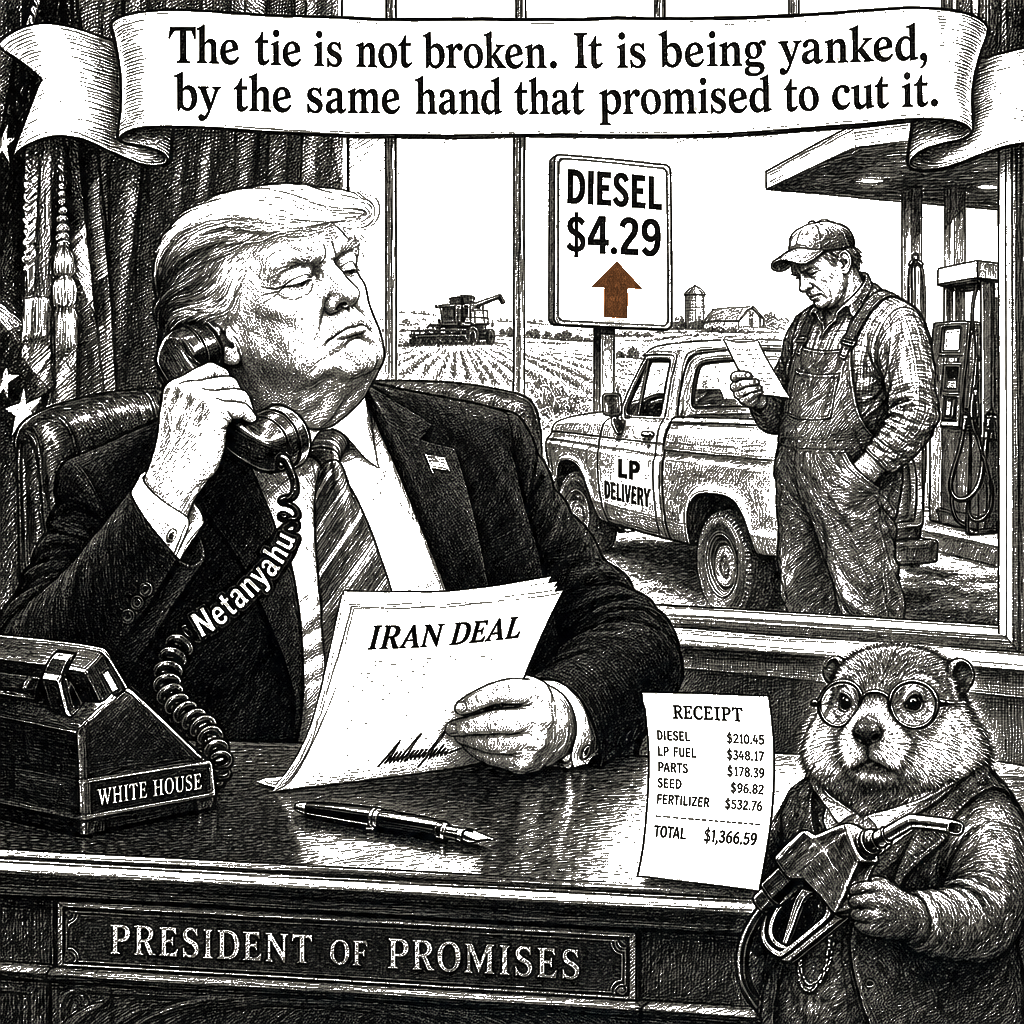
Trump is sacrificing Adams County diesel buyers to salvage his Iran deal. The man who promised energy dominance is now the lead actor in a Persian Gulf drama that spikes the oil market every time a missile launches, then spikes it again every time he calls for restraint. Iran fired missiles at Israel on Monday morning—the first since a fragile ceasefire was patched together in April—and the Islamic Revolutionary Guard Corps says this is the start of “a full week” of strikes. Brent crude jumped 2.6% to $95.50 a barrel on the news. The Strait of Hormuz, the narrow channel through which roughly a fifth of the world’s oil passes, is under direct threat again, as it has been, on and off, since the United States and Israel opened a new shooting war in February. The diesel I pump into my truck at the co-op in Friendship, Wisconsin rises with each cycle like clockwork, and this week it is going to rise again.
The White House is telling Benjamin Netanyahu to sit on his hands because a final diplomatic arrangement is supposedly within reach. President Trump told Axios he will call Netanyahu and tell him not to retaliate, framing it as a simple choice between a “good deal” and blowing the deal “because of what is happening now.” But what is happening now is what happens when you light the fuse and then ask the bomb not to go off. The February strikes on Iran were launched by the United States and Israel. The violations of the ceasefire that followed came from both sides—Israeli drones, Iranian-backed militia rocket fire, a constant churn of low-grade violence that keeps the Hormuz threat alive. When Iran’s Revolutionary Guard says it will strike vessels that try to cross the Strait, oil traders do not wait to find out whether the threat is real. They price the barrel as if the entire flow could be cut tomorrow, and the price arrives in Adams County by the next truck delivery.
This is the nationalist shell game in real time. The rhetoric promises that American energy independence insulates the rural working class from the mess of Middle Eastern diplomacy, but the diesel pump in Friendship doesn’t run on national independence. It runs on the global spot price. As we covered just last month when the administration admitted the ceasefire was on life support, the volatility is structural. The price of crude has swung wildly since the US and Israel launched their strikes back in February. Every missed diplomatic milestone translates directly into shop operating margins. The White House treats global oil as a bargaining table, but the market treats it as a commodity that clears at whatever price the supply disruption demands.
The President told Axios he doesn’t want the deal to blow up because of what is happening now. But what is happening now is the direct consequence of a military campaign his administration initiated. The strikes, the retaliations, the violated truces—these are not external events impinging on a diplomatic process. They are the diplomatic process. And while the dealmakers huddle, every fresh exchange adds a risk premium to the barrel, and every risk premium adds dimes to the gallon. The dime I pay is not a line on a trader’s screen. It is the cost of running my shop, the cost of the LP truck that delivers my propane, the cost of the diesel that powers the pumps on the irrigated potato fields south of town.
Bethany McLean documented the template in Saudi America. The modern domestic patch runs on complex financial equilibria rather than geological certainty, and the resulting supply architecture is fragile. Domestic production creates a temporary buffer against absolute shortage, but it does not decouple American operators from the global clearing price. The price of diesel in Adams County is set at the margins of the global market, and the margin is currently the Strait of Hormuz. When the geopolitical actors move, the clearing price moves. The American fuel grid is not a closed loop. It is a networked infrastructure that responds to a supply shock in the Middle East with an immediate price adjustment in the Midwest.
The political theater operates as if a diplomatic phone call can override the geography Yergin mapped in The Prize. The 20th-century energy map was wired through the Gulf, and whoever controls the sea lanes dictates the clearing price of the barrel. The Carter Doctrine, declared in 1980, put the U.S. military on permanent notice that the Persian Gulf would be defended as a vital national interest. For forty-six years every president has operated inside that doctrine. Trump is operating inside it now. But the shape of the operation has changed: the United States no longer merely protects the flow of oil; its own military actions, and its own on-again, off-again dealmaking, are now among the primary sources of instability in the flow of oil. That is not a policy that “secures” energy. It is a policy that manufactures crisis and then claims credit for not letting the crisis explode.
The farmer down the road who put in his corn on diesel that cost a dollar less per gallon than it does this week now watches his input costs climb while his commodity price waits on a global market that pays no attention to his balance sheet. That farmer voted for Trump in 2024, and he is not wrong that every president before him let the same dynamic run. But the promise was that this time the pain would stop—that American “energy dominance” would break the tie between Middle Eastern conflict and the rural pump price. The tie is not broken. It is being yanked, by the same hand that promised to cut it.
Every spike in crude is a tax on the small operator, the independent hauler, the one-man shop that runs on a diesel truck. I see the numbers climb. Diesel has been over four dollars a gallon for months. The co-op’s fuel-tank fill report goes up every time Brent jumps. The gap between the diplomacy and the pump is not an abstraction; it is the margin that decides whether a small operator in Friendship can afford to keep a truck on the road. When the tractor runs, it burns diesel. When the truck hauls parts to Stevens Point for a transmission rebuild, it burns diesel. When heating oil keeps the shop above freezing in February while the work runs through dinner, it burns diesel. Every dollar the geopolitical conflict adds to the barrel gets stripped out of a service economy that does not have the margin to spare.
There is a deal in play, we are told. A good deal. Maybe it will come together next week, and maybe the missiles will stop, and maybe the Strait of Hormuz will quiet down, and maybe diesel will fall back toward three dollars. That is the bet the White House is making with our fuel tanks. The administration that launched the strikes now wants the credit for the peace; the same people who opened a new front in the Gulf now promise they can close it before the next spike cracks a farm-equipment payment. Up here, we do not have the luxury of betting. We just pay the price, and we notice whose signature is on the bill.