The police bodycam footage carries the whole terrible sequence. Henry Nowak, eighteen years old, bleeding from a wound that will kill him, tells an officer he has been stabbed. The officer replies, “I don’t think you have, mate.” The officer then handcuffs him. The young man dies in the cuffs of the people who were supposed to help him. That footage is the record of an institutional failure so complete that the British police have already apologized, the case is under independent investigation, and the National Police Chiefs’ Council is reviewing the anti-racism guidelines that may have contributed to the officers’ fatal miscalibration. The family of Henry Nowak released a statement that would anchor any decent public conversation: they do not want their son’s death used “to create further division, hatred, or tension.”
The Trump administration smelled opportunity before the body was cold. Within days, Defense Secretary Pete Hegseth, Vice President JD Vance, and the State Department had all issued statements that had nothing to do with justice for Henry Nowak and everything to do with turning a single homicide in Southampton into an indictment of multicultural democracy itself. The volume itself is the first diagnostic signature: multiple senior officials, multiple statements, in a compressed window, amplifying the same narrative frame. The RAND Corporation called this the “firehose of falsehood” in 2016. Steve Bannon, when describing the method to Michael Lewis in 2018, called it “flood the zone with shit.” The goal is not to win an argument on the merits. The goal is to make the sheer quantity of messaging prevent any argument from settling, and to drown a specific procedural failure beneath a wave of civilization-level abstraction so that the grieving family’s plea is silenced by the roar.
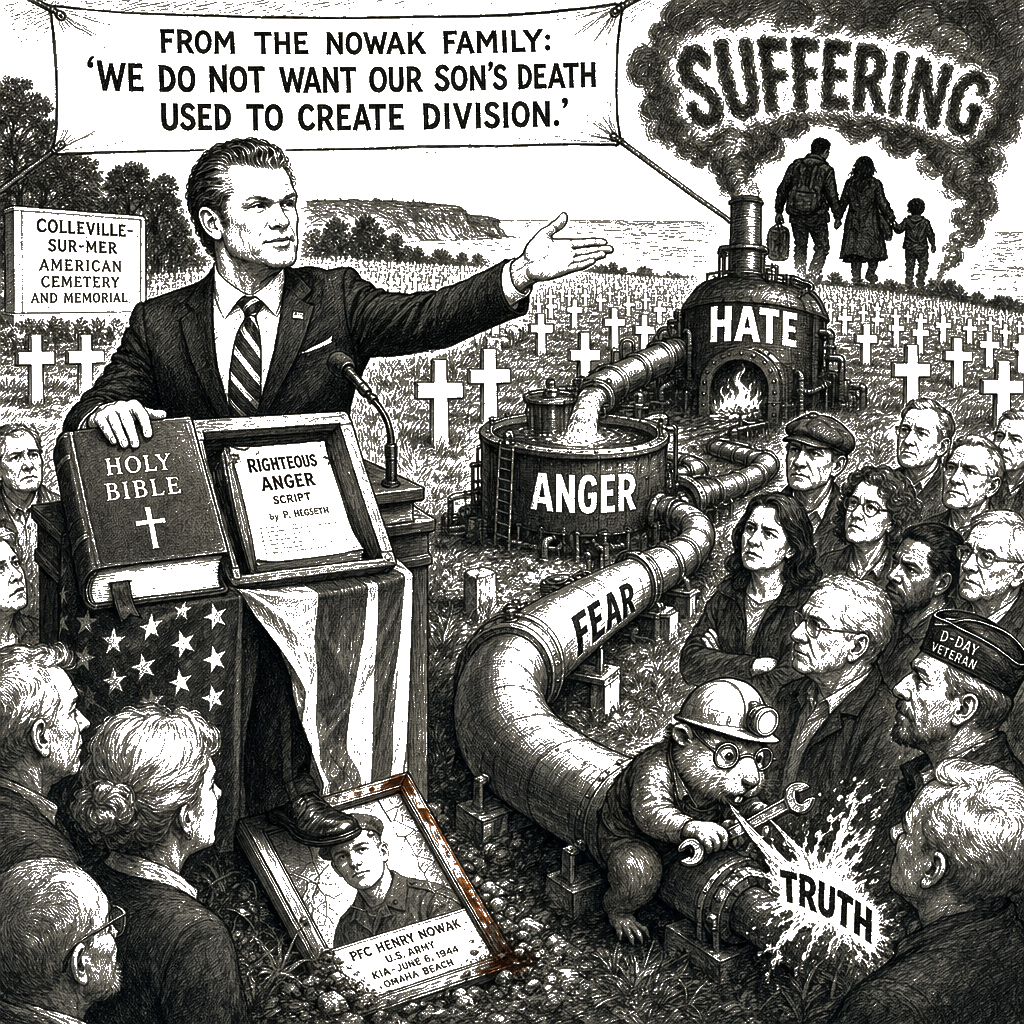
Hegseth opened the assault on the beaches of Normandy. At the American military cemetery in Colleville-sur-Mer on the 82nd anniversary of D-Day, he ignored the silence owed to the dead and instead told the crowd that the freedom those Allied soldiers secured was being undone by a new “invasion” — European migrant arrivals — carrying a “different, dangerous ideology” onto modern European shores. He delivered this at a ceremony honoring the dead of 1944, turning their sacrifice into a cudgel against the very democratic Europe they died to preserve. Hegseth was not speaking about soldiers. He was speaking about human beings seeking safety, and he did so in the exact vocabulary of the people his predecessors fought to destroy. The speech was no improvisation; it follows the logic of his book, Battle for the American Mind, which argues that public education is indoctrinating children to hate America and that only Christian education can save them. The prior commitment explains why a defense secretary would desecrate a military cemetery for a culture-war rally.
Across the water, Vance did the same work in a different medium, turning Hegseth’s abstraction into a personal weapon of grief. He posted on X that Nowak “died the same way a civilization dies,” handcuffed by authorities who “neither trusted nor cared for him, and accused of hate crimes he did not commit.” The last clause is false. Henry Nowak was not accused of hate crimes. The only accusation came from the killer’s brother, who made the false emergency call claiming Nowak had hurled racial abuse and knocked off a turban — a claim the trial judge explicitly rejected. Vance then instructed his audience that “the proper response — the only response — is righteous anger.” He did so closely tracking an earlier statement from Nigel Farage, the leader of Britain’s Reform UK party, who told his own followers that they must respond to Nowak’s death with “pure, cold rage.” This is not a coincidence of phrasing; it is the operational signature of coordinated narrative operation in real time. The United States vice president adopted the exact emotional register of the British far-right leader, and then the U.S. State Department followed, issuing a formal diplomatic intervention that denounced British “ideological conditioning and two-tiered policing” — a phrase invented by the British nativist right and laundered through the Murdoch press. When the State Department adopts a domestic far-right slogan to attack a closest ally’s interior ministry, the veneer of policy debate is stripped away. The apparatus is laundering fringe slogans into official state vocabulary.
The move from a single killing to “civilization dying” is a logical leap so vast it has a technical name in the argumentation literature: hasty generalization. A single criminal act by an individual Sikh man is treated as diagnostic of an entire population of migrants. The leap from “Vickrum Digwa committed murder” to “immigration is an invasion” vaults over every relevant criminological fact, including the weight of evidence that immigrant populations offend at lower rates than the native-born. The force that makes the leap feel plausible is not evidence; it is the prior ideological commitment that wanted the leap before the case ever happened. The administration then deployed what the rhetorical scholars call a strawman: it turned a specific tragedy into a universal indictment of anti-racism. The British media, from the Times to the Wall Street Journal, immediately blamed the killing on “DEI indoctrination” and called it a “woke murder.” The logical chain they are demanding the public accept is that a police officer’s failure to believe a dying boy’s account of his own stabbing is the direct result of decades of multicultural policy. The officer’s failure was believing a false report from the killer’s brother. The failure was gullibility, not ideology. But ideology is what the administration sells, and the term “two-tiered policing” is the frame-engineered relabeling designed to disguise that. The phrase takes a real phenomenon — anti-racism guidelines that may have contributed, in this specific case, to a catastrophic misreading of the facts — and recasts it as a generalized indictment of the entire framework designed to address systemic racism, against the weight of every empirical study of British policing from the Macpherson Report onward. The term does no work except grievance-activation.
The cui bono trace runs straight through the international far-right network that the Trump administration has been building for eighteen months. Vance met with Alternative für Deutschland leader Alice Weidel in Munich. He campaigned for Viktor Orbán in Hungary. Trump’s second-inauguration guest list included Farage, AfD members, and right-wing heads of state. The statements on Nowak are not an improvisation; they are a coordinated escalation in an ongoing project to delegitimize liberal governance everywhere, paint immigration as an existential threat, and install regimes friendly to ethno-nationalist rule. The concentrated beneficiary is the political coalition that profits when white identity grievance is activated and pointed at migrants. The diffuse cost is borne by every immigrant, every person of color, every family that now must wonder whether the next murder will be blamed on their entire community, and whether their own police will make the same fatal assumption when they are the ones bleeding.
The intellectual architecture behind this project is not hidden. It is published, indexed, and waiting to be read. Stephen Miller, the architect of the administration’s deportation operations, has a documented history of enthusiasm for Jean Raspail’s The Camp of the Saints, a notorious 1970s novel depicting European civilization drowned under a tide of non-white immigrants. Christopher Rufo of the Manhattan Institute, a senior figure in the administration’s culture operations, explicitly framed Nowak’s death last week as a rallying cry against “demographic suicide, ideological suicide, and moral suicide.” This is not hyperbole; it is doctrine. The blueprint has a name and an author, and the people citing it are the people running the deportation machine.
When you understand the blueprint, you stop treating the rhetoric as mere heat and recognize it as a pipeline. In the Star Wars universe, Yoda traces the slide from fear to suffering: fear leads to anger, anger leads to hate, and hate leads to suffering. Vance’s rhetoric is not merely describing the pipeline; he is operating it with his thumb on the valve. The manufactured fear is the “invasion” Hegseth named from the graves of Normandy. The channeled anger is the “righteous anger” Vance demanded. The sustained hate is the anti-immigrant hysteria the administration has spent its political capital cultivating. The suffering falls on immigrant communities, rendered as existential threats, and on democratic institutions, delegitimized as enemies of the people. The historical template cycles: take a real crime, strip it of context, attach it to a group, call for righteous anger, and when people protest, accuse them of defending the crime. The designated out-group changes — from southern and eastern Europeans in the nineteenth century to Muslims after 9/11 to Sikhs and migrants now — but the machinery never does.
Starmer’s government has been notably restrained. The prime minister’s office referred to unnamed people “trying to interfere in our democracy and seeking to stir up division on our streets.” Foreign Secretary David Lammy told Vance directly that his comments were wrong. The British government rebuked the entire interference while refusing to escalate the rhetorical war. That restraint is not weakness. It is the discipline of a country that has learned, from centuries of imperial violence and from the Troubles and from the 7/7 bombings and from the murder of Jo Cox, that some fires can be lit with a single sentence and then cannot be extinguished by the same speaker who lit them. The administration knows this. It is not interested in restraint. It is interested in accelerant.
The family of Henry Nowak asked that his death not be used to create division. That request remains the moral anchor in the storm the administration has chosen to manufacture. The British government, for all its failures in the immediate aftermath, has committed to investigating its own institutional rot. The independent police watchdog is doing its work. The guidelines are under review. That is what accountability looks like in a liberal democracy: messy, slow, incomplete, but committed to the proposition that institutions can be improved rather than burned down. The administration offers no accountability, only accelerant. Its officials have turned a murdered teenager into a prop, and they are doing it not despite the family’s plea but against it. We will not look away from the cui bono trace. We will not let the dead be weaponized without naming who is holding the weapon. And we will keep the receipts, because in the long push for justice, the receipts are the only thing the fire cannot burn.