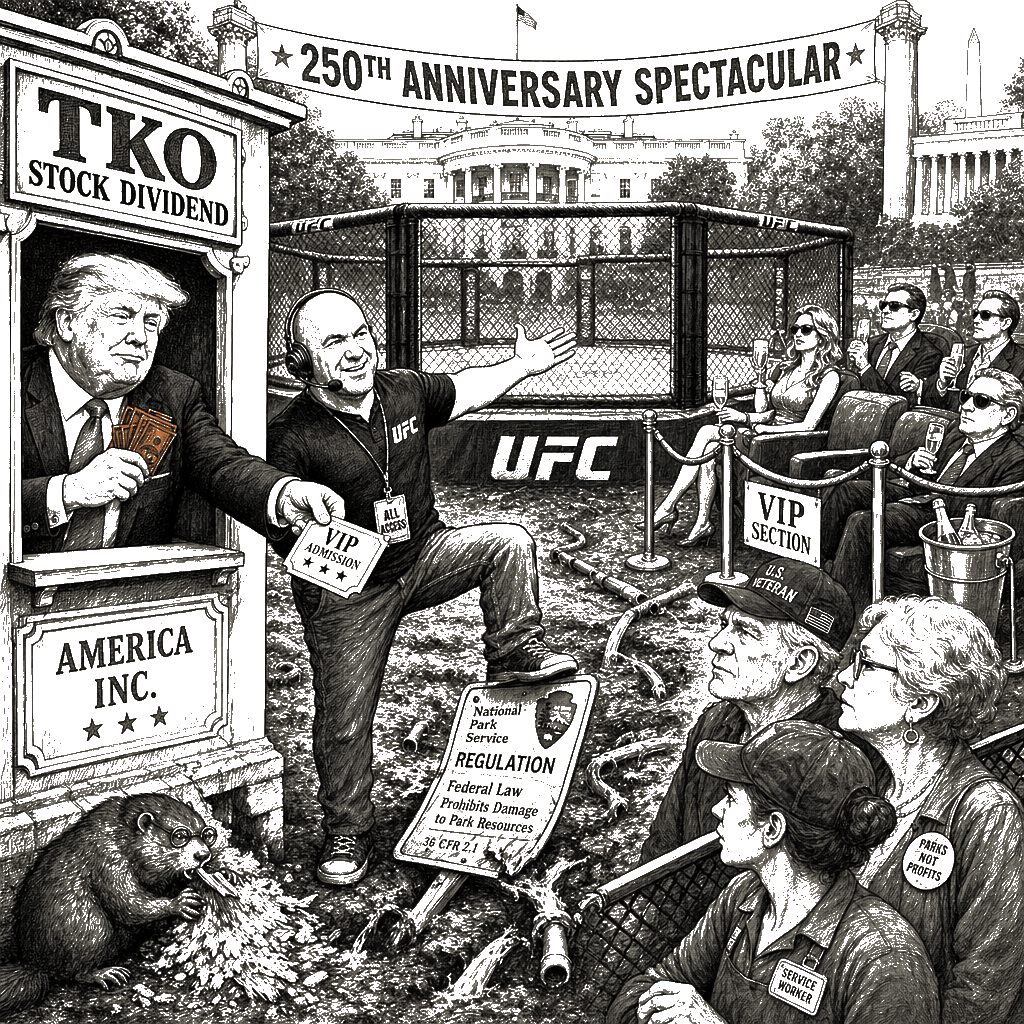
Donald Trump and Dana White are strip-mining the White House lawn for private profit. They erected a ninety-two-foot, six-hundred-ton steel octagon on the grass where presidents and the public once gathered, and they called it a birthday present. Then they called it the nation’s 250th anniversary. Then they called it a coincidence. It is none of those things. It is an extraction. The lawn is the collateral; the Lincoln Memorial is the billboard; and the ticket is sold to the highest bidder.
Ask the only question that sorts the entire arrangement: who benefits? The answer requires you to look past the television cameras and read the distributional math. The beneficiaries are Dana White, CEO of the UFC; Larry Ellison and his son David, who control the broadcast signal through Paramount Skydance; and Donald Trump, who purchased up to $50,000 in TKO Group Holdings stock in May. TKO is the parent company of the UFC and WWE. The vendor his administration hired to occupy the executive mansion is the same company he bought a stake in—a direct financial circuit between the White House lawn and the president’s portfolio. The cost-bearers are the American public. The 600-ton structure destroys the South Lawn’s turf and irrigation infrastructure. The event violates National Park Service regulations. It circumvents the explicit authority of Congress, which alone holds the power to authorize structures on national monumental grounds. The Lincoln Memorial, consecrated ground honoring the dead, is rented as a corporate backdrop for a million-and-a-half-dollar VIP seat. The public pays for the maintenance of these grounds; the administration sells access to them; and the profit routes to the president’s portfolio and his donor class.
The administration’s press apparatus did not stumble into the language. This is the frame-engineered relabeling that Frank Luntz documented in his 2002 memo and that the political right has perfected in the quarter-century since: substitute a term that carries patriotic gravitas for the on-the-nose description that would expose the transaction. “Two Hundred and Fiftieth Anniversary celebration” replaces “the president’s 80th birthday party, featuring cage fights and million-dollar VIP packages, held on public property the president is statutorily forbidden to use for private gain.” The technique works because the phrase “250th anniversary” sounds like something you should support; calling it a birthday payday sounds like a shakedown. The administration is not confused about which one it is. It is betting you will be.
Dana White called the timing a “coincidence.” That vocabulary does not emerge spontaneously. It is drilled. The repetition of “anniversary,” “coincidence,” and “earned marketing” across UFC corporate statements and White House briefings follows a single script. It is written by the same hands that sell the pay-per-view, and it demands we treat the destruction of public property as a patriotic duty.
There is a deeper structural pattern operating here, one we have watched in real time as the administration treats every federal asset as liquid capital. The mechanism is always the same: take what belongs to the public—the land, the memory, the broadcast signal—and wrap it in enough patriotic-sounding branding that the extraction is harder to see. It is the identical structural logic that drew legal action earlier this year when the administration and allied state officials looked for ways to hand over public Miami land to private developers for a personal library project, a maneuver that faced a direct constitutional challenge over the unauthorized transfer of federal assets. The geography shifts from a state-level land transfer to a White House lawn rental, but the architecture does not change. The public asset is the raw material, and the finished product is sold to the president’s allies.
The corruption-of-republics frame that George Lucas built into the prequel trilogy is not about Sith Lords; it is about what happens when public assets are treated as private accounts. “Democracies aren’t overthrown; they’re given away,” Lucas told the Chicago Tribune in 2005. The Senate chamber does not need to be stormed. It just needs to stop asking questions when the executive branch announces, with patriotic bunting, that the South Lawn is now a commercial venue and the president will be celebrating his birthday there, and by the way it’s called the 250th anniversary so stop worrying. The thunderous applause comes later, when the pay-per-view numbers come in.
Malcolm X had a strict discipline about what you call a thing. He knew that if you control the vocabulary, you control the argument. Donald Trump called the White House lawn a venue. Dana White called it a marketing tool. The president’s stockbroker called it TKO. They are all telling you exactly what they are doing. The government treats the public square as a private equity holding, and the public square is sold.
The lawsuit from the Public Integrity Project puts the receipts on the table. Paul Romano is a retired Air Force sergeant and Vietnam veteran. Susan Douglas is a senior-citizen activist and organizer. Romano’s statement to the press is worth reading in full: “The Lincoln Memorial is sacred ground, and it honors everyone who has ever worn this country’s uniform. Using it as a backdrop for a for-profit cage fight so the President and his friends can make money is a desecration.” That is not a partisan complaint. It is a veteran standing on the same ground that the civil-rights movement claimed as its moral stage, looking at a pay-per-view cage fight, and naming what he sees. The lawsuit alleges that the event violates National Park Service regulations, circumvents congressional authority, and is designed to enrich the president and his allies. The complaint points out that the erection of a 600-ton steel structure on national monumental grounds must be authorized by Congress. It was not. The lawsuit also notes Trump’s TKO stock purchase. The statutory violations are backed by a clear financial motive; the public justification, however, relies on a different machinery.
The administration will respond as it has in similar moments: the lawsuit is political, the plaintiffs are partisan, the event is patriotic, the president has done nothing wrong. That is the preemptive-legitimacy-withdrawal the catalog describes: attack the institution that is bringing the complaint rather than engaging the substance of the complaint, and hope the public treats the counter-attack as a rebuttal. It works often enough that they keep doing it. But the substance remains: there is a cage on the South Lawn. The president stands to make money from it. Congress was not asked. The law, on its face, appears to require congressional authorization. The lawsuit is not a political document; it is a legal pleading with numbered paragraphs and statutory citations. The burden now is on the administration to show, in court, that a for-profit private event on the White House lawn, personally enriching the president, is consistent with the laws that govern the use of monumental grounds. The burden is not on the plaintiffs to prove that it is a desecration; the desecration is visible from the street.
Martin Luther King warned in his 1967 SCLC address that when a society treats machines, profits, and property rights as more important than persons, it does not have a policy problem; it has a structural pathology. Here the pathology is fully visible: the profit motive is eating the public square, and the administration calls it a birthday party. The cure is not a softer press release. The cure is the enforcement of the law and the rejection of the frame. King also taught that the question is not whether to be an extremist, but what kind. Paul Romano, a veteran who served this country and now has to sue it to stop a cage fight on hallowed ground, is an extremist for the proposition that the White House lawn belongs to the people, not to the president’s birthday-party donors. That is the kind of extremism the moment demands.
The cage is up. The cameras are in position. The lawsuit is filed. The question is whether the machinery of accountability can grind through the spectacle before the spectacle becomes the new normal. The arc of the legal universe bends toward accountability, but it does not bend by itself. It bends when the people who filed the suit are backed by the public that owns the grass. It bends when the press calls it extraction instead of entertainment. We must name it, reject the vocabulary, demand the structure’s removal, and force the presidency back to governing—not ticket-selling. The receipts are public. The harm is on the grass. The answer is in the law. We know the law. We must enforce it. We must hold the ground. We must demand the accountability of the men who treat the presidency as their own.