
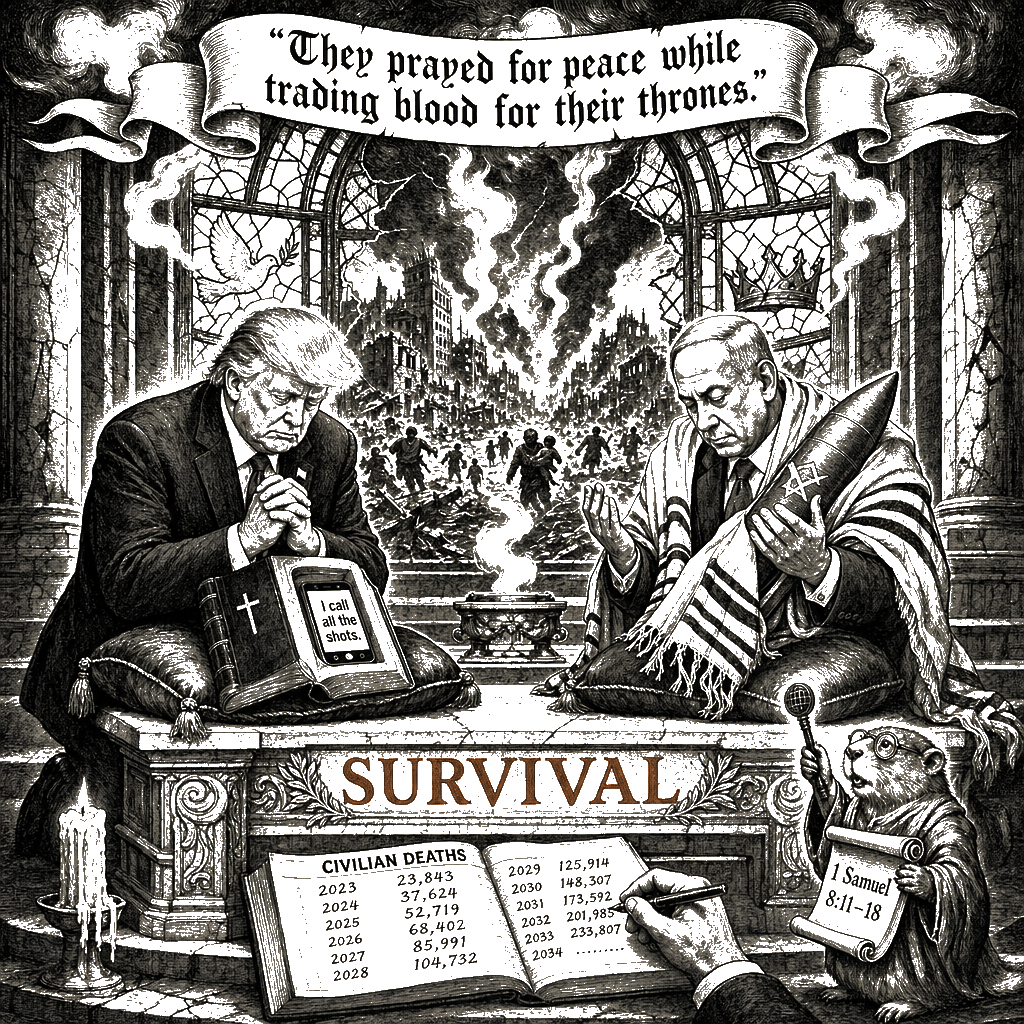
The missiles falling on a Dahiyeh suburb and the Iranian rockets streaking toward Tel Aviv are smoke signals from two crumbling political kingdoms. As the reporting tracked the president swearing at the prime minister over the threatened resumption of the bombing of Beirut and the cascade of retaliation that followed, the pattern came into sharp focus. Two aging leaders, both sitting atop fractured political machines and facing serious legal jeopardy the moment they lose their grip on power, have found a common remedy for their domestic predicaments. Donald Trump and Benjamin Netanyahu are trading Middle Eastern lives for their own political survival.
Trump boasted to the Financial Times, “I call all the shots.” Less than a week later, Netanyahu called his own. The strongman myth—the idea that one domineering personality can impose order through sheer will—crumbles under the weight of a fractured heart. Two men, each believing he can bomb his way to regime survival, are gambling with blood they neither shed themselves nor will answer for in a courtroom. The real war is being waged inside their souls, and the Middle East is paying the price.
Let me show you exactly what the text says about this, because the pulpit has been quiet on it. In 1 Samuel 8, the elders of Israel ask the prophet Samuel for a king “to judge us like all the nations.” They want a central authority to lead them. God tells Samuel to listen, but to warn them solemnly about what the king will do. The warning is precise. “He will take your sons,” the text says, “and put them in his chariots and horsemen.” He will appoint his own commanders. He will take your daughters to be perfumers and cooks. He will take the best of your fields, vineyards, and olive groves and give them to his attendants. He will take a tenth of your grain and vintage and give it to his officials and servants. And when you cry out because of the king you have chosen, the Lord will not answer you.
The prophetic warning is not about a bad king versus a good king. It is about the structural logic of concentrated political power: the state consumes the bodies of its people to feed its own wars and maintain its own authority. In Lebanon, in Iran, in Israel itself, the sons and daughters are being taken for the chariots, and the fields are being scorched for the king’s household.
The Evangelical legalist machinery, when it bothers to touch 1 Samuel 8 at all, treats the passage as a historical curiosity—a warning about the specific failures of Saul or Solomon, or a lesson about Israel’s lack of faith in God’s direct rule. The apparatus has spent decades baptizing modern political power as divine ordinance. We are taught from Romans 13 that the authorities are established by God, that we are to submit, that the geopolitical maneuvering of the American-Israeli alliance operates under a sovereign mantle we are not permitted to question. The legalist machinery instructs us to look at leaders facing domestic collapse, facing indictments in their own countries, and to see instruments of divine providence rather than men securing their own power.
The prophets do not read it that way. The prophet reads the strongman and names exactly what he is doing. “Woe to you who build Zion with bloodshed, Jerusalem with injustice” (Micah 3:10). Isaiah 31:1 pronounces a Woe to “those who go down to Egypt for help, who rely on horses, who trust in the multitude of their chariots and in the great strength of their horsemen.” The text does not distinguish between righteous wars and unjust ones when the motive is the consolidation of the ruler’s own security apparatus. Woe to the leader who seeks political survival through military force. The plain-language reading is unambiguous: a leader who goes to war to save his own political skin is trading blood for survival.
The submission texts are texts I taught from the pulpit and the Sunday School room for decades. I understand the instinct to look for the sovereign hand behind the strongman, because the alternative—that our political alignments were not blessed, that the leaders we supported were merely acting in their own interest at the expense of the vulnerable—is a heavy weight to carry. But the text does not require us to abandon our friends in the region or to stop praying for peace. It requires us to read the text with our eyes open to the actual cost. The church that turns the king into a divine instrument loses the right to speak for the victims of his chariots. It surrenders its own prophetic nerve.
The journalism laying out the political arithmetic this week is brutally honest. The president is worried about global oil prices and his party’s control of Congress. He wants a quick resolution so he can co-host the North American World Cup without global distractions. The prime minister is facing an election before October; his coalition will collapse without a manufactured victory, and his own pledges to neutralize Iran and Hezbollah remain unfulfilled. The calculus is cold: bomb, escalate, negotiate from a position of bloodshed, and pray the other side breaks. They are trading the lives of strangers to secure their own polling numbers and their own freedom from prosecution. The prophet calls this bloodshed. The political class calls it strategy.
Where the Evangelical apparatus fails the text is in its selective blindness. The same movement that has spent decades insisting on the sanctity of the unborn and the traditional family has happily conscripted its moral vocabulary into the service of men who are actively killing to preserve their own power. The apparatus says it is for the defense of a holy ally. The text says the ruler is building a city with bloodshed. The gap between those two readings is the chasm. One reading sees the bodies and calls it a tragedy to be avoided. The other reading sees the geopolitical chessboard and calls it a blessing.
There is no prophetic word that sanctifies the frantic logic of men trying to outrun their legal jeopardy. There is only the Woe, and the warning. The king takes the sons. The king takes the daughters. And when the people cry out because the king has consumed them, the Lord will not answer them, because they asked for this king. The transactional alliance between these two leaders is not a divine instrument. It is a consumption. And the church that blesses the transaction is blessing the very thing the prophets warned the people about.
I love the church too much to let it keep cheering for the chariots. We can stop lying to the text. We can name the bloodshed as the text names it. We can refuse to baptize the political survival of aging leaders into a divine mandate. The peace we are told is almost at hand will not be built on the truth. Woe to those who build cities with blood to save their own thrones, and woe to the people who cheer them on.