
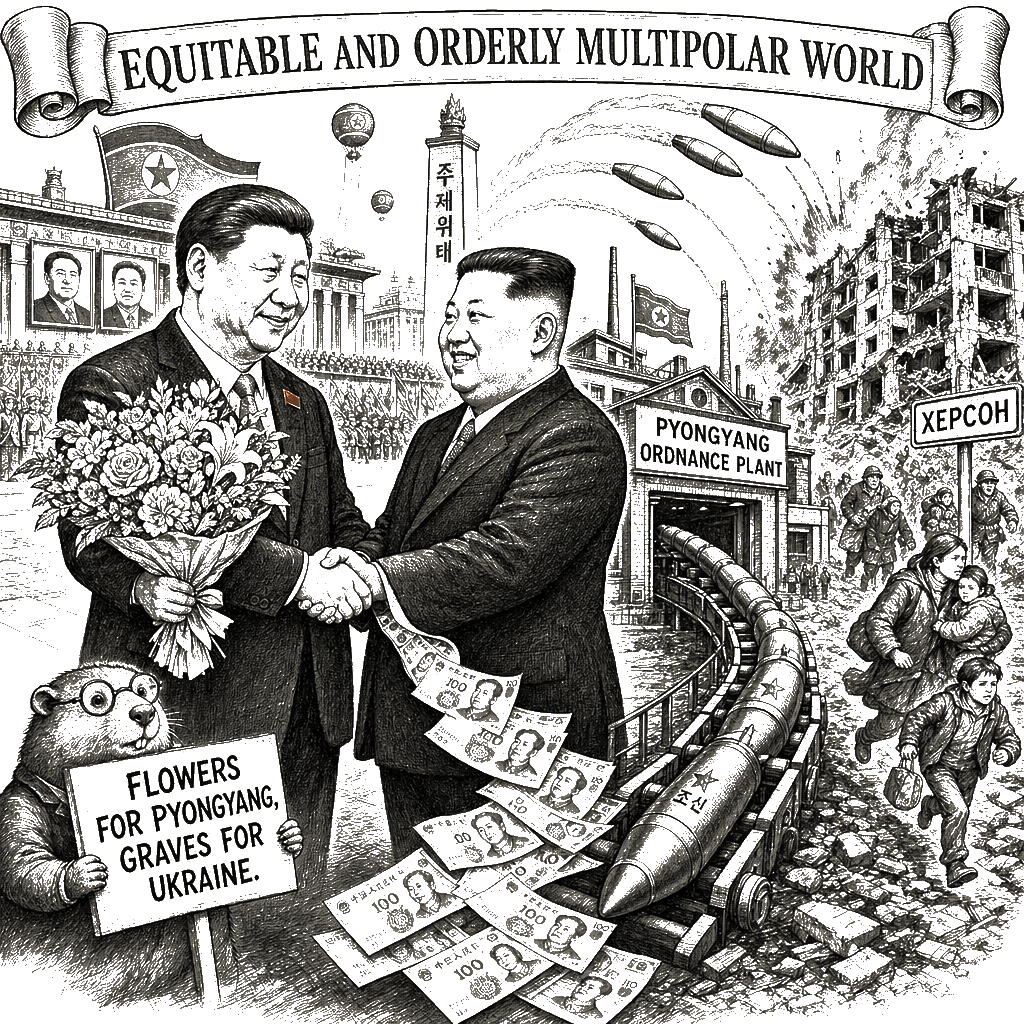
Xi Jinping is funding the slaughter of Ukrainian civilians. On Monday, he landed in Pyongyang to clasp the hand of a nuclear-armed dictator who has been shipping artillery shells and ballistic missiles to Russia for use against Ukrainian cities. The choreography of flowers and an honor guard at Kim Il Sung Square masks the purely transactional nature of the summit. Kim demands hard currency, expanded cross-border trade corridors, and an unshakeable economic lifeline from Beijing to sustain his regime, all while defiantly cementing North Korea’s status as an irreversible nuclear power. Xi, meanwhile, is purchasing a willing battering ram to blunt American influence, aiming to project military pressure against a resurgent Japan and isolate Tokyo as it drifts toward Washington.
When Xi flew into Pyongyang, he brought promises of expanded trade, tourism, and border economic zones. That assistance flows directly into a regime that has made no secret of its material support for Russia’s invasion. Pyongyang’s factories churn out ordnance that lands on apartment blocks and maternity hospitals. Xi’s boilerplate language about an “equitable and orderly multipolar world” is the operational vocabulary of complicity. Hannah Arendt’s phrase—the banality of evil—was never meant to describe cocktail-party bureaucrats alone; it fits perfectly the head of a party-state that sanitizes mass death with diplomatic communiqués as though the corpses in Kharkiv were an ambient feature of great-power competition.
As we noted months ago when diplomatic protocol took center stage during the Trump-Xi summit in Beijing, Beijing’s strategy is methodical and uncompromising. Now, emboldened by a burgeoning military partnership with Moscow, Kim wields more agency, but the underlying asymmetry remains stark: China provides the oxygen of economic survival, but demands a geopolitical weapon in return. By leveraging this alliance to install a China-centric multipolar system, Xi is explicitly betting that a fortified, nuclear-armed North Korea is the perfect pressure point to fracture the West’s grip on Asia.
This is not a theoretical arms-length relationship. China remains North Korea’s principal benefactor, and Beijing knows exactly what its client does with the hard currency and fuel it provides. Under Michael Walzer’s just-war theory, a state that knowingly supplies the means for another state to wage an unjust war forfeits its own claim to neutrality. China’s alliance with Pyongyang places it squarely inside the circle of moral responsibility for the war crimes rolling out of Russia’s occupation. When Kim Jong Un’s sister calls North Korea’s nuclear status “a stark reality,” she is advertising the blackmail premium China purchases with every yuan of trade.
The summit is not about denuclearization. Beijing has abandoned that pretense. The goal is a China-centered order where American leadership is simply crowded out, and the cost of the project is paid in Ukrainian blood. Xi is not building a “multipolar” system in the abstract; he is bricking up an alliance of dictatorships that wage war, starve civilians, and shield one another from consequence. When he rode into Kim Il Sung Square behind a motorcycle escort, he was signaling that the slaughter in Ukraine is an acceptable price for Chinese primacy.
Two children handed flowers to the Chinese president as he stepped off his plane. They were the face put on a transaction that delivers high-explosive warheads to a theater of civilian massacre. The image is the message: Xi Jinping offers flowers in Pyongyang and sends graves to Ukraine.