
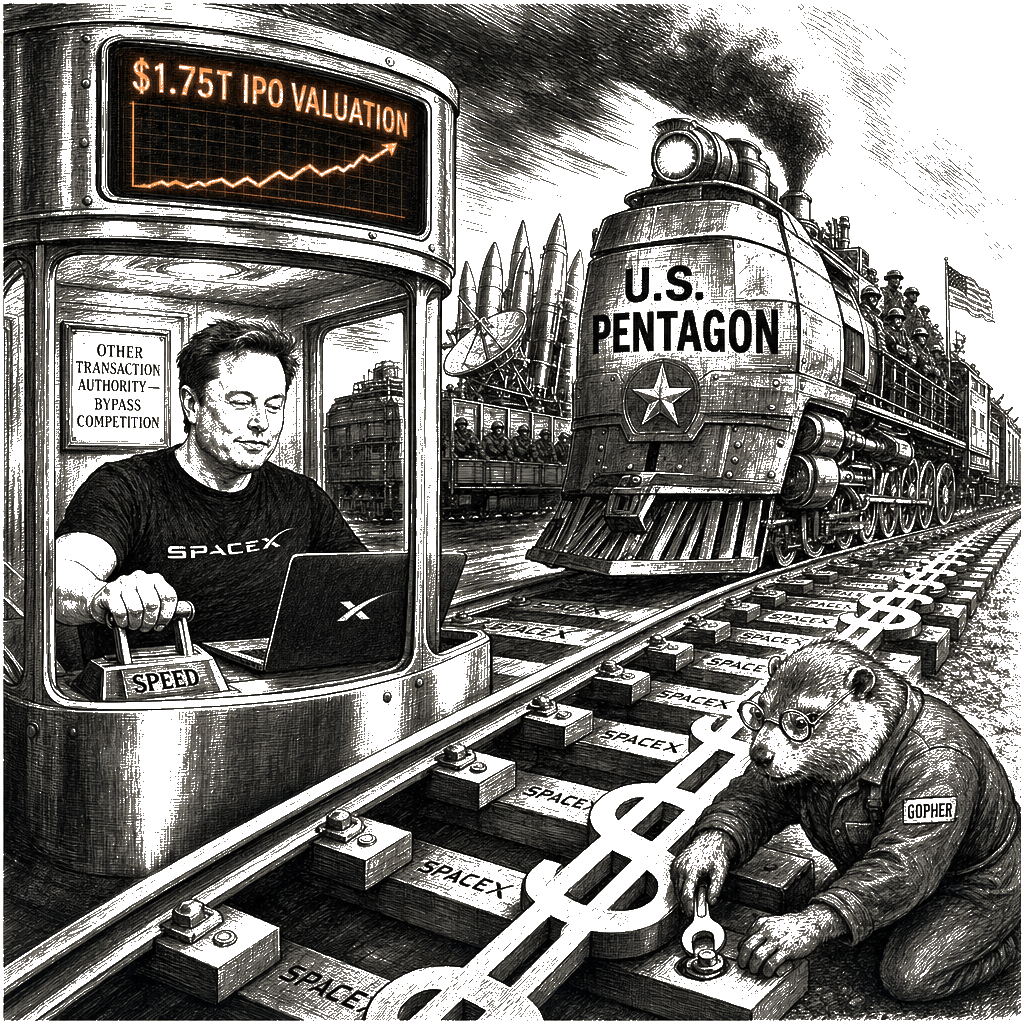
Musk is selling the Pentagon the rails of American war. The Wall Street Journal reported the mechanics of the capture, and the numbers are not small change. Four billion dollars in 2025 alone from “Customer A”—the United States government. A recent haul of $6.5 billion for communications satellites and missile-tracking networks, fast-tracked through the Pentagon’s other transaction authority, a legal loophole that strips away the competitive bidding and oversight rules that once braked the arms-procurement train. Speed is the pitch, and the Defense Department is buying it.
The pitch works because the military is starving for operational tempo, and SpaceX is starving for a clean exit to the public markets. As SpaceX sets the price for a $1.75 trillion initial public offering, that astronomical figure is not built on launching commercial broadband or colonizing Mars. It is underwritten by the Department of Defense. The military is the reliable anchor customer, the bedrock that underwrites the stock price—meaning every share sold prices in the permanence of the military relationship, regardless of who sits in the White House.
Dwight Eisenhower warned in 1961 against the conjunction of an immense military establishment and a large arms industry, but he imagined a relationship of arm’s length. He did not foresee the era of capture. When a private company writes itself into the operational DNA of the armed forces—becoming the rail network upon which every military train must ride—the arm’s length vanishes. The Pentagon cannot fire the vendor when the vendor owns the tracks. White House lawyers already found this out; they could not cancel the contracts even when the CEO feuded with the President. The dependency is total. The controversial part is when the manufacturer’s IPO valuation depends on military contracts awarded outside competitive bidding through mechanisms specifically designed to avoid the oversight Congress built after decades of procurement scandals—and when the machinery’s operator has demonstrated willingness to feud with presidents while holding contracts the government considers impossible to revoke.
Andrew Bacevich spent his career mapping the permanent-war substrate that turns national security into a perpetual profit engine. This is the engine running at full throttle, the operating-tempo logic he dissected in Washington Rules: the military-industrial complex converts every immediate operational requirement into permanent institutional authority by presenting the decision as already made by events. Defense Secretary Pete Hegseth toured the Starbase facility in Texas and praised SpaceX for cutting through endless projects. “The critical nature of some of these capabilities drove us to push what we can get into production right now,” Air Force Secretary Troy Meink testified in May. Push it through. Bypass the slow committees. Cut the regulations. Speed. Hegseth’s “endless projects” critique is the metastasis in new vocabulary—the disruption rhetoric that sounds like reform but is just the latest language for the same permanent expansion Eisenhower warned about. The phrase turns congressional oversight into a flaw. The demand for speed is real, but speed without oversight is just a faster march into the dark. You trade scrutiny for launch cadence, and suddenly the military’s capabilities are dictated by a corporate roadmap, not by strategic necessity.
Look at the legal architecture that makes this possible. The “other transaction authority” that fast-tracked these contracts is designed to bypass the Federal Acquisition Regulation, the competitive-bidding requirements, and the reporting obligations that traditionally governed how the Pentagon spends your money. The refresh cycle that was supposed to keep the military current has been converted into a permanent surveillance infrastructure that outlives the technology it was meant to acquire. The National Reconnaissance Office runs its Starshield imaging satellite network through agreements that, in the Journal’s words, “skirt some standard government contracting rules”—and the NRO’s response about “legal and regulatory compliance” doesn’t actually dispute the skirting.
Barbara Tuchman documented how institutions abandon judgment in pursuit of false necessities, a folly born of the belief that efficiency justifies the suspension of rules. The Pentagon is doing it again, outsourcing its sovereign capacity because it cannot wait for the committees. The “need for speed” Meink cited treats competition requirements and acquisition regulations as enemies of capability rather than what they are: the public’s structural guarantee that it retains some control over how its killing machinery gets built and deployed.
The cluster of capabilities here—missile-tracking satellites, airborne-targeting surveillance, classified intelligence constellations, massive rapid-launch capacity—amounts to a kill chain in the making. A private company is building the sensor network, the communications backbone, and the rapid-response launch infrastructure for a military posture that Congress has not debated, much less authorized through normal acquisition channels with competitive bidding and public justification. What’s happening at Cape Canaveral tells the rest of the story. SpaceX gained permission for up to 76 Starship flights per year from a military-owned launchpad—three times what Space Force officials had planned for—while the United Launch Alliance warns that operations will disrupt other providers. Military documents say the higher launch rate “would give the Air Force access to Starship’s capabilities and enhance the government’s access to orbit.” Access to what? The military’s interest isn’t launching science missions.
The service members who will fight these wars are told their connectivity and targeting data depend on a quarterly earnings report. The people in the sandbox are tethered to a corporate P&L statement. Michael Walzer’s framework in Just and Unjust Wars holds that war is a condition entered and exited by political decision, not a permanent operational state. The architecture described in the Journal report is built against exactly that premise. Once the satellites are up and the communications backbone is running and the targeting data is flowing into command systems, the system writes its own permanence.
Musk wants to be the backbone. He has succeeded. The Pentagon will ride on tracks it does not own, paying a toll it cannot refuse, marching toward wars priced by a private balance sheet. This is how the landscape produces a permanent semi-war footing: one “other transaction” at a time, one bypassed regulation per contract, one speed-driven capability that critics should just trust won’t migrate from tracking missiles to guiding weapons without congressional knowledge. The architecture is the authorization. When the White House determines it can’t cancel a contract during a political feud because it’s too essential to cancel, and when both parties endorse speed-to-field as the sufficient justification for bypassing oversight, then the contract isn’t an acquisition. It’s the government handing the keys to a privately held kill chain and promising not to take them back. This is the final shape Eisenhower warned against: not just influence but inevitability.