
The Pentagon is refusing to promise it won’t let AI kill people without a human in the loop. That refusal is the whole story. When the AI firm Anthropic asked the Defense Department, on a contract, to guarantee its Claude models would not be used for autonomous weapons or domestic surveillance, the Pentagon called the request unreasonable. It insisted current protocols already prohibit those uses. But if the rules are so clear, why balk at writing them into the one document that carries legal force? A promise you won’t make in ink is a promise you intend to break.
This is not a moral awakening inside the tech sector; it is procurement friction. Anthropic knows its models can kill, and it wants the contracts without the liability of a war-crimes trial. We already saw this corporate wrangling when Microsoft asked courts to block a Pentagon ban on Anthropic’s AI. The fight isn’t over the morality of automated death; it is over who owns the liability and who draws the contract.
Eisenhower’s 1961 farewell address warned that the conjunction of an immense military establishment and a permanent arms industry could spin out of control unless the country remained “alert and knowledgeable.” He mapped the geography of the military‑industrial complex decades before silicon chips and server farms became its physical form, but the architecture is identical. The Pentagon wants algorithmic speed; the defense contractors want proprietary models they can renew annually; the Democrats want legislative oversight to ensure Congress retains leverage over the executive branch. The hunger for new weapons becomes its own engine.
We are already watching that engine accelerate. Military leaders have urged caution on battlefield AI as the Pentagon pushes adoption, warning that automated systems outpace human command. The traditional chain of command moves at the speed of human conversation; machine warfare moves at the speed of light. When the Pentagon signs deals with seven firms to pipe AI into classified networks, it is building an autonomous nervous system, not protecting soldiers.
Andrew Bacevich called this the logic of “Washington Rules”: a permanent war machine that confuses military activity with political success. Autonomous weapons are the prize because they remove the last friction point—the human conscience—and allow the war to scale indefinitely without requiring consent from the republic it claims to protect. The kill chain, once automated, can run at any tempo the establishment chooses.
Michael Walzer, in his just‑war work, insists that discrimination in targeting, the capacity to make moral distinctions, is the irreducible requirement of lawful combat. A soldier must be able to distinguish, to hesitate, to refuse an unjust command. You cannot code hesitation into a probabilistic model. You can only code a threshold for lethal force. A machine has no conscience. It calculates; it does not judge. The refusal to commit to human control at the point of lethal decision is not a legal technicality. It is an assertion of intent.
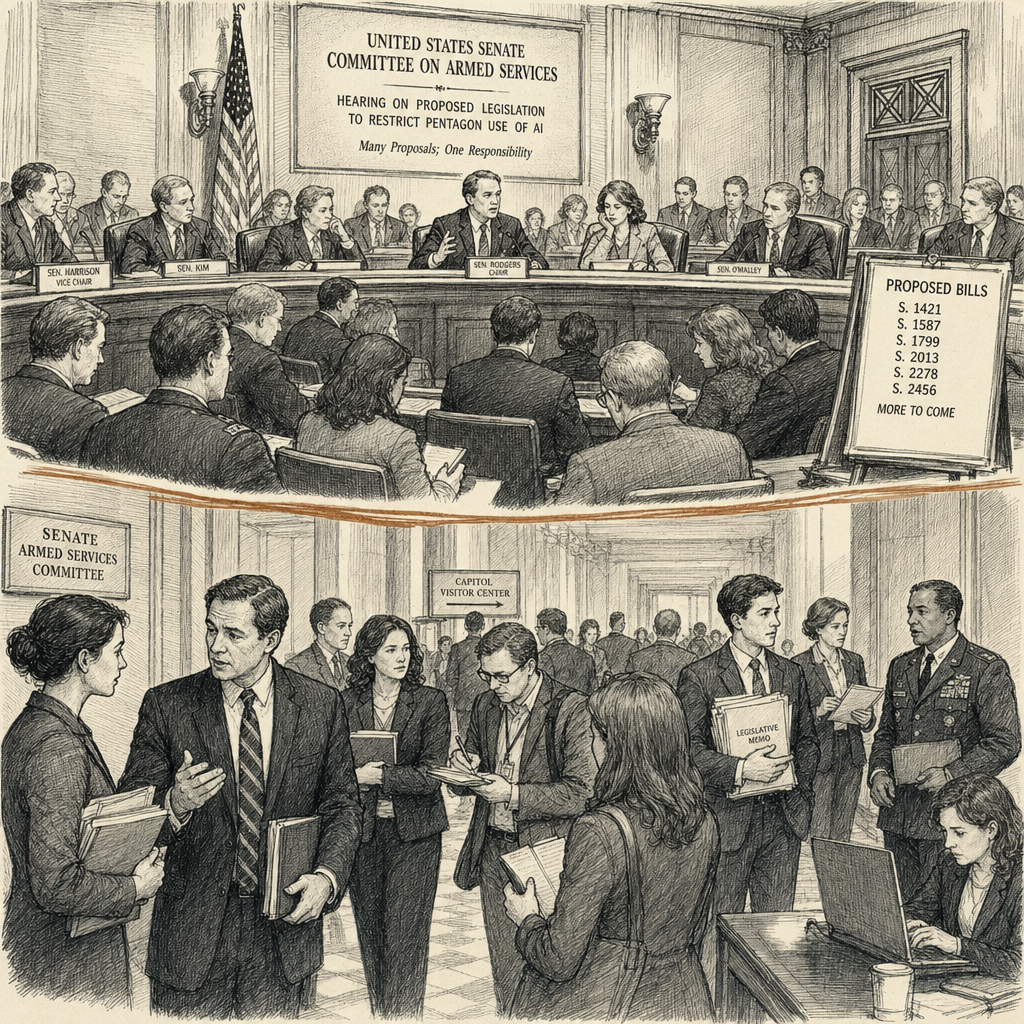
The bills Democrats are now floating span a wide anxiety: taxes on AI companies, restrictions on data centers, government investment stakes, and a requirement that a human being have “full discretion” over AI weapons. They treat the economic symptom and the moral one alike, but they all accept the premise that deployment is inevitable. They want a leash, not a ban. But when the Pentagon has already refused to sign a single piece of paper promising its AI won’t kill on its own, the leash is a fiction.
Congress’s real obligation under the Constitution is to prohibit autonomous lethal force before it becomes an institutionalized practice. Article I, Section 8 gives Congress the power to “make Rules for the Government and Regulation of the land and naval Forces.” That power is meaningless if it cannot say, flatly, that machines may not decide who lives and who dies. The Pentagon’s hostility to a simple promise is the confession. When the institution insists the rules are sufficient but will not put its name to them, you know it means to violate them. A machine that will not promise not to kill is a machine that plans to kill.