
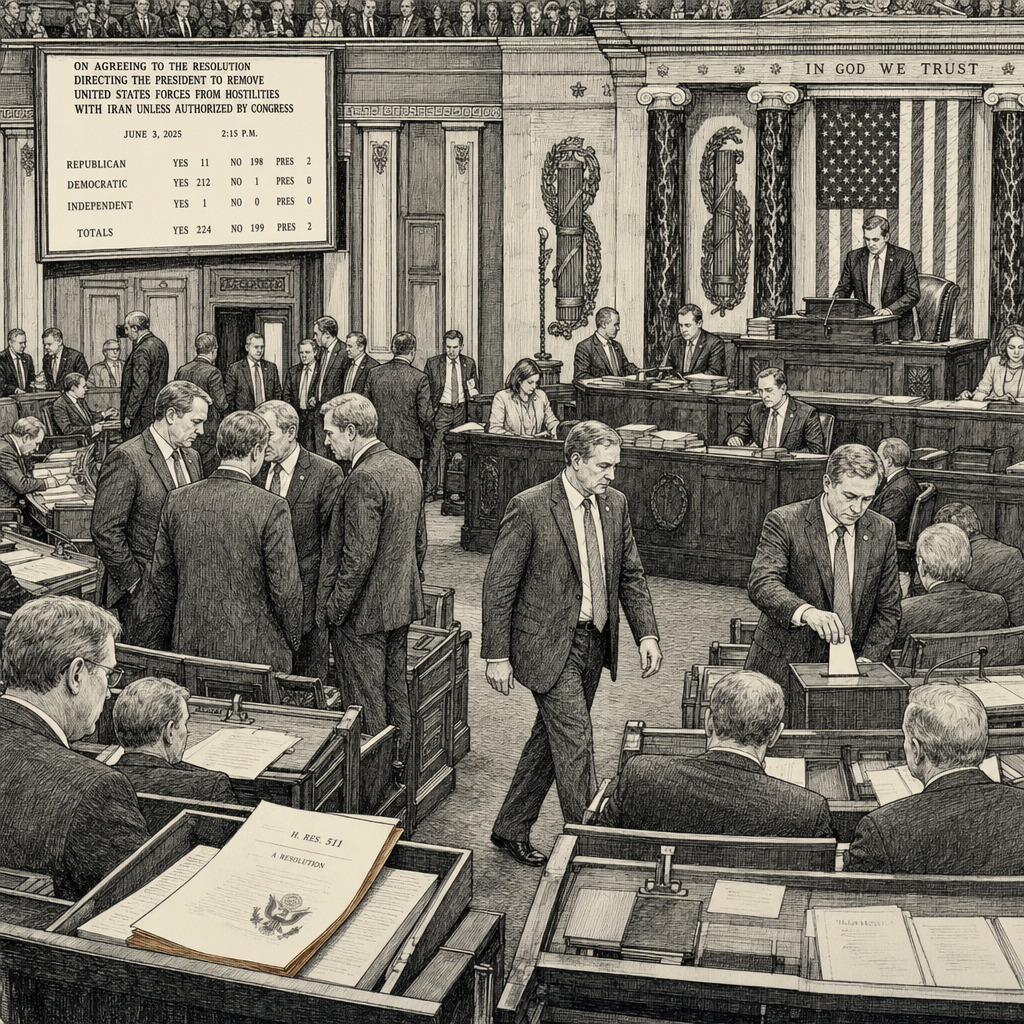
Trump is killing American troops in an illegal Iran war he refuses to end. The House passed a war powers resolution last week directing him to remove all U.S. forces from hostilities against Iran—four Republicans broke ranks to join the Democrats. The Senate advanced its own version 50-47 after a key GOP senator flipped. Both votes drew Republican support not because the party has rediscovered constitutional backbone, but because the war is a catastrophe and voters are furious.
The architects of this campaign thought airstrikes would break Iran. Instead, Iran fought on, struck American bases and Gulf allies, and closed the Strait of Hormuz—the shipping lane controlling one-fifth of global oil and gas. Jet fuel, fertilizer, and diesel prices soared. The IMF started drafting recession warnings. Thirteen American service members are dead. A June 4 Economist/YouGov poll found sixty-eight percent of the public wants an immediate deal to end the war. The strategic outcome is an Iran emboldened and more hardline, a disaster a president who campaigned on avoiding forever wars should have seen coming.
The depletion of precision-guided munitions tells a separate, shabbier story. Weapons stocks that take years to manufacture and replace are burning through at a rate contractors can barely match, opening a readiness gap that will take years to close—and a bonanza for the defense industry that will be paid to rebuild them. The military-industrial complex feeds on permanent crisis, and it is being fed right now at the expense of American soldiers and the economic stability of the country they are supposed to protect.
No congressional authorization preceded this war. Presidents who sought approval before acting—Reagan in Lebanon, Bush 41 in Iraq, Bush 43 after 9/11 and before the 2003 invasion—at least made a show of respecting the separation of powers. Trump, like Clinton in Kosovo and Obama in Libya, simply bypassed Congress. But this war is on a different scale, a grinding open-ended commitment that makes those interventions look brief. The Washington consensus has treated military force as the first resort for decades, and the Iran war is that consensus in its purest form: a campaign launched without a plan, sustained by inertia, and kept alive long enough to bleed the country dry.
The political irony is heavy enough to count as a historical verdict. Trump won office trashing forever wars and promising to put America first. He now presides over a Middle Eastern quagmire that has turned his own party against him, cratered his approval ratings, and handed Tehran all the leverage. Michael Walzer’s just-war calculus is unforgiving on this point: political leadership answers for every life expended, and this administration answers by treating troop deployments as expendable inventory while civilian supply chains burn.
Dwight Eisenhower’s 1961 farewell address warned that the military-industrial apparatus treats perpetual readiness as a political commodity, and that dynamic now forces legislators to weigh ammunition stocks against their November midterm seats. Barbara Tuchman documented how governments consistently persist in policies that actively work against their own interests to save face. Doubling down on a conflict that raises domestic inflation, blocks global energy transit, and kills deployed personnel is exactly that persistence. The administration cannot claim it did not receive warning when the strait closed and the price of survival went up.
The House resolution is a concurrent measure, non-binding and incapable of legally compelling a single soldier’s withdrawal. It doesn’t need to. The political fracture it exposes is the real force. The defectors in the House operate as vote-counters, not peacemakers. Congressional oversight functions as a circuit breaker, not a suggestion. Constitutional posture would require Congress to reclaim the authority it surrendered, pass a binding joint resolution directing immediate withdrawal, and force the executive to face the electorate on the record rather than behind a closed strait. The War Powers Resolution exists to force Congress off the sidelines. A binding joint resolution would turn today’s non-binding signal into a constitutional brake—the one Eisenhower warned would be needed when the military-industrial logic outran public consent. The machinery runs on electoral feedback, and it runs until the receipts come due.