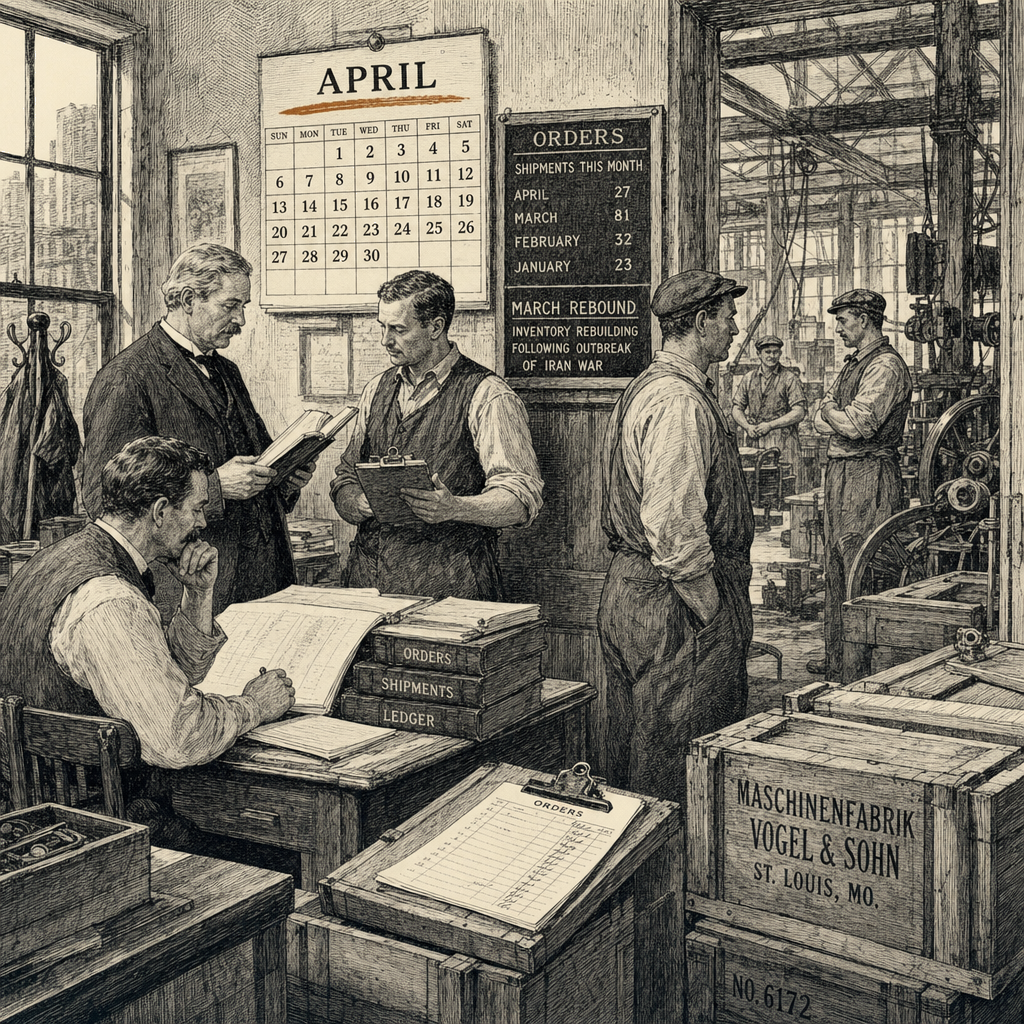
In April, German factory orders fell 3.8 percent. The data agency Destatis reported it plainly. Economists had predicted a decline, but not this deep; the Wall Street Journal’s panel expected a 2.2 percent dip. The graph lines have teeth now. They bit the auto industry and the electrical-equipment floor. On the less volatile three-month rolling basis, the drop was 3.1 percent—a number that tells you the March uptick was the lunge to the cellar door before the bombing run.
The story is not the numbers. The story is the war.
“Sharply higher energy costs… threaten to halt a nascent recovery.” That is the economic journalist’s studied regret, stripped down. In May, business economists warned of recession tied directly to the Iran conflict. China’s factory floors stalled the same month. Eurozone retail sales buckled under the same energy weight. The chain of transmission runs from Washington’s sanctions desk through the Strait of Hormuz, through the price of diesel it takes to assemble a BMW engine, through the household budget of the Frankfurt plant worker, through the empty register of the Berlin café where she used to take lunch, down to the child of the barista who opens a shop next to a factory floor that is now silent.
The American voter does not perceive it as a cost America imposes on allies. It just arrives in the inbox of Europe’s central bank governors as a warning on the first page of that morning’s brief: factory orders down, inflation up, room for monetary maneuver now dramatically shrunk. The design is not to hurt Germany. The design is to impose pain on Iran without the domestic blowback of American casualties, and the design works only if the pain is transmitted. Transmitted pain, by definition, goes somewhere.
We talk about macroeconomics as if it were weather. We say the factory orders fell back, as though a cold front blew through the Ruhr valley. But economic shock is man-made. When policymakers choose the machinery of conflict over the fragile stability of ordinary labor, they are making a moral choice. The prophet Habakkuk asked the builders of empire a simple question: “Woe to him who builds his town by bloodshed and founds it on wrong!” The question is as old as the bricks. When the price of energy spikes and the factory floor goes silent, the cost is not absorbed by the board of directors. It is absorbed by the machinist in Stuttgart, the logistics clerk in Barcelona, the family heating their apartment with what is left at the end of the month.
Let me say the hard part, because the prophetic voice is worthless if it only points at the other side of the ocean. The climate this war exploits is one our own communities helped to build. We who live in comfortable democracies are quick to cheer the precision of our alliances and the righteousness of our strategic posturing, while we ignore the ordinary laborer whose paycheck is being eaten alive by the energy markets our policies destabilize. We call it necessary. We call it geopolitical strategy. The tradition calls it pecado estructural—structural sin, bound into laws and markets rather than committed by individual hands—where the machinery of the state grinds down the very people it claims to shield.
Dorothy Day did not, so far as I know, post bond for German auto workers laid off because their factories’ gas bill had been atomized by sanctions on a country very few of them could find on a map. But Day did refuse to confuse the easy interpretation—“our side is imposing justice”—with the actual consequence: someone, somewhere, stops eating because we have stopped feeding the flow of energy that kept the factory turning. She called her paper a work of “clarification”—a way to avoid “pious self-deception” about what the machinery of our safety and abundance costs the poor. She would not have called the German factory a battlefield; she would have called it what you would call it if the sibling you loved and the neighbor you ate with every Sunday were the one out of work because of a war our sanctions keep prosecuting.
“We have killed 318,000 Japanese,” Day wrote, and refused to pretend one could go to Mass with clean hands. She wrote it after an American weapon vaporized an entire city. No American official has yet stood up and told the congregation what the factory-floor tally costs the souls who assemble the dashboards.
You cannot prosecute a sanctions regime that operates, by design, through escalated energy prices and then act surprised when energy-dependent workers lose their jobs. You cannot recite Matthew 25 in the pew and pass the bill to a German household budget. There is an accounting coming—not from a speechwriter’s skill, but the old accounting the quarterlies never factor into their cost estimates: every regime built on hard-shoulder energy is a regime built on the necks of people who are no less the brother and sister of the Divine than the victims of the regime we confront.
The Good Samaritan did not ask the wounded man for his papers. He did not ask him to justify his presence on the road from Jerusalem to Jericho. He saw a man who had been stripped and left half-dead by the violence of the road, and he went to him. The wounded man in this parable is the global working class, stripped by war and inflation, left on the side of the road while the political and religious elites pass by on the other side, too busy debating the geopolitical necessity of the conflict to notice the body bleeding in the dust.
“The Lord will ask us to account for all the migrants who have fallen on their journey of hope. They were victims of the throwaway culture.” That is Fratelli Tutti—the Pope speaking of the migrant body. But the throwaway culture does not do courtesy borders. The German factory floor is a workplace others build the weapons for, paid for by the workers’ own taxes, to make a war happen far from their homes. Then the American sanctions hit, and the workplace that made the jobs is the part that gets thrown away.
Perhaps our foreign-policy debate will have the honesty to say: yes, this cost is worth it. We will hold the energy spigot shut because the Iranian regime is doing what every reader of this column will agree is evil, and the collateral damage to allied manufacturing is a price we have decided to require our allies to pay. The problem with honesty is that if you accept the responsibility for that cost on a factory floor in Düsseldorf, you have accepted a moral position: that the things we need to deny the Iranian state are worth more than the worker who no longer assembles the dashboard. If that claim is to be squared with the tradition we inherited—the red print of Matthew’s Gospel, the congregation’s nervous silence when it arrives at the bit about camels and needles—then at least one side of the conscience is under oath when it recites the Nicene Creed.
There is a door open. We can tell the truth now and let the chips fall inside our own industrial policy. We can acknowledge that sanctions are a blunt weapon that strikes the autoworker on the line before it grazes the cleric in the ministry. We can reduce the moral assurance that comes from framing this as straightforward “cost of doing righteousness.” We can look at the factory floor and the retail counter and see them as holy ground—not because they produce profit, but because this is where ordinary people earn their daily bread and hold their communities together. When we let them freeze in the draft of our wars, we are not just bad economists. We are bad neighbors.
“Be able to have compassion on another: this is the key.” The Pope did not ask us to restrict that capacity to those whose address is convenient. The machinist in Stuttgart and the logistics clerk in Barcelona are real. Their dignity is bleeding out. And they know, even if our congregations do not, whose sanctions are holding the knife.