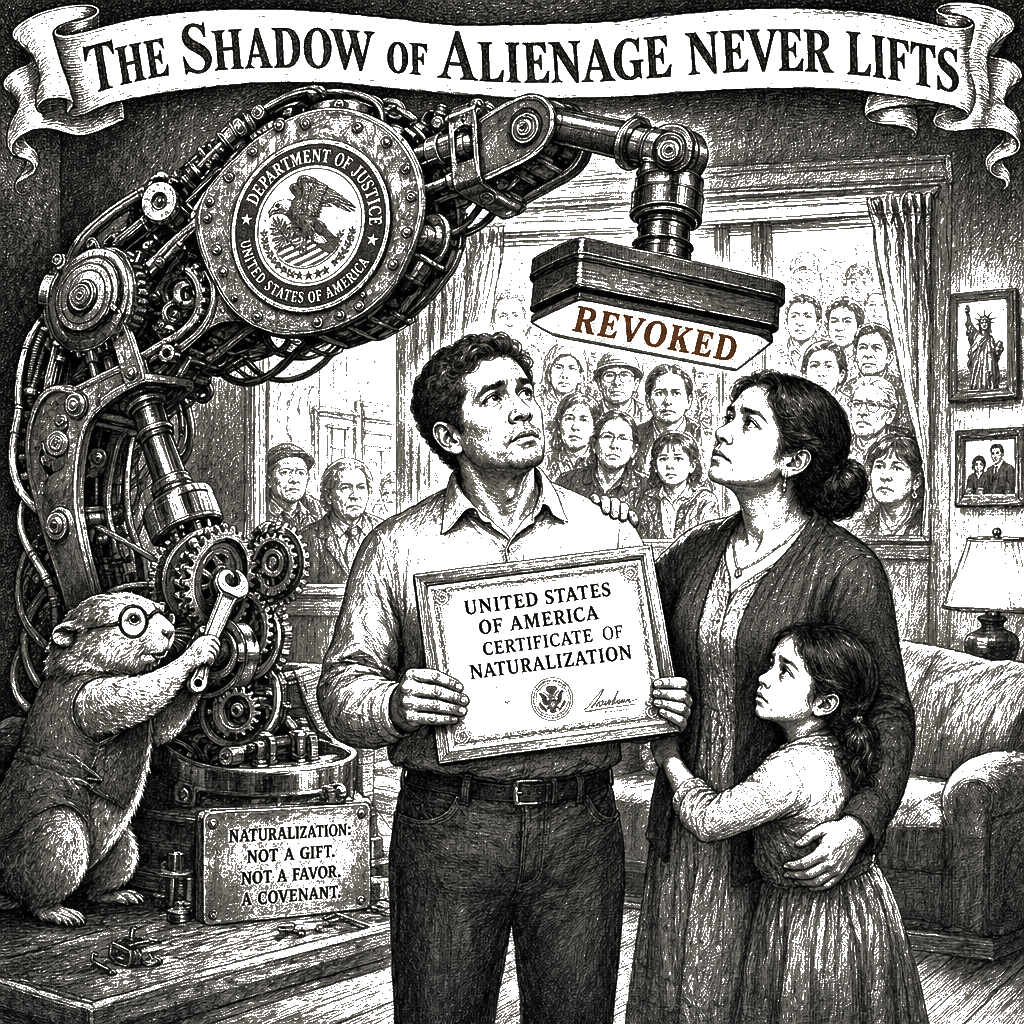
Donald Trump is unmaking Americans. On Monday, the Justice Department announced it was filing denaturalization actions against seventeen people, seeking to strip them of citizenship they had earned, sworn oaths for, and lived under. The administration has spent months building the legal architecture for this, as the Senate debated just last week whether citizenship should be a revocable privilege for those who earned it. Now the machinery is operational. You are deciding which citizens are citizens enough to keep their passports, and which ones must carry the fear of the state in their pockets for the rest of their lives.
The seventeen are accused of crimes—sexual abuse of a minor, wire fraud, drug distribution. If the accusations are true, they should face the consequences the law provides. But the law already provides consequences for crime: prosecution, imprisonment, restitution. Denaturalization is a different penalty. It says that you do not belong here at all, that your presence in this country was never legitimate, that the oath you swore and the certificate you hold are voidable if the government decides your past is unacceptable. It makes citizenship conditional forever. When Acting Attorney General Todd Blanche calls these people “criminal aliens who have exploited the naturalization process,” he is speaking as if the naturalization oath was a trapdoor rather than a threshold. The phrase “criminal aliens” is the legal blade: apply it, and a person falls out of the category of neighbor, into the category of disposable.
The law already provides for denaturalization when the procurement of citizenship was secured by willful fraud, but you do not stop at fraud. You expand the criteria by executive decree. You use the Immigration and Nationality Act not as a shield against deception, but as a sword to cut the rope that ties naturalized citizens to the soil. You open cases against people accused of crimes they may have committed decades ago, because the mere accusation is enough to trigger the machinery. You are telling a neighbor who has paid taxes, raised children, and sworn allegiance that their belonging is conditional on never making a mistake.
The Torah commands the people of Israel more than thirty times to love the ger, the resident alien, because they themselves were once strangers in the land of Egypt. The people now targeted are not resident aliens; they are citizens. But the heart the commandment describes—the heart that knows what it is to be a stranger—is the heart being denied. The logic of denaturalization says that for the naturalized citizen, the shadow of alienage never lifts. You can be a citizen for decades, pay taxes, raise children, serve in the military, and still be told that your belonging was a mistake, that you never really belonged at all.
The bishops of Mexico and the United States wrote in Strangers No Longer that we must awaken to the presence of the Lord in the migrant, and you have answered that invitation by making the migrant permanently vulnerable to the sword of the state. You are doing something older than modern policy. You are building a wall inside the house.
I must confess that the climate you are exploiting is one our own communities helped to build. We who hold secure citizenship have too often treated the naturalization ceremony as a performance of assimilation rather than a covenant of mutual belonging. We have benefited from a border economy that relies on the labor of people it refuses to fully recognize, and we have accepted a political rhetoric that treats the foreign-born as a threat to be managed. For years, we have accepted the idea that some Americans are more equal than others, that the naturalized citizen’s citizenship is thinner, more breakable. Now we are seeing what that idea looks like when it is turned into policy. The Biden administration pursued 24 denaturalization cases across its entire term, each a selective, case-by-case action. On Monday, the Trump administration filed 17 in a single stroke, already outrunning that number in just over a year. This is not targeted prosecution; it is the construction of a machine, and it is happening in plain sight.
To live with the knowledge that your country can decide you never belonged is its own kind of exile. The seventeen people named this week will now have to prove, against the power of the state, that their naturalization was not procured by concealment or willful misrepresentation—the very statute the department invoked. The law requires the accused to prove their own legitimacy, not the government to prove its case. Their children will watch. Their neighbors will wonder. The fear will spread among naturalized citizens who have done nothing wrong but who now see that citizenship is not the permanent shield they believed it to be. And the children of immigrants, even those born here, will absorb the lesson: that for some of us, American-ness is always conditional.
This is what the throwaway culture looks like when it reaches citizenship itself. Pope Francis, at Lampedusa, named the globalization of indifference that allows us to treat human beings as disposable. The same indifference underlies a policy that treats citizenship as a status the state can revoke when the person is no longer convenient. When Jesus said that whatever you did to the least of these you did to him, he did not carve a loophole for naturalized citizens who have stumbled. He did not say I was a legal permanent resident and you welcomed me. He said I was a stranger.
You can lay down the sword of second-class citizenship. A humane immigration policy does not require the perpetual surveillance of its newest citizens. It requires a system that opens the door to those who seek refuge and work, that regularizes the status of the people already here, and that treats the naturalization oath as an irreversible welcome rather than a revocable license. The command is the same one Archbishop Romero issued in the name of a suffering people: cese la represión. Stop the repression. The family at the kitchen table, the small-business owner, the veteran, the mother who came here as a child and built a life—they are Americans. You are trying to tell them they are not, and you are wrong.