
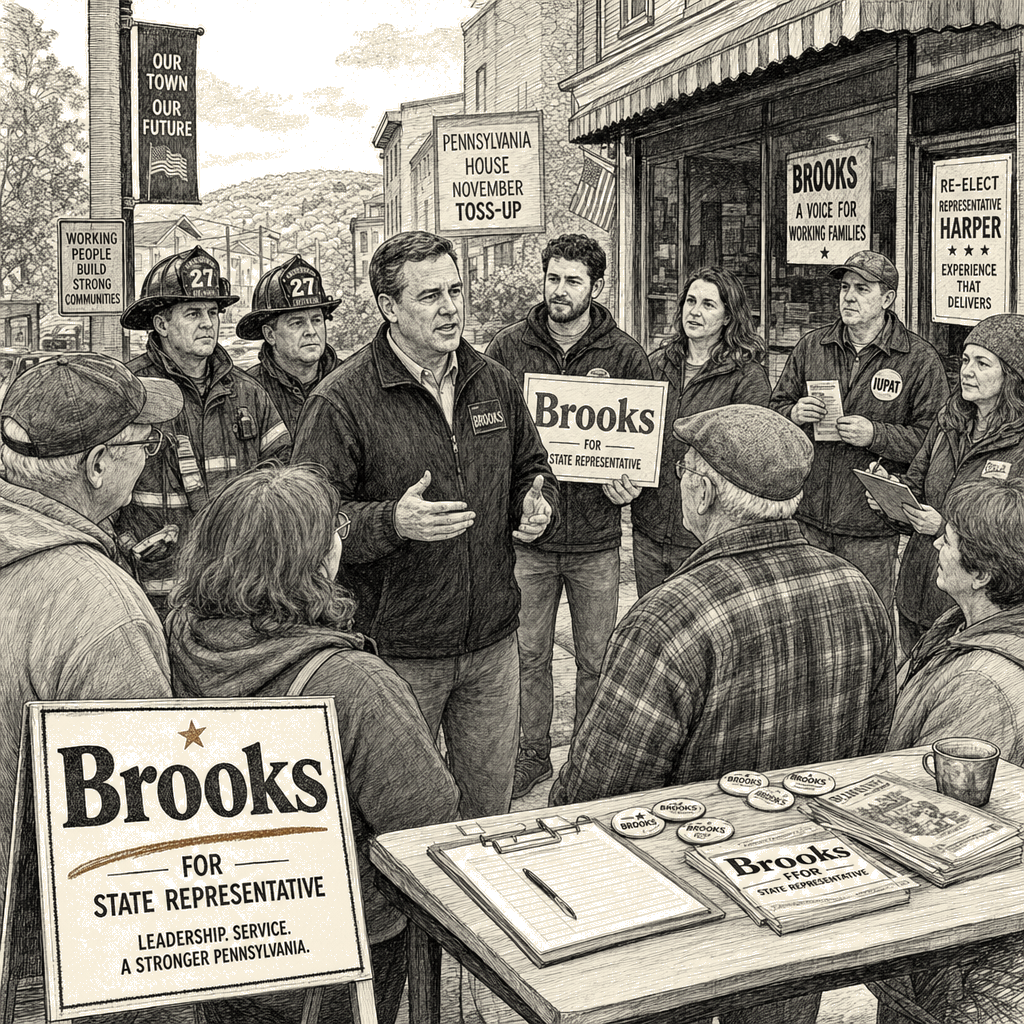
Congress is a landlord’s association that rents out a few seats to the tenants, and every so often a tenant runs for Congress and the landlord class loses its mind. Bob Brooks, the Democratic nominee in Pennsylvania’s seventh, is a career firefighter and former union president who lists “clam bake” as his first leadership credential. I read the Guardian’s profile of Brooks with the kind of attention I usually reserve for a well-drafted collective bargaining agreement, and it’s a clean study in contrasts: a man who spent years reading the fine print on local contracts so his members didn’t get bled dry is facing Ryan Mackenzie, a Harvard Business School graduate buoyed by $1.1 million from Koch-affiliated Americans for Prosperity. The pundits have called the race a toss-up, but it’s really a referendum on a piece of folklore that the donor class has spent decades repeating: that governance is a specialist’s game, best left to the people who can afford to play it.
There is a genuine truth in the numbers, and it’s exactly why this race matters. Brooks points out that only 2 percent of Congress comes from the working class, even though working-class people make up 60 percent of the country. Mackenzie’s pedigree is the standard one we’ve been sold for generations: a straight line from business school to the state house, a tidy 8 percent voting score from the AFL-CIO, and the unwavering endorsement of the U.S. Chamber of Commerce. Mackenzie’s campaign recently decided to brand Brooks a “conman” and a “fraudster,” claiming the candidate is just consultants dressing up a working-class everyman. Americans for Prosperity apparently finds his clam-bake credential disqualifying. Let me tell you what’s actually disqualifying: a man with an 8 percent labor score who takes a million dollars from the Koch machine to unseat a Democratic incumbent. That man is not running to represent “the district.” He is running to represent the money.
And let’s not pretend Brooks is a harmless teddy bear; as he’ll tell you himself, he’s a “union boss,” which is a plain-English way of saying he knows how to read a balance sheet, spot an extraction, and get his members paid when the company claims the till is empty. When a legislator votes for a Medicaid cut or a tax break for a hedge fund, he isn’t making a macroeconomic adjustment. He is shifting a line item off his balance sheet and onto yours. A business-school graduate looks at that transfer and calls it efficiency; a union president looks at it and calls it a grievance, and he knows exactly how to file it. The Koch network doesn’t spend nearly $1.1 million to defeat a firefighter because the firefighter is a “dumpster-fire candidate.” The insult is a receipt in the right direction: when a Koch-backed candidate calls a firefighter a fraud, the firefighter is doing something they are scared of.
Here is the constructive case for the Brooks campaign, and for the handful of working-class candidates Shapiro and the party are quietly trying to install across Pennsylvania. We don’t just need politicians who promise to care about housing, wages, and healthcare because it polls well in a focus group. We need politicians whose entire professional lives have been built on the literal mechanics of bargaining for them. A union local is a miniature democracy where the board answers to the members, the healthcare is non-negotiable, and the only “trickle-down” in a union hall is the senior guy pulling the extra shift so the rookie can go home. When the firefighter enters the legislature, he doesn’t see a “market inefficiency” in healthcare; he sees a broken boiler in a building he has to walk into.
The structural problem Brooks is pointing at — and the one his candidacy only begins to solve — is the donor gate itself. The Kochs are not terrified of Bob Brooks the man. They are terrified of the category he belongs to, because the category, once it reaches a threshold in a legislature, ceases to be a symbolic gesture and starts to be the votes. Brooks already helped push through the Social Security Fairness Act of 2025, a law that expanded benefits for firefighters, police, teachers, and public workers whose pensions had been robbed by a forty-year-old offset rule. That is a working-class candidate delivering working-class legislation, and every such delivery shrinks the gap between “working people” and “the people who write the laws.”
Getting this kind of representation into Washington is brutally difficult, because the American system — unlike the Nordic countries, where sectoral bargaining lets the whole industry negotiate at one table — forces the worker to fight the donor class one district at a time, block by exhausting block. But we have hard proof that when the people who actually pay the dues control the institution, it works. We’ve run a fully profitable, public-owned bank in North Dakota since 1919. The expanded Child Tax Credit in 2021 didn’t just look good on a spreadsheet; it dropped child poverty by 46 percent in a single year. The boring, transformative tools that would turn a lone firefighter into an advance guard are all about locking the donor class out of the firehouse. Public campaign financing — small-donation matches like New York City’s — is the lock-pick for the donor gate: it lets a candidate run on a firefighter’s salary without kneeling to corporate PACs. Sectoral bargaining is the firebreak; set a wage floor industry-wide, and a union-backed candidate stops worrying that a non-union competitor will undercut him the minute he votes for labor. The PRO Act, stalled but not dead, is the hose that puts out the right-to-work fire the Kochs and the Chamber have been stoking for seventy-five years.
Mackenzie’s campaign has taken to calling Brooks an “arsonist,” which is a spectacularly ill-advised choice of metaphor. Mackenzie is the one who votes for the policies that strip the insulation out of the walls and then wonders why the neighborhood catches fire. The AFL-CIO gives him an 8 percent lifetime score. The Chamber of Commerce endorsed him. If you are wondering which class this congressman represents, the Kochs have done you the courtesy of answering the question in advance. They are terrified of the category, and the category, once it reaches a threshold in a legislature, stops being a gesture and becomes the votes. They know Brooks’s threat is real: he already pushed the Social Security Fairness Act through. His slogan is simple: “I’m tired of getting kicked in the teeth.” The Kochs’ response is to call him a fraud. That response is the most precise admission of which side they’re on that the Kochs have ever produced. It tells you which side the fire is on.