
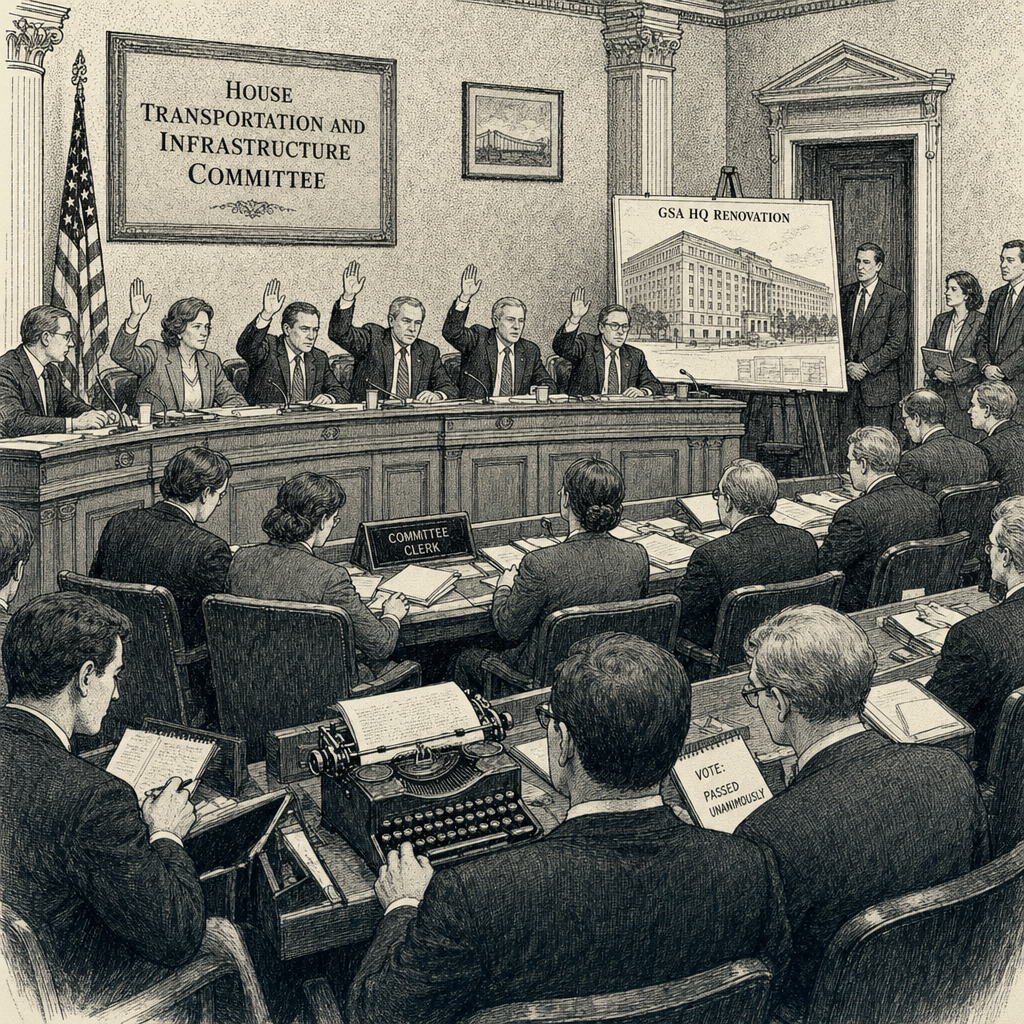
GSA administrators are poisoning federal children to fund a $239 million headquarters renovation. The building’s indoor air quality failed its 2021 inspection. Inspectors found in 2022 that the on-site childcare center received inadequate fresh air whenever outside temperatures dropped below forty degrees. Forty percent of the structure was classified as uninhabitable.
Administrator Edward C. Frost called the approval a “boon.” He gushed that the revamped 1800 F Street would set a “new high watermark for building design,” promising a “high‑quality and dynamic federal campus” that will “inspire excellence.” The House Transportation and Infrastructure Committee approved the plan on Thursday, clearing the way for the agency to redirect capital away from immediate remediation. The original completion target was 2031; now the renovation will wrap by December 2028. Faster and fancier—at whose expense? The only thing connecting right now is a direct line from the Treasury to a construction contract. The press release promises a campus that will “connect people” and “inspire excellence.” The inspection report documents a facility that cannot heat its own daycare intake.
The math at the kitchen table does not care about the administrator’s watermark. When a federal employee’s mortgage is eating thirty-five percent of take‑home pay, and the off‑site daycare invoice runs $2,400 a month, the gap between a $239 million architectural watermark and a childcare center’s broken HVAC is not a budgeting exercise. It is a triage decision. Pew has tracked this since before many of these parents could vote: roughly four in ten Millennials report it is harder to feel financially secure than their parents were at the same age, and the margin closes every time a public employer treats facility aesthetics as infrastructure and family care as a discretionary afterthought. Anne Helen Petersen’s burnout framework named the mechanism: institutions optimize for executive deliverables and offload the operational debris onto the employee’s home calendar. The line item that never appears in the GSA funding announcement is the out‑of‑pocket cost of monitoring a preschooler’s respiratory health because the workplace failed a basic environmental test. There is no shopping‑around answer when the employer controls the building your kids are in.
Swift wrote the American care infrastructure’s mission statement into the Midnights chorus: “You’re on your own, kid.” The lyric tracks the exact arc from institutional promise to parental improvisation. Federal childcare and leave policy followed the same trajectory after the Build Back Better childcare savings collapsed and the paid‑family‑leave compromise buried itself in the same political machinery now celebrating headquarters renovations. When you are watching federal agencies relocate while frontline workers absorb the shock, or tracking Homeland Security funding battles as TSA officers approach pay cutoffs, the pattern stops reading as bureaucratic friction and starts reading as structural preference. The institution invests in its own physical plant. The families are left to buy space heaters and track air‑quality apps.
My parents’ generation understood the parish and the federal workplace through an operational vocabulary: when a neighbor was sick, you brought a meal; when a family’s environment turned unsafe, you fixed it before the children were exposed. The corporal works of mercy were not abstract theology. They were the baseline for how a functional society treated its working families. I sat at my own kitchen table at eleven at night running the spreadsheet four ways, trying to close the gap between a Fishtown mortgage, a monthly childcare bill that matches a car payment, and a pediatric co‑pay that lands before the insurance processor updates. The spreadsheet always balances the same way. The household absorbs the institutional deficiency. The capital gets redirected upward. The numbers in the Pew survey are the aggregate of that eleventh‑hour tally.
The renovation finishes in 2028. Delivering for the taxpayer requires a functioning HVAC intake rated for winter days, a childcare center that passes inspection, eight weeks of guaranteed paid family leave, and a federal childcare credit that actually reduces family costs instead of subsidizing architecture firms. The government does not need a quarter‑billion‑dollar campus to inspire excellence. It needs to fund the line items that keep federal workers’ children breathing, and then keep the rest of the budget out of their offices. The cold tea on my kitchen table says the same thing the inspection report does: you cannot renovate a building while the children inside are breathing air that fails a preschool intake test.