
RFK Jr. is gutting the childhood vaccine schedule to appease a constituency that doesn’t exist.
It is true that the executive order signed by the White House in early June, directing federal agencies to explore changes to the childhood immunization schedule, operates at the level of an exploration rather than a mandate, and that any immediate rollback runs headlong into the preliminary injunction won by the American Academy of Pediatrics in federal court. The trouble is that the administrative friction it generates — the committee was first suspended by judicial order, then its independent members were slated for removal, and the statutory selection process was swapped for a political‑loyalty threshold — is doing exactly what it was designed to do: it is normalizing the frame that the existing schedule is an arbitrary political construct rather than a documented public-health architecture, and it is forcing parents to treat a settled prophylactic regime as a live legislative debate.
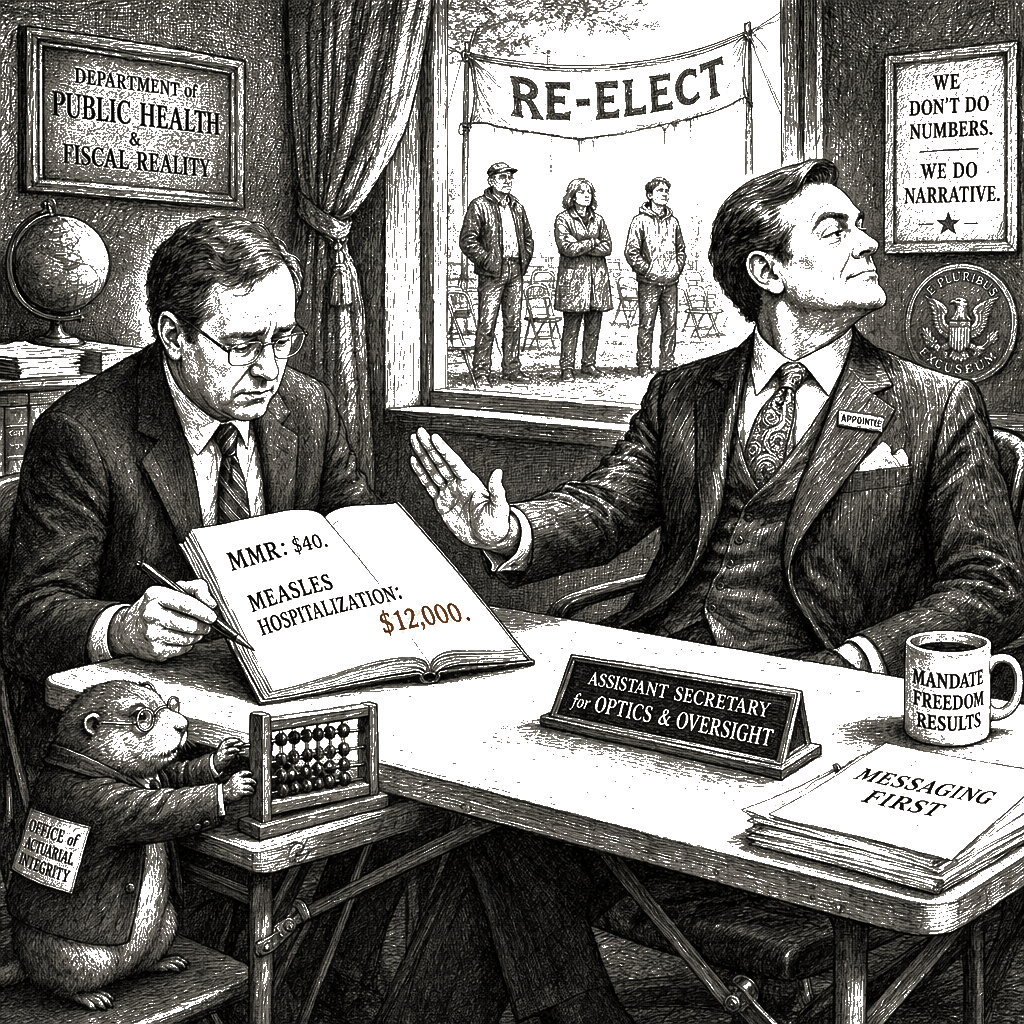
The actuaries, to their credit, have refused to play along. At the end of May, AHIP — the trade body representing the private insurance industry — announced that its members would continue to cover routine childhood vaccines through 2027, extending the 2026 policy despite the political pressure coming out of HHS. The insurance companies have run the numbers. The per‑course cost of an MMR series is routinely under $40, while a single measles hospitalization routinely exceeds $10,000 in acute-care liability. The marginal cost of a dose, administered at scale, is negligible compared to a paediatric ward full of unvaccinated children with measles — which is running at nearly two thousand confirmed cases this year — and the private insurers know, with actuarial certainty, that the cheapest way to manage a population’s health is to prevent the pathology from establishing itself in the first place. As Elizabeth Jacobs, an epidemiology professor at the University of Arizona, put it to the Guardian: “They’ve run the numbers and they know that it will cost them a heck of a lot more to treat kids with measles who are hospitalized than it is to pay for vaccines.” The public-good infrastructure of childhood vaccination is being defended not by the regulators whose job it is to defend it, but by the profit-seeking intermediaries who are the least likely demographic to act out of civic virtue.
The administration’s claim that the United States recommends more childhood vaccines than peer nations is a textbook manufactured‑controversy operation — the Oreskes‑Conway playbook in which a baseline discrepancy is asserted against an evidentiary consensus to manufacture delay and attrition. The US schedule is, by the peer‑reviewed comparative literature, on par with other high‑income nations; the difference is not the volume of antigens but the political apparatus that has decided to treat a biological fact as a negotiable policy platform. When the health secretary overhauls the committee’s selection process and forces a federal judge to pause its operations, he is not asking for better science; he is applying the institutional leverage of the department to produce the appearance of uncertainty where the clinical literature offers none.
There is a technical precision required here that the political framing deliberately obscures. The childhood immunization schedule is not a cafeteria menu assembled by committee politics — and here it is worth being precise about what “the schedule” actually is, because the public discourse has the misleading habit of treating it as a bureaucratic checklist rather than a temporal architecture built on the interaction between waning maternal antibodies, the maturation of infant immune responses, and the epidemiology of pathogen exposure in daycare and school settings. You cannot delete a node from that architecture and preserve the downstream coverage. To treat the schedule as if it were a bloated software dependency graph that can be pruned for efficiency is to misunderstand both the biology and the public‑health logistics that make it work. The 1955 Cutter incident established the modern safety regime; the 1986 National Childhood Vaccine Injury Act established the no‑fault compensation apparatus; the Vaccine Safety Datalink tracks twelve million people for active surveillance. Paul Offit’s clinical accounting of aluminium adjuvant safety records — seventy years of accumulated data — remains the clearest summary of this baseline, and it is entirely public. The safety signals are documented. The administrative will is what is being withheld.
I will concede the skeptics’ strongest point: the pharmaceutical manufacturers who profit from vaccine sales have their own capture incentives, and the regulatory pipeline should always be open to independent safety review. But the remedy for regulatory capture is not the systematic dismantling of the capture‑resistant infrastructure; it is the hardening of the review process against political interference. Insurers, whose financial interests align squarely with avoiding expensive acute‑care hospitalizations, sit on the opposite side of that capture dynamic — they are the counterweight, not the ally of pharmaceutical over‑recommendation. That is exactly what the AAP’s injunction achieved. The White House has appealed the order blocking the vaccine recommendation rollback, the federal courts are weighing the administrative‑law questions, and the medical establishment has mounted its own midterm challenge to the broader policy direction. The question is no longer whether the schedule is safe — the epidemiological record is unambiguous — but whether the administrative state will be permitted to degrade its own public‑health apparatus because the current health secretary prefers a conspiracy narrative to a clinical trial.
The political calculus behind this campaign appears to be imaginary. Trump’s own pollsters have told the White House that vaccine restrictions are unpopular and that anti‑vaccine rhetoric is a liability ahead of November. The AAP, meanwhile, has begun mounting a midterm challenge — recruiting physician candidates and funding local public‑health campaigns — that threatens to make the childhood immunization schedule a ballot‑box issue. Hughes, the AAP’s lawyer, speculated that Kennedy may have bypassed Chief of Staff Susie Wiles to get the executive order directly to the president, suggesting the miscalculation originated inside the building, not from external polling. The administration, in other words, is alienating the insurance industry, the medical profession, and its own electoral strategists — all for a constituency of voters whose views are held by a minority and whose political utility its own pollsters have disowned, because the data on preventable hospitalizations does not negotiate with polling averages.
The whole enterprise carries the shape of a deferred liability — a cost the administration has already incurred but refuses to book, growing with every preventable hospitalization. In this instance, the political operation has persuaded itself it can harvest anti‑vaccine sentiment without paying the electoral cost. The expense will be measured in cases: nearly two thousand measles infections so far this year, a record wave of whooping cough last year. The insurers, whose job is to price loss, have already marked it down. They are not making a statement about the public good. They are protecting their own margins. That alignment is not a temporary coincidence; it is a standing rebuke delivered by the actuarial tables.
The insurers have locked in coverage through 2027. The midterms are in November. The administrative record moves at the speed of the courts, and the public consultation period on any proposed schedule change will be whatever the rulemaking procedure dictates. Parents who are navigating this should file their comments through the standard Federal Register portal when it opens, because the regulated parties know how to count submissions and the agencies know how to read them. AHIP’s announcement is not a substitute for policy. It is a signal that the private sector has looked at the same evidence the administration is ignoring and decided, on the narrowest possible grounds, that the administration is wrong. The virus does not care about midterm polling. The work is to be done.